Giancarlo Cristea versus DIICOT. 18 months of criminal prosecution for a legally prescribed medication. Three courts. Three victories. One definitive national precedent.
3Consecutive victories
0Judges for DIICOT
18Months under investigation
28 Jan 2026Date of final ruling
Read the documentation
Context · What happened
How these three cases came to exist
On 23 July 2024, Giancarlo Cristea — a Romanian citizen who emigrated to the United Kingdom 11 years ago, living with severe Crohn's disease — landed at Henri Coandă Airport with his wife and daughter. He voluntarily declared his legally prescribed medical cannabis at customs. The same medication he had transported legally in 2023, with written confirmations from Romanian authorities.
DIICOT (Romania's organised crime prosecutors) confiscated the medication and opened a criminal investigation. 9.67 g cannabis (the patient) and 14.68 g (his wife) — treatment-level quantities with valid medical prescriptions from the United Kingdom.
Fig. 4
How The Cases Began
The story behind three judicial victories
Medical Cannabis
What followed are three separate legal cases, three courts examining the same facts, and three decisions that together form a landmark national legal precedent for patients' rights in Romania.
Romanian citizen in the UK
Romanian citizen who emigrated to the United Kingdom 11 years ago. One of the first patients in the UK to receive a legal medical cannabis prescription (November 2018).
Legal prescription
Medical cannabis prescribed for severe Crohn's disease. Written confirmation obtained in advance from Romanian border (IGPF) and customs (DGPV) authorities.
Activist since 2016
Joined UK cannabis advocacy organisations in May 2016. Campaigned at Westminster with MP Paul Flynn, attended the House of Lords legalisation event (May 2019).
Fig. 1
Justice ordered the return of wrongfully seized
Justice ordered the return of wrongfully seized medication
Decizie Judiciara
Timeline · 18 months
✕
23 Jul 2024
Confiscation at Airport
DIICOT opens Case 1
V1
Mar 2025
Victory 1 Tribunal
Dos. 45878/3/2024 Case dismissed
V2
Oct 2025
Victory 2 Tribunal
Dos. 24750/3/2025 Special Confiscation overturned
V3
28 Jan 2026
Victory 3 Court of Appeal
Dos. 4362/2025 Definitive ruling
→
2026+
National Precedent
Landmark ruling in force
Documentation · The Three Victories
V1
Victory IDIICOT case dismissedMarch 2025
Tribunalul București — First Ruling
✉
Enjoyed this article?Ti-a placut articolul?
New articles on neurodivergence & affirming therapy — no spam, unsubscribe any time.
Articole noi despre neurodivergenta & terapie afirmativa — fara spam, dezabonare oricand.
SubscribeAboneaza-te
✓ Subscribed! Check your inbox.✓ Abonat! Verifica inbox-ul.
Something went wrong. Try again.A aparut o eroare. Incearca din nou.
Case 45878/3/2024 · Tribunalul București (Bucharest First Instance Court)
DIICOT opened the first criminal case on 24 July 2024 — the day after the confiscation. The investigation lasted approximately eight months. Throughout, lawyers Raul Bud and Sebastian Gabriel Nagy presented the court with the key documents: British medical prescriptions, health certificates, and — crucially — written confirmations previously obtained from Romanian authorities.
Tribunalul București examined Government Decision 1915/2006, Article 49 — the legal framework allowing transport of controlled-substance medications when accompanied by appropriate medical documentation. The court concluded that no offence had been committed.
Fig. 5
First Ruling
Tribunalul București — first judicial victory
Court Ruling
DIICOT issued a dismissal order and publicly stated that "the act was not committed with the intent required by law." This is the first formal acknowledgment that transporting legally prescribed cannabis cannot be prosecuted under Romanian law.
Immediate impact: DIICOT publicly acknowledges that holding medical cannabis with appropriate documentation does not constitute a criminal offence under Romanian law.
Case Details
📋Case: 45878/3/2024
🏛️Court: Tribunalul București
📅Ruling: March 2025
⚖️Outcome: Case dismissed
§Legal basis: GD 1915/2006, Art. 49
👨⚖️Lawyers: Raul Bud, Sebastian Gabriel Nagy
✅"Act not committed with intent required by law"
Fig. 2
Three courts, three victories
Three courts, three victories — a definitive precedent
Decizie Judiciara
V2
Victory IIDIICOT issues Special ConfiscationOctober 2025
Tribunalul București — Second Ruling
Case 24750/3/2025 · Tribunalul București
After losing the first case, DIICOT did not stop. Despite the dismissal, they issued an abusive Special Confiscation order — targeting the very same cannabis medication that had already been recognised as legal medicine in the first trial. This Special Confiscation order attempted to permanently seize the treatment despite the court having already ruled it was legally prescribed medication.
Tribunalul București reviewed the Special Confiscation order and overturned it as unfounded. The court confirmed once more the medical nature of the substances and ruled that DIICOT’s confiscation order had no legal basis.
Fig. 6
Second Ruling
Tribunalul București — second consecutive victory
Court Ruling
This ruling struck down DIICOT’s attempt to circumvent the first verdict through an abusive confiscation procedure, and reaffirmed that legally prescribed medication cannot be treated as illegal narcotics under any procedural mechanism.
Furthermore, DIICOT destroyed part of the confiscated medication through laboratory testing — despite the containers being sealed and the medical documentation clearly stating the composition: THC 20%, CBD, terpenes. The partial destruction of confiscated medication, despite proper labelling and sealing, constitutes an additional abuse with no legal basis.
Consolidated impact: The court overturns DIICOT’s abusive Special Confiscation order — legally prescribed medication cannot be confiscated through abusive procedural mechanisms. The principle of medical treatment continuity is reinforced.
Case Details
📋Case: 24750/3/2025
🏛️Court: Tribunalul București
📅Ruling: October 2025
⚖️Outcome: Special Confiscation overturned
§Confirmation: GD 1915/2006, Art. 49
🔄DIICOT’s Special Confiscation order ruled unfounded
✅Court overturns confiscation, confirms medication is legal
Fig. 3
The legal journey through three cases
The legal journey through three cases
Decizie Judiciara
V3
Victory IIIDefinitive National Precedent28 January 2026
Curtea de Apel București — The Final Ruling
Case 4362/2025 · Curtea de Apel București (Bucharest Court of Appeal) · 28.01.2026
DIICOT appealed the overturning of the Special Confiscation order to the Curtea de Apel București. This is the ruling with the greatest legal impact of the three — a decision by an appeal court, final and definitive, establishing a formal national precedent for all of Romania.
The Curtea de Apel rejected DIICOT's appeal as INADMISSIBLE. But the substance of this ruling goes much further: the court established that the Romanian state must return the confiscated medication — not treat it as drugs. The medication is medication — not an illegal narcotic.
The judge's reasoning was unequivocal: "No prosecutor has the right to distinguish between legal and illegal cannabis through any criterion other than existing documentation — the medical prescription and the travel letter." With this ruling, Giancarlo Cristea becomes the first citizen to have confiscated cannabis returned by DIICOT — an unprecedented moment in the history of Romanian justice.
Fig. 7
Final Ruling
Curtea de Apel București — definitive victory
Court Ruling
This distinction is critical. It means that Romanian authorities cannot permanently confiscate patients' legal medications — they have an obligation to return them. It confirms that a valid prescription from an EU member state must be recognised as such under the applicable European legal framework.
Definitive national precedent: The state is obligated to return legally confiscated medications. Medical cannabis with a valid prescription cannot be treated legally as a drug. This ruling is final and irrevocable.
The Historic Ruling
"The state must return the medication — not seize it as drugs."
📋Case: 4362/2025
🏛️Court: Curtea de Apel București
📅Ruling: 28 January 2026
⚖️DIICOT appeal rejected
★DEFINITIVE NATIONAL PRECEDENT
💊Medication = medication, not drug
✅State obligated to return the medication
UK Context · Legal Activism
One of the UK's first legal medical cannabis patients
Giancarlo Cristea became one of the first patients in the United Kingdom to receive a legal medical cannabis prescription after the November 2018 legalisation. Before that, he had campaigned alongside MP Paul Flynn at Westminster protests (23 February 2018), attended the House of Lords Drug Science legalisation celebration (22 May 2019), and was a member of United Patients Alliance (UPA) since May 2016.
He began his activism eight years before the DIICOT incident — not in reaction to it. The campaign for patients' rights in Romania is a continuation of that same commitment, translated into a legal context where the stakes affect hundreds of thousands of Romanian diaspora patients who travel home with legally prescribed medications.
I did not fight for myself. I fought for every Romanian patient travelling from the UK, from the Netherlands, from Germany — with their legal medication in their luggage — afraid of being treated as a criminal.
Giancarlo Cristea · Curtea de Apel București, January 2026
Legislation · Legal Foundations
The Legislative Framework Behind My Three Victories
Every judicial victory I won was grounded in specific provisions of Romanian and European legislation. These laws were not created for my case — they already existed and protected patients. The courts applied the law correctly, despite DIICOT's accusations. Here are the legal instruments that any patient can invoke in a similar situation.
Romanian Legislation
GD 1915/2006, Article 49
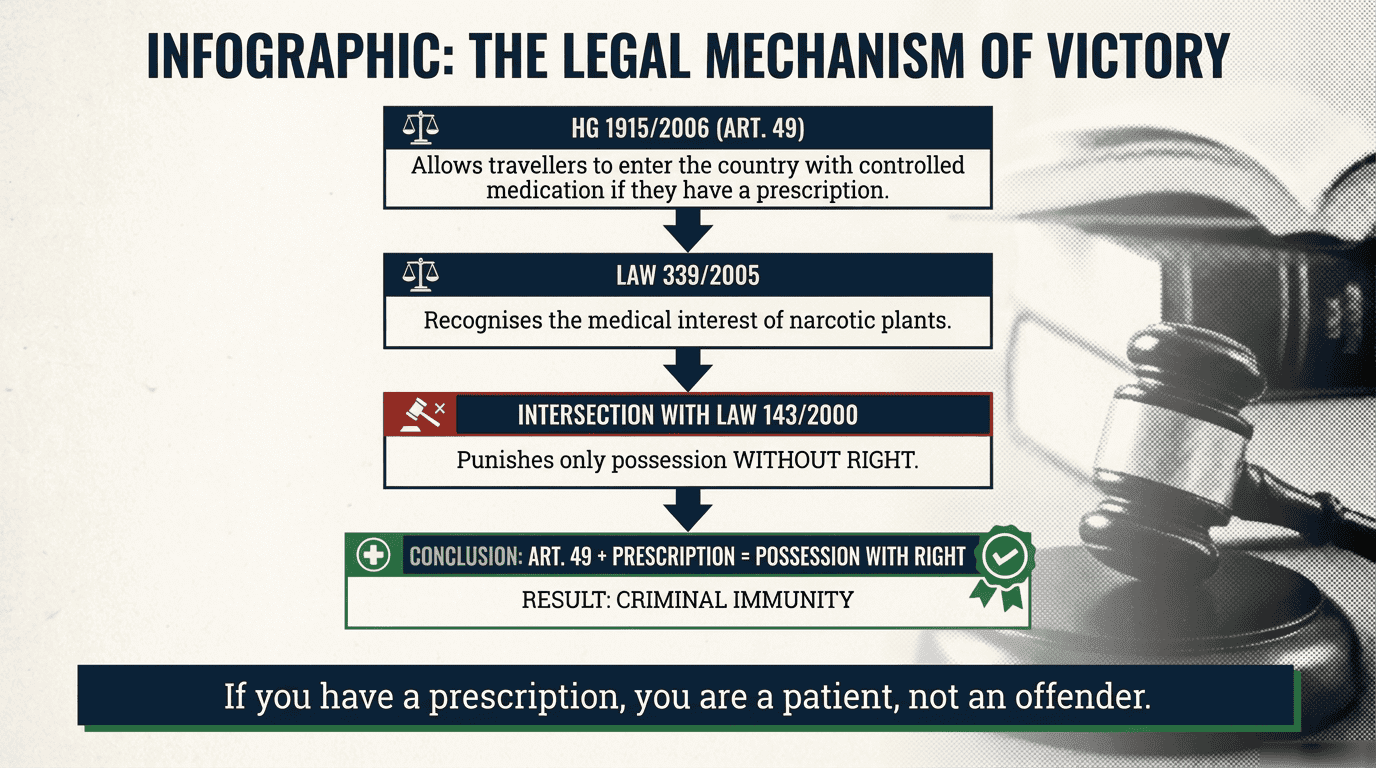
The Government Decision regulating the transport of medications containing controlled substances. Art. 49 explicitly permits individuals to transport medications containing internationally controlled substances, in the quantity necessary for treatment, with appropriate medical documentation.
Fig. 8
Legislative Framework
The legal basis for patient rights
Legislation
→ Invoked and confirmed in all 3 court decisions
Romanian Legislation
Law 143/2000 — Combating Drug Trafficking
The law under which DIICOT brought their accusations. All three courts established that this law does not apply to legally prescribed medications transported with valid documentation — a critical distinction between controlled substances in a medical context vs. illicit trafficking.
→ Courts rejected the classification of the acts under Law 143/2000
Romanian Legislation
Law 339/2005 — Plant & Substance Regime
The law governing the legal regime of plants, substances, and preparations containing narcotic and psychotropic substances. It defines the legal framework for controlled substances in Romania and establishes exceptions for medical use with a valid prescription.
→ The legislative framework differentiating medication from drugs
European Law
Article 6 ECHR — Right to a Fair Trial
The European Convention on Human Rights guarantees the right to a fair trial. This principle was central in all three of my victories. In Victory II, the court rejected the abusive Special Confiscation order issued by DIICOT. In Victory III, the Court of Appeal rejected DIICOT's appeal as inadmissible.
→ Protocol 7, Art. 4 ECHR — ne bis in idem
European Law
Article 50, EU Charter of Fundamental Rights
The EU Charter enshrines the principle of ne bis in idem at European level: no one may be tried or punished twice for the same criminal offence. The Court of Appeal definitively confirmed the application of this principle in my case.
→ Definitively confirmed by the Bucharest Court of Appeal, 28.01.2026
Official Confirmations
IGPF no. 28850–28909 & DGPV no. 20264
Before the confiscation, both the General Inspectorate of Border Police (IGPF, 23.09.2022) and the General Directorate for Drug Prevention (DGPV, 22.09.2022) had officially confirmed the legality of transporting my medication with the documentation I presented. DIICOT ignored these confirmations.
→ Official confirmations ignored by DIICOT at the time of confiscation
Court Decisions — Legal Reasoning
Bucharest TribunalCase 45878/3/2024 · 11 March 2025
The court admitted my complaint against DIICOT's original dismissal and changed the legal basis from "no criminal intent" to "the act is not a crime" — a significantly stronger ruling. The court established that transporting legally prescribed cannabis with proper medical documentation simply does not constitute a criminal offence under Romanian law.
Basis: Art. 16(1)(b) teza I C.proc.pen. · GD 1915/2006 art. 49 · Case dismissed — act is not a crime
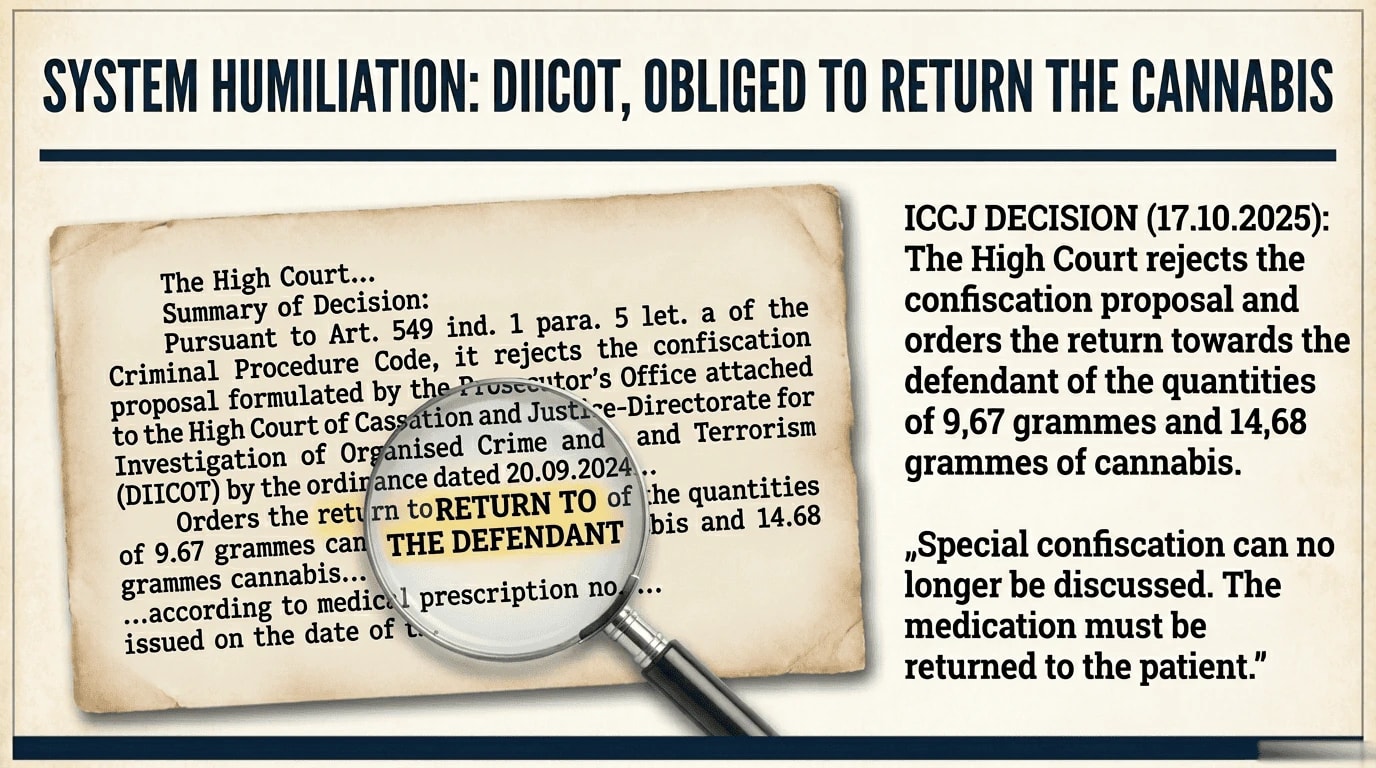
Bucharest TribunalCase 24750/3/2025 · 17 October 2025
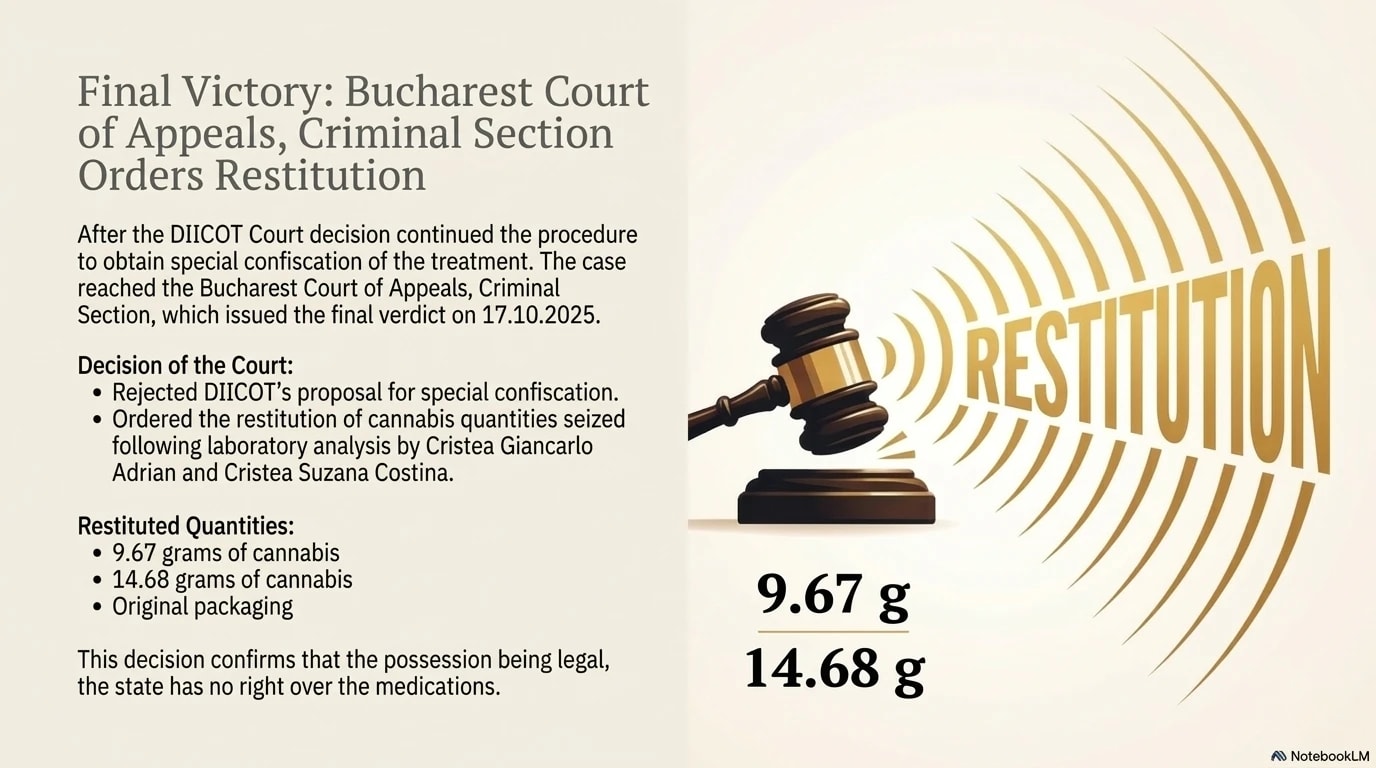
The Tribunal rejected DIICOT's Special Confiscation proposal and ordered the return of all confiscated cannabis (9.67g + 14.68g) to my wife and me. The court found that the distinction between drugs and medications is artificial when prescriptions are valid, and that confiscation cannot apply when there is no criminal offence.
Basis: Art. 549¹ alin. 5 lit. a C.proc.pen. · GD 1915/2006 art. 49 · Confiscation rejected — medication ordered returned
Bucharest Court of AppealCase 4362/2025 · 28 January 2026 · DEFINITIVE
The Court of Appeal rejected DIICOT's appeal as INADMISSIBLE, establishing a definitive precedent: the state is obligated to return medications confiscated by DIICOT in July 2024. Legally prescribed medical cannabis cannot be treated as an illegal narcotic. This is a definitive and irrevocable ruling.
Legal Guide for Patients in Similar Situations What You Need to Know
If you are a patient with a medical prescription for cannabis or other medications containing controlled substances and you are travelling to or through Romania, my court decisions give you a clear legal framework. Here are the essential steps you should follow.
Important note: This guide provides legal information based on court decisions in my case (2024–2026) and on Romanian and European legislation in force. It does not constitute personalised legal advice. Each case has its own particularities — consult a specialised lawyer for your specific situation.
Fig. 4
Cristea versus The State
Cristea versus The State — The Right to Medicine · 3 judicial victories
Decizie Judiciara
Why it matters · National impact
TV Reports · Judicial Victories
Video — DIICOT Forced to Return the Medication
DIICOT forced to return the medication based on the court's decision. Direct result of the first judicial victory.
Video — PROTV: The Tribunal Decided
PROTV report: The Tribunal ruled that DIICOT prosecutors must return the confiscated medications.
Video — Tribunal Orders DIICOT to Return Medical Cannabis
The Tribunal orders DIICOT to return medical cannabis prescribed to a couple. Landmark decision in Romanian legal history.
Fig. 5
Decizie Judiciara
A legal precedent for all patients in Romania
The Bucharest Court of Appeal ruling of 28 January 2026 is not merely my personal victory. It is a legal reference point for hundreds of thousands of Romanian diaspora patients who travel with controlled-substance medications prescribed legally in other countries.
Combined with the framework established by Government Decision 1915/2006, Article 49, prior written confirmations from IGPF nr. 28850–28909 (23.09.2022) and DGPV nr. 20264 (22.09.2022), and the unanimous recognition across all three courts, my three decisions form a clear legal body: patients have rights, and their medications must be respected.
Fig. 9
Legal Precedent
A precedent for all patients in Romania
Precedent
§
Legal principle confirmed
GD 1915/2006, Art. 49 permits transport of controlled-substance medications with appropriate documentation — confirmed across all three of my court cases at two court levels.
℞
Medication ≠ Drug
The Tribunal stated it explicitly: the distinction between drugs and medications is artificial. The Court of Appeal confirmed: the state must return my legally prescribed medication — not permanently confiscate it as a narcotic.
◆
Impact for Romanian patients
Hundreds of thousands of diaspora patients can now cite my rulings if they face similar situations at the Romanian border. I fought so that no other patient has to go through this.
Know the facts. Know your rights.
Read the full story, the legal case documentation, or the patient guide — for complete understanding of the context and implications of these three victories.