The Simon Baron-Cohen Controversy: Autism's Toxic Legacy
The Simon Baron-Cohen controversy explained: how his empathy and 'extreme male brain' theories harmed autistic people, and what this autism science got wrong.
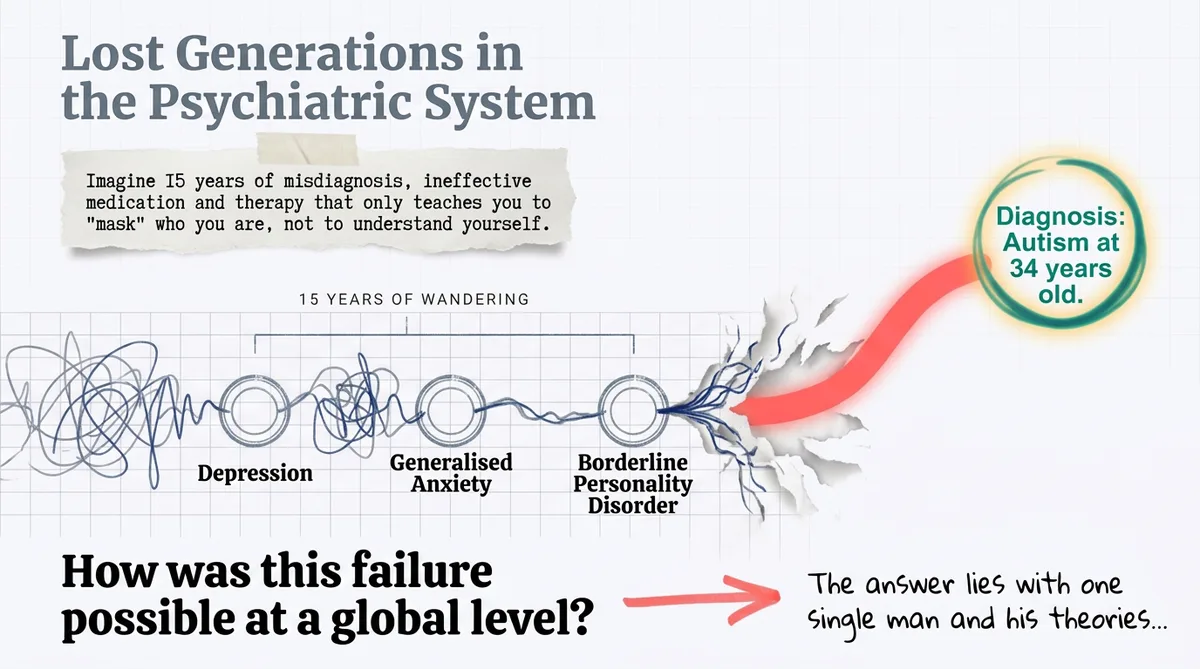
Imagine this: you're 34 years old, sitting in a psychiatrist's office, and you're told — at last — that you're autistic. But behind you are 15 years of wrong diagnoses: depression, generalised anxiety, borderline personality disorder. 15 years of medications that didn't work, of therapies that taught you to mask better, not to understand yourself. And you wonder: how was this possible?
The answer, in large part, leads to one man: Sir Simon Baron-Cohen, Professor of Psychology and Psychiatry at the University of Cambridge, Director of the Autism Research Centre (ARC), knighted in 2021, recipient of the MRC Millennium Medal in 2023, and winner of the 2026 Grawemeyer Prize in Psychology — a distinction described as carrying Nobel-level prestige. For four decades, his theories have shaped how autism is diagnosed, researched, and understood worldwide. He defined what it means to be autistic — without asking us, those who are.
This article is not a personal attack. It is an assessment. A necessary, documented assessment, written from the perspective of the community that has lived through the direct consequences of these theories. Because between the awards, knighthoods, and UN speeches, there are generations of people who were underdiagnosed, pathologised, and labelled based on models that never represented us.
1. The Extreme Male Brain: How a Theory Built on Stereotypes Left Generations of Autistic Women Undiagnosed
The Extreme Male Brain theory (EMB), formulated by Baron-Cohen in 2002, claims that autism is essentially an exaggerated version of the "male brain." The logic: men are, on average, better at "" (analysing and building systems), while women are, on average, better at "empathising" (reading others' emotional states). Autism, in this framework, occurs when systemising is pushed to the extreme and empathy is at its minimum — a "hyper-male brain."
The fundamental problem with EMB is not just that it relies on gender stereotypes about what "masculine" and "feminine" mean in cognition. The problem is what it produced in practice: a diagnostic system built on the profile of a white boy with technical interests and visible social difficulties. Women, non-binary people, and anyone who didn't fit this pattern were systematically missed by clinical tools.
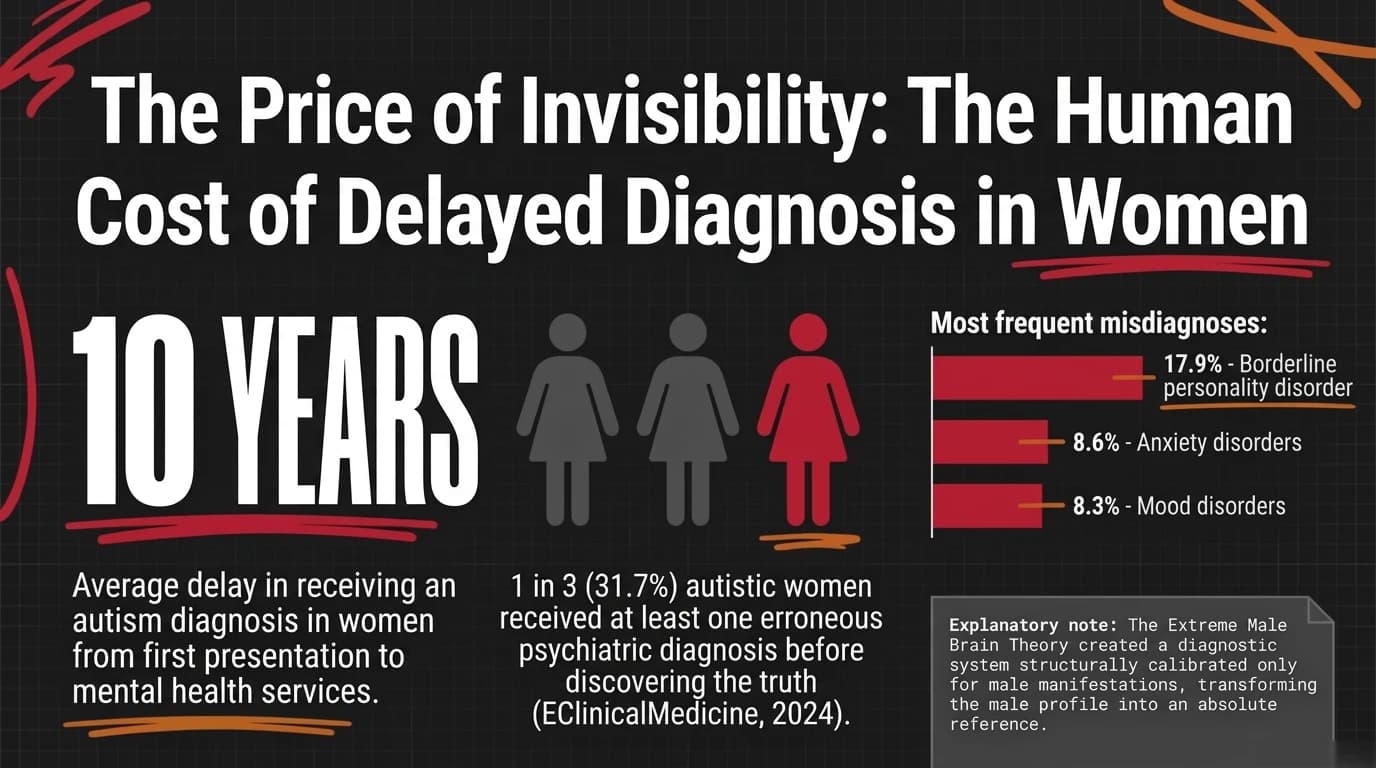
A study published in EClinicalMedicine in 2024, with a sample of 1,211 autistic adults, showed that 31.7% of autistic women received at least one psychiatric diagnosis perceived as erroneous before receiving their autism diagnosis — compared to 16.7% of men. The most frequent misdiagnoses for women: personality disorders (17.9%), anxiety disorders (8.6%), mood disorders (8.3%). Women weren't "masculine enough" to be identified as autistic by a system built on EMB theory.
The diagnostic delay is even more dramatic. According to the Autism Research Institute, autistic women experience an average delay of 10 years in receiving an autism diagnosis from their first presentation to mental health services (Gesi et al., 2021). Ten years wandering through the psychiatric system, with wrong diagnoses and ineffective treatments.
Meanwhile, the neuroimaging evidence for EMB has collapsed. Ecker's 2017 study (N=196), the first to directly test the hypothesis at the brain level, found no evidence that autism probability increases with brain "masculinity." A much larger study, published in Autism Research in 2021 (van Eijk & Zietsch, N=2,226), confirmed: the apparent differences in "brain masculinity" between autistic people and the control group completely disappear after adjusting for brain size.
Additionally, in 2019, a large study reported by Science showed that testosterone administration in adult men had no effect on performance on the Reading the Mind in the Eyes test. The testosterone-empathy link, a central pillar of the theory, failed to replicate.
Baron-Cohen has never formally retracted EMB theory. On the contrary — in 2026, the Grawemeyer Prize was awarded to him precisely for his research on the "prenatal sex steroid theory of autism," the biological branch of the same model. The theory doesn't just persist — it is rewarded.
2. Mind-Blindness: A Myth That Has Endured 40 Years
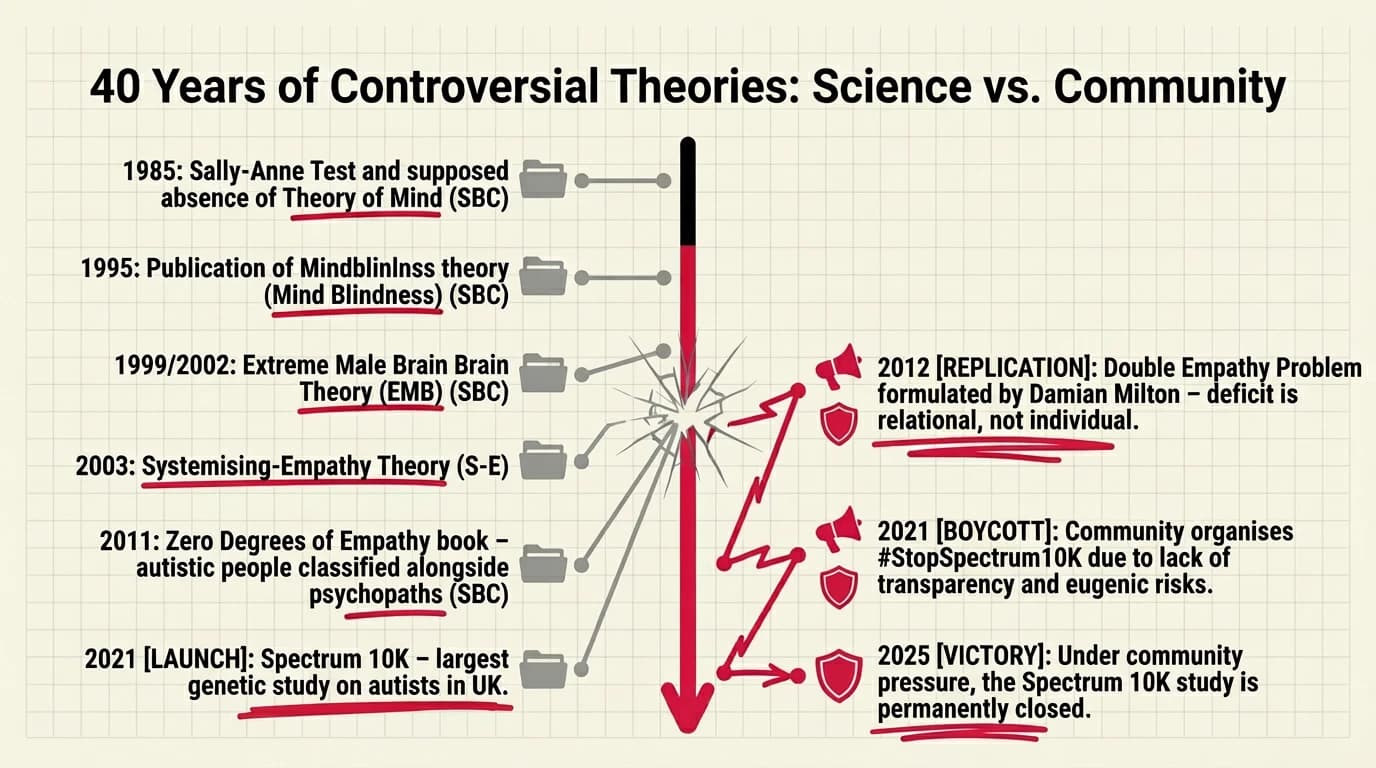
In 1985, Baron-Cohen, together with Alan Leslie and Uta Frith, published the study that would become one of the most cited in autism research history: the Sally-Anne test. A simple experiment — one doll places a marble in a basket, another doll moves it, the child is asked where the first doll will look for the marble. Autistic children in the study "failed" this test, and the conclusion was radical: autistic people lack (ToM). They don't understand that others have thoughts, intentions, and perspectives different from their own.
The term Baron-Cohen popularised for this supposed condition is mind-blindness. For over 20 years, he maintained that this deficit was specific (occurring only in autism) and universal (occurring in all autistic people). This claim generated a myth that permeated textbooks, clinical training, and public perception: the autistic person as someone who cannot understand what others feel.
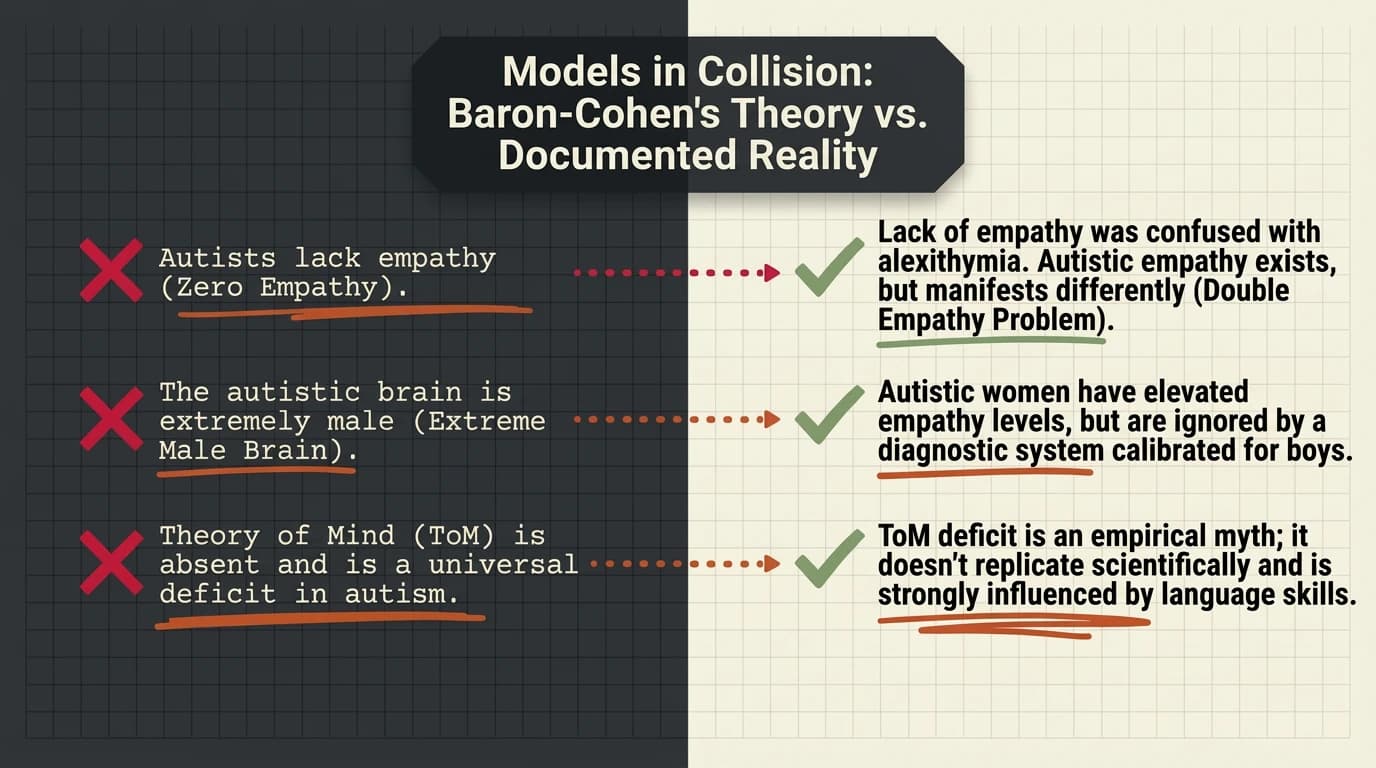
But the myth began to crumble under the weight of its own replication failures. In 2019, Morton Ann Gernsbacher and Melanie Yergeau published a devastating systematic analysis documenting the empirical collapse point by point:
The empirical failures of 'mind-blindness'
- Specificity failures: ToM tests aren't "failed" only by autistic people. Children with language disorders, Down syndrome, Williams syndrome, typical children from small families, children from disadvantaged backgrounds, blind and deaf children — all show low performance.
- Universality failures: Many autistic people pass ToM tests without difficulty — especially those with developed verbal abilities.
- Replication failures: The picture sequencing study had an initial effect of d = -1.714 that fell to d = -0.039 in replications — essentially zero.
- Tests measure something else: ToM test performance is primarily predicted by linguistic ability, not by the supposed "mind-reading" deficit. The RMET measures emotional vocabulary, not empathy.
A 2026 study by Travis LaCroix (Taylor & Francis) offers an even more radical diagnosis: applying Lakatos's methodology, LaCroix argues that the Theory of Mind deficit theory is a "theoretically degenerating research programme" — a framework that accumulates contrary evidence without being abandoned. More concerning, LaCroix describes "looping effects": the theory has become embedded in assessment tools, diagnostic criteria, and training programmes, generating a self-referential system that confirms itself.
The Paradigm Shift: The Double Empathy Problem
In 2012, Damian Milton — an autistic researcher himself — formulated an alternative that changed the conversation: The Problem. Milton argued that communication difficulties between autistic and non-autistic people are not the result of a unilateral deficit. They are the result of a relational mismatch — a rupture in reciprocity between two people with different social norms, expectations, and experiences.
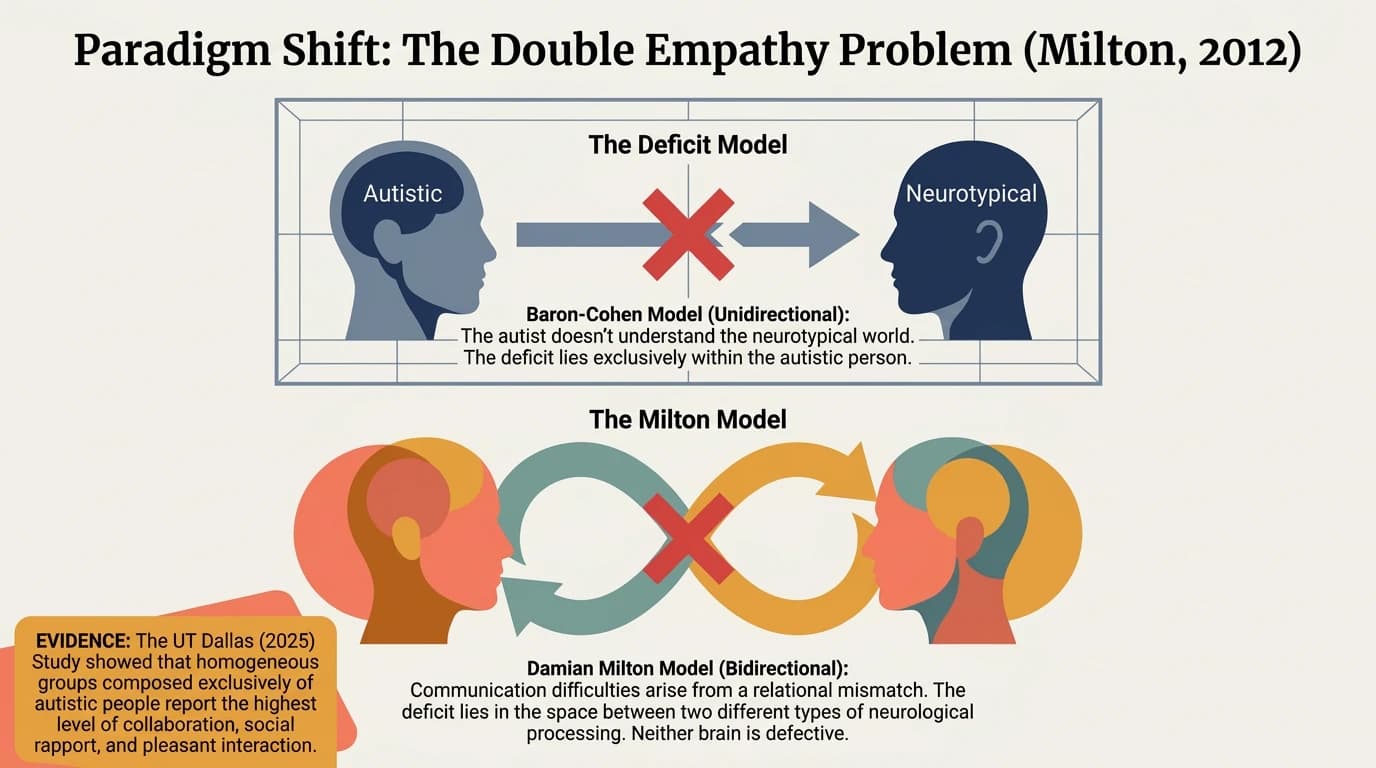
Empirical evidence continues to accumulate. A study from the University of Texas at Dallas, published in 2025, examined group interactions between autistic, , and mixed groups. The result: homogeneous autistic-autistic groups reported the highest level of rapport — they perceived the interactions as significantly more pleasant and friendly. The problems don't arise because autistic people "lack empathy" — they arise because inter-neurotype communication is a two-way street, and only one direction has been studied for 40 years.
3. Zero Degrees of Empathy: Autistic People Alongside Psychopaths
In 2011, Baron-Cohen published the book Zero Degrees of Empathy. The central thesis: human "evil" can be explained by a lack of empathy, and this lack can be measured on a scale from zero to six. At "zero empathy" sit three categories of people: psychopaths, people with borderline personality disorder, and autistic people.
Yes, you read that correctly. In Baron-Cohen's framework, we — autistic people — are classified alongside psychopaths in a category defined by the complete absence of empathy. The difference, in his view? Psychopaths and borderline people are "Zero Negative" — their lack of empathy is destructive. Autistic people are "Zero Positive" — not because they have empathy, but because they systemise well. Our value, in this framework, is functional, not human.
In 2013, Geoffrey Bird and Richard Cook published research proposing the hypothesis: what Baron-Cohen attributed to autism — difficulty recognising emotions and responding empathically — is actually the product of alexithymia, a separate condition characterised by difficulty identifying and describing one's own emotions. Alexithymia frequently co-occurs with autism, but is not synonymous with it. What Baron-Cohen labelled as "zero empathy" in autistic people was, in reality, a different, overlapping construct — not intrinsic.
The social damage of this association is not abstract. When a Cambridge researcher with Nobel-level prestige writes an entire book placing autism and psychopathy in the same category, that association seeps into the press, into clinician training, into the perceptions of employers, teachers, and families. "Lacking empathy" becomes a label that follows us — at work, in relationships, in court. And no one mentions alexithymia.
4. Assortative Mating and Silicon Valley: Science or Narrative?
Another theory promoted by Baron-Cohen is that of assortative mating: the idea that people with high systemising abilities tend to form couples, and their offspring have an increased probability of being autistic. The symbolic location of this narrative? Silicon Valley — the tech epicentre where, according to Baron-Cohen, the concentration of "high systemisers" produces a higher rate of autism.
The theory sounds intuitive, but it has an enormous gap: those "high systemisers" who form couples are, in all likelihood, themselves undiagnosed people. The theory doesn't explain the production of "new" autism — it describes, at most, the genetic transmission of already-existing autism, between generations who were never identified as autistic.
Moreover, the Silicon Valley narrative fed a problematic public image: autism as a "disease of tech elites," as a product of genius that crossed a threshold. A story that completely ignores autistic people without socioeconomic privilege, autistic people of colour, autistic people in rural areas, autistic people who don't code and don't design processors.
And which, implicitly, suggests something with unpleasant eugenic resonances: if certain genetic combinations "produce" autism, then those combinations can — theoretically — be avoided.
5. Spectrum 10K and the Spectre of Eugenics
In August 2021, Baron-Cohen launched 10K — the largest genetic study on autistic people in the UK, with the stated aim of collecting DNA data from 10,000 autistic participants.
The autistic community's response was swift and massive. In less than three weeks, the #StopSpectrum10K campaign gathered thousands of voices. The criticisms were precise: the study requested consent for sharing genetic data with external entities, without full transparency about possible uses.
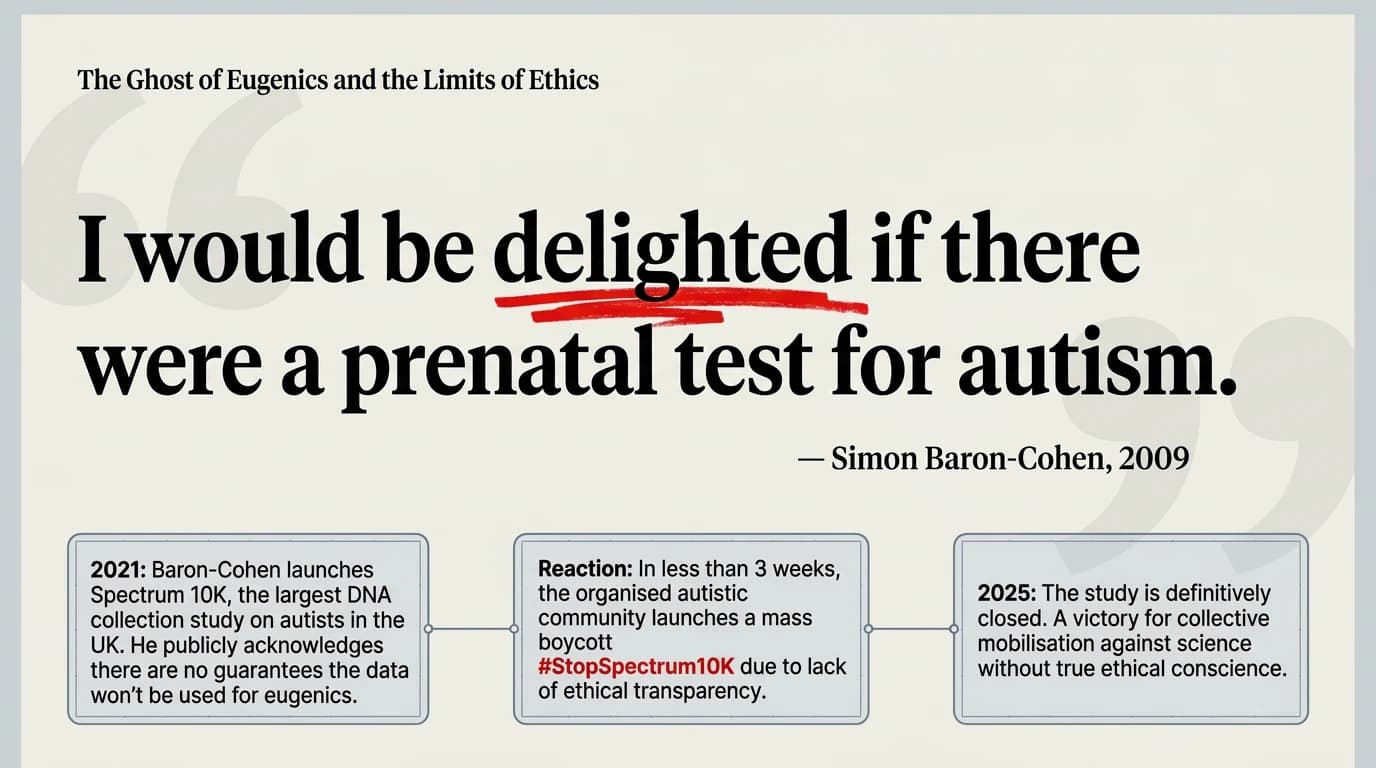
Why was this fear justified? Because Baron-Cohen himself wrote, in a 2009 article, that he would be "delighted" by the possibility of a prenatal test for autism — with the caveat that such a test should be used to support "social development," not to terminate pregnancies. The caveat is important. But it is also Baron-Cohen who acknowledged that "there are no guarantees the data won't be used for eugenics."
On 30 January 2025, the study was permanently closed. The closure of Spectrum 10K represents a concrete victory for the community boycott — proof that collective mobilisation can stop problematic research projects. But concerns about genetic autism research don't disappear with a single study.
6. Neurodiversity-Lite
In recent years, Baron-Cohen has gradually adopted language that includes terms from the . In a 2019 article published in Scientific American, he wrote about autism as a "form of neurodiversity," about the "strengths" of autistic people, and about the need for acceptance. On the surface, this is a welcome evolution.
But beneath the rhetoric, the model remains the same. Jac den Houting warned about the "neurodiversity-lite" phenomenon: researchers, clinicians, and even autistic people who adopt the language of neurodiversity without understanding its fundamental presuppositions. Neurodiversity doesn't say "autism comes with strengths AND deficits." Neurodiversity says: neurological variation is a natural part of human diversity, and the value of neurodivergent beings does not depend on their usefulness.
Baron-Cohen operates in a different paradigm. In his view, autism deserves acceptance insofar as it produces something valuable — mathematical talent, systemising ability, attention to detail. Autistic women without visible "masculine" talents? Autistic people with intellectual disabilities? Autistic people who don't systemise? They don't appear in the equation.
A 2021 article on Critical Neurodiversity drew parallels between Baron-Cohen's arguments and the Galtonian eugenic tradition. Francis Galton — the father of modern eugenics — built his career starting from the observation of "talented men at Cambridge." Baron-Cohen started from exactly the same point — "men at Cambridge" — and reached a similar conclusion. The difference in language is real. The difference in logic is far smaller than anyone would like to admit.
7. What Remains: An Assessment
It would be dishonest to reduce four decades of activity to a list of criticisms. Baron-Cohen has made real contributions:
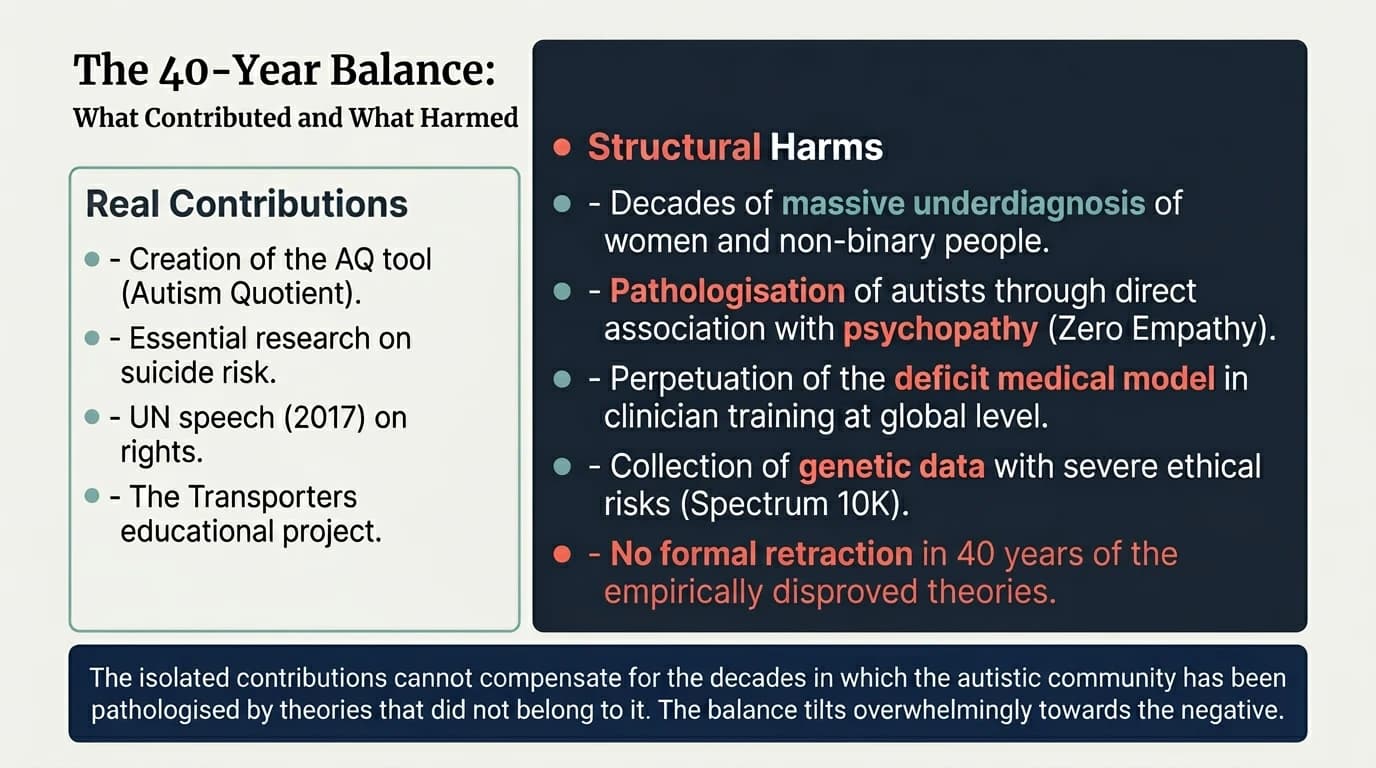
| Real contributions | Structural damage |
|---|---|
| The Autism Quotient (AQ) questionnaire — a screening instrument that paved the way for self-identification of thousands of adults | Decades of massive underdiagnosis of women and non-binary people |
| Important research on suicide among autistic people | Pathologising autistic people through direct association with psychopaths (Zero Empathy) |
| The Transporters educational project | Perpetuating the deficit medical model in clinician training worldwide |
| UN speech (2017) for autistic rights | Collecting genetic data with severe ethical risks (Spectrum 10K) |
| The Autism Research Centre at Cambridge | No formal retraction in 40 years of empirically dismantled theories |
These contributions are real. But they do not compensate for 40 years of institutionalised deficit model.
Mind-blindness created the narrative that autistic people lack empathy. The Extreme Male Brain created a diagnostic system that missed generations of women. Zero Degrees of Empathy placed us in the same category as psychopaths. Assortative mating turned genetic causation into a narrative with eugenic resonances. Spectrum 10K tried to collect our DNA without sufficient guarantees — and when the community said "stop," the study was ultimately permanently closed in January 2025.
And at the centre of all this stands a simple fact: in 40 years of contested theory, Baron-Cohen has issued no formal retraction.
Baron-Cohen's legacy is not measured in awards. It is measured in every autistic woman who received a borderline diagnosis. In every autistic teenager who grew up believing they couldn't feel. In every adult who learned at 40 that they were autistic — and wondered where the diagnostic tools were in all those years they suffered without explanation.
Where We Go From Here
If you're reading these lines and you are autistic or neurodivergent — you already know that something was wrong with the story you were told about yourself. Perhaps you grew up believing you were "broken," that you "lacked empathy," that your brain was a damaged version of a "normal" one. That story was not yours. It was Baron-Cohen's.
But the story is changing. Damian Milton showed us that empathy is a two-way street. Gernsbacher and Yergeau demonstrated that "mind-blindness" is an empirical myth. Bird and Cook identified what was actually being confused with "lack of empathy." Autistic researchers themselves — carrying a double burden, living the experience and researching it simultaneously — are rewriting the science from within.
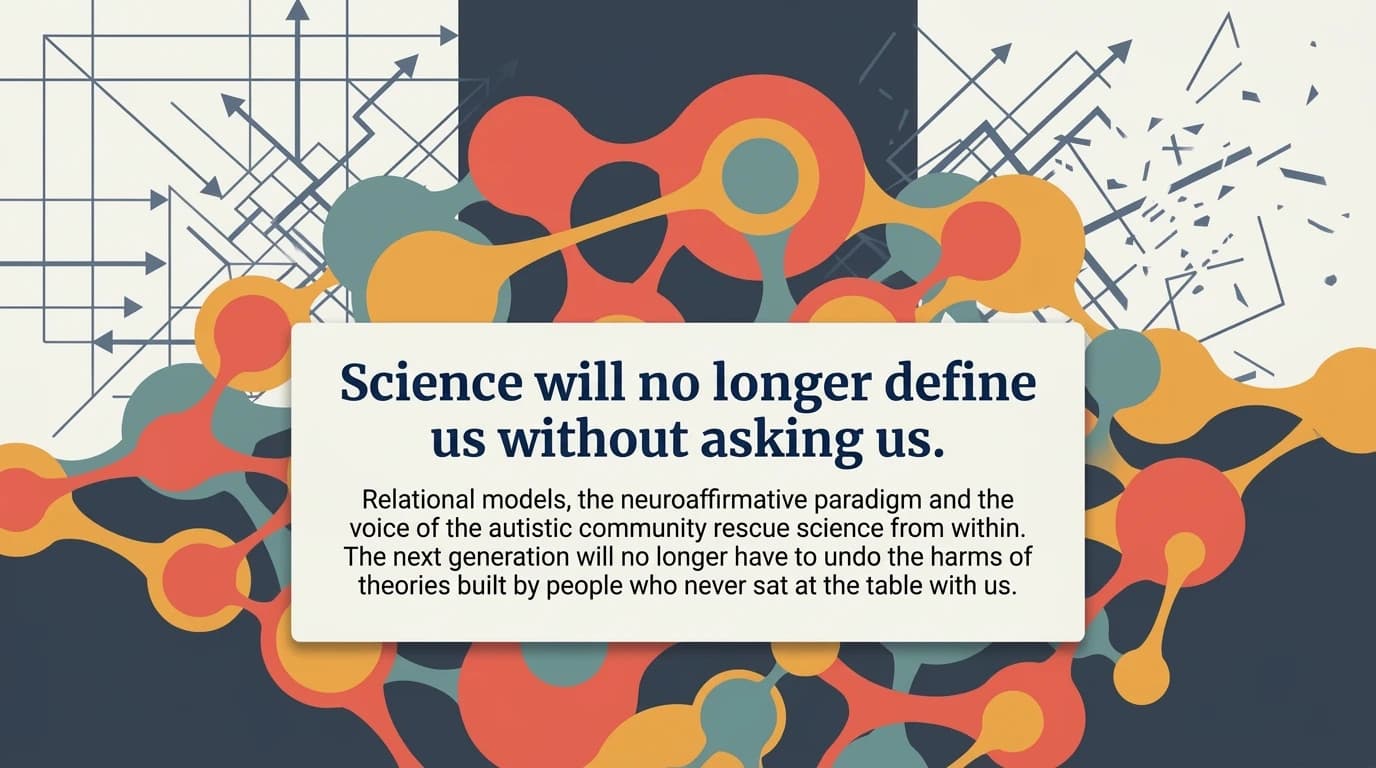
Relational models, the paradigm, the community's voice — all are gaining ground. Institutions resist, because institutions always resist. But the direction is clear. The science of the future will no longer define us without asking. Or at least, that is the stakes: that the next generation of autistic people will no longer need to undo, layer by layer, the damage of theories built by people who were never at the table with us.
Looking for a neuro-affirmative therapeutic space?
I work with neurodivergent adults — ADHD, autism, AuDHD — in a framework that doesn't start from the premise that something is broken in you.
References
- Askham, A. V. (2021). Backlash from autistic community pauses research, exposes communication gaps. The Transmitter.
- Autism Research Institute (2024). Women in Autism.
- Autistically Sarah (2025). Spectrum 10K Has Been Stopped: So Why Am I Still Worried?
- Bird, G. & Cook, R. (2013). Mixed emotions: the contribution of alexithymia to the emotional symptoms of autism. Translational Psychiatry, 3(7), e285.
- Critical Neurodiversity (2021). Simon Baron-Cohen, Neurodiversity-lite, and the History of Eugenic Thought.
- Foster, S. et al. (2025). Autism rapport study: autistic-autistic groups report highest rapport. University of Texas at Dallas.
- Gernsbacher, M. A. & Yergeau, M. (2019). Empirical Failures of the Claim That Autistic People Lack a Theory of Mind. Archives of Scientific Psychology, 7(1), 102–118.
- Gesi, C. et al. (2021). Gender Differences in Misdiagnosis and Delayed Diagnosis among Adults with ASD. Brain Sciences, 11(7), 912.
- Hoerricks, J. (2025). Colonising Neurodivergence: Baron-Cohen, Autism, and the Demand That Autistic Voices Bend. The AutSide.
- Kentrou, V. et al. (2024). Perceived misdiagnosis of psychiatric conditions in autistic adults. EClinicalMedicine, 71, 102586.
- LaCroix, T. (2026). Autism, Theory of Mind, and the Dynamics of Value-Laden Research Programs. Psychological Inquiry, Taylor & Francis.
- Lai, M.-C. et al. (2013). Cognition in Males and Females with Autism. PLOS ONE, 7(10).
- Milton, D. (2012). On the ontological status of autism: the 'double empathy problem'. Disability & Society, 27(6), 883–887.
- Underwood, E. (2019). Study challenges idea that autism is caused by an overly masculine brain. Science.
- van Eijk, L. & Zietsch, B. P. (2021). Testing the Extreme Male Brain Hypothesis. Autism Research, 14(8), 1597–1608.
← Previous article Neuro-Affirming Therapy (Part 2) All articles → Back to Blog
New articles, directly to your inbox
Neuro-affirming content on ADHD, autism, AuDHD and PDA
— no spam, no aggressive frequency.

More in this series
Next Steps
If this resonated, here are practical ways to go deeper.