Attachment Through the Lens of Neurodiversity — NAT (Part 1)
Neurodivergent Attachment Theory (NAT): the 5 styles, 7 assumptions and theoretical foundation. How attachment works for ADHD and autistic adults.

The 5 Styles, The 7 Assumptions, and The Theoretical Foundation
Neurodivergent Attachment — If you are neurodivergent, you may have received the message, directly or subtly, that "you love wrong": too intensely, too coldly, too much, or too little. But what if the problem was never the way you love — but the map others used to read it?
For a long time, attachment theory was the only framework through which relationships were evaluated in psychotherapy. But this framework was built on observations of neurotypical behavior — and applied universally, without accounting for the fundamental neurological differences that influence how people process safety, connection, and intimacy.
This omission is not merely academic — it has direct clinical consequences. Neurodivergent people have been misdiagnosed with attachment disorders, subjected to inappropriate therapeutic strategies, and, most painfully, internalized the message that their way of loving is defective. In a world that measures intimacy through eye contact and verbal reciprocity, those who process connection through other sensory and cognitive channels remain invisible — or, worse, pathologized.
I see the consequences of this internalization every week. Clients who come to my practice convinced they "love wrong" — too intensely, too distantly, too logically. My first therapeutic task is often to show them that it's not about "wrong," but about a different map of connection — one that no one has ever validated for them.
This guide explores Neurodivergent Attachment Theory (NAT), a neuro-affirmative perspective grounded in the research of Dr. Monsheng Letsoalo (2025), which proposes a new map of attachment — one that recognizes that safety is not merely emotional, but also sensory and biological. Alongside the NAT framework, this material integrates practical perspectives from McNulty (2020) and research on the double empathy problem (Crompton et al., 2020) to offer a comprehensive vision of love, affection, and neurodivergent partnership.
The material is structured in two parts. This first part presents the theoretical foundation: the 5 neurodivergent attachment styles, comparative analysis of relational behaviors, implications for therapeutic practice, and the 7 fundamental assumptions of the NAT model. Part 2 (published separately) explores practical applications: reconceptualized love languages, communication in neurodiverse couples, sensory intimacy, and concrete strategies for everyday life.
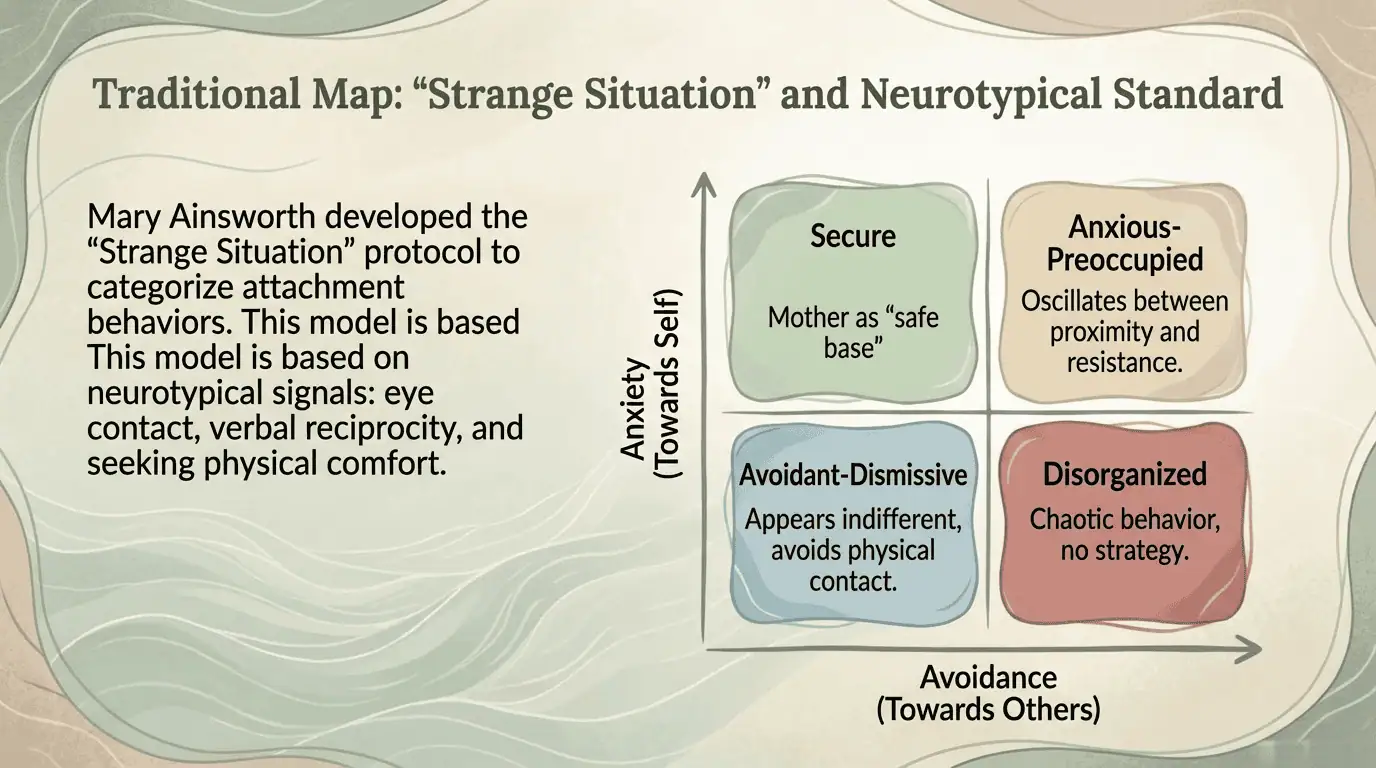
Traditional attachment theory, developed by Bowlby and Ainsworth, is based on a protocol called the "Strange Situation" which evaluates attachment through neurotypical signals: eye contact, verbal reciprocity, and seeking physical alignment. This model classifies attachment styles into four categories: Secure, Anxious-Preoccupied, Avoidant-Dismissive, and Disorganized.
Though revolutionary at the time of publication, this model was developed through observation of mother-child interactions in a specific cultural and neurological context. The implicit premise: the more actively a child seeks physical and eye contact with the attachment figure, the more "healthy" the relationship. This assumption completely ignores the fact that for many neurodivergent people, eye contact can be sensorily painful, and seeking physical proximity can be overwhelming — without this reflecting the quality of attachment.
It is important to acknowledge that classical attachment theory has made essential contributions to understanding human development (Bowlby, 1969; Ainsworth et al., 1978). NAT's critique does not invalidate these contributions; rather, it contextualizes them: they describe with accuracy one part of human experience — the neurotypical part. The problem arises when a partial framework is applied as a universal standard. As Schore (2001) emphasizes, affective regulation develops through relationship with caregivers, but how this regulation manifests varies significantly depending on the person's neurological profile.
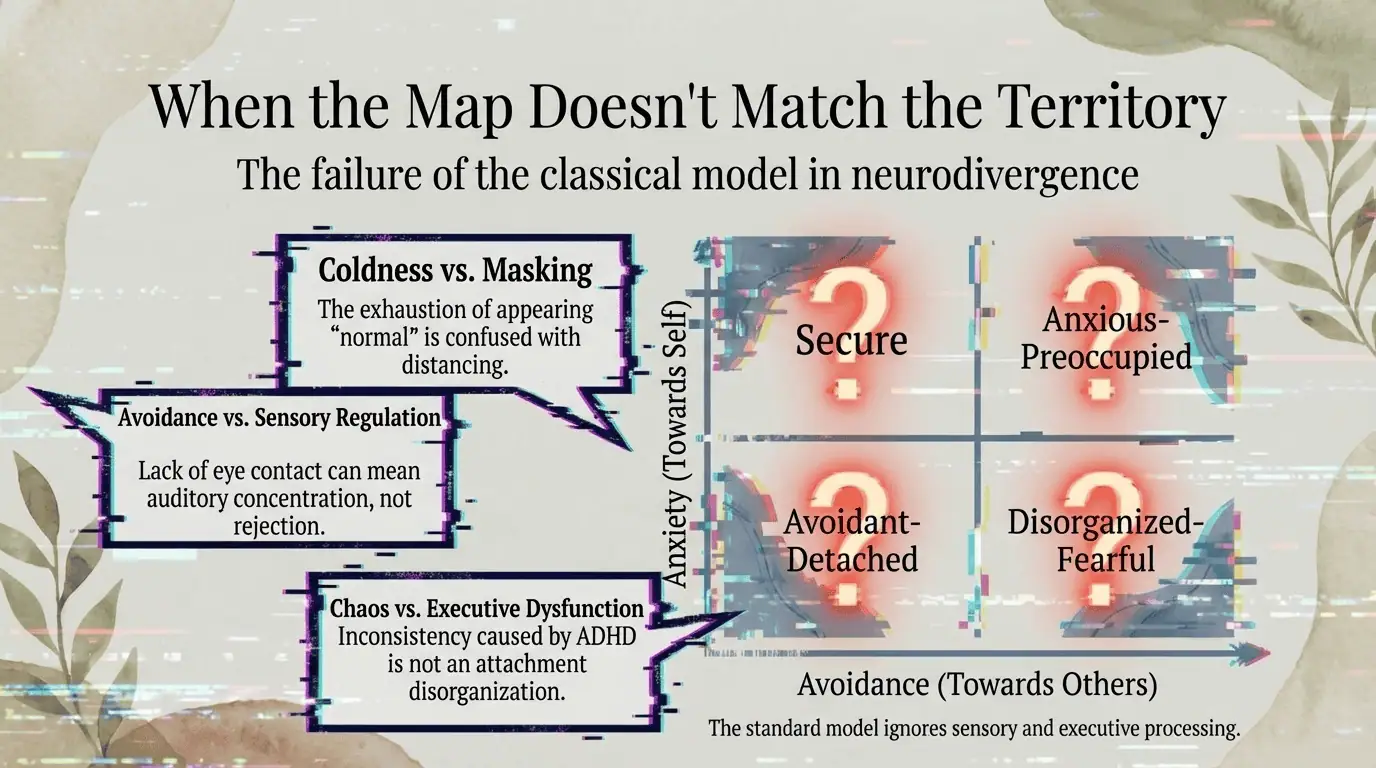
What happens when the classical model is applied to neurodivergent people? Systematic misinterpretations emerge: coldness can actually be masking (exhaustion from trying to appear "normal"), eye contact avoidance can be sensory regulation (auditory focus, not rejection), and behavioral chaos can be executive dysfunction caused by ADHD, not disorganization of attachment.
These confusions have real consequences: neurodivergent people receive diagnoses of "insecure" or "disorganized" attachment not because their relationships are deficient, but because evaluation tools are not calibrated for their way of processing the world. An autistic child who does not make eye contact with their mother during reunion may not be avoidant — perhaps they process reconnection through sound, smell, or physical proximity without eye contact. Crompton et al. (2020) have demonstrated that this is not a problem of autistic social deficit, but a problem of double empathy — misunderstanding is reciprocal, not unilateral.
I have seen exactly this in clinical assessments: autistic children diagnosed with "disorganized attachment" because they did not make eye contact during reunion with their mother. When I assessed through a different channel — physical proximity, vocal tone, body orientation — the attachment was intact. The instrument was deaf, not the child.
Walker (2021) adds a political dimension to this discussion: pathologizing neurodivergent ways of connecting is not merely a clinical error, but reflects a broader social norm that privileges a certain type of body and mind. The neurodiversity paradigm invites us to see neurological variation not as deviation from a norm, but as natural expression of human diversity — including in how we form and maintain attachment relationships.
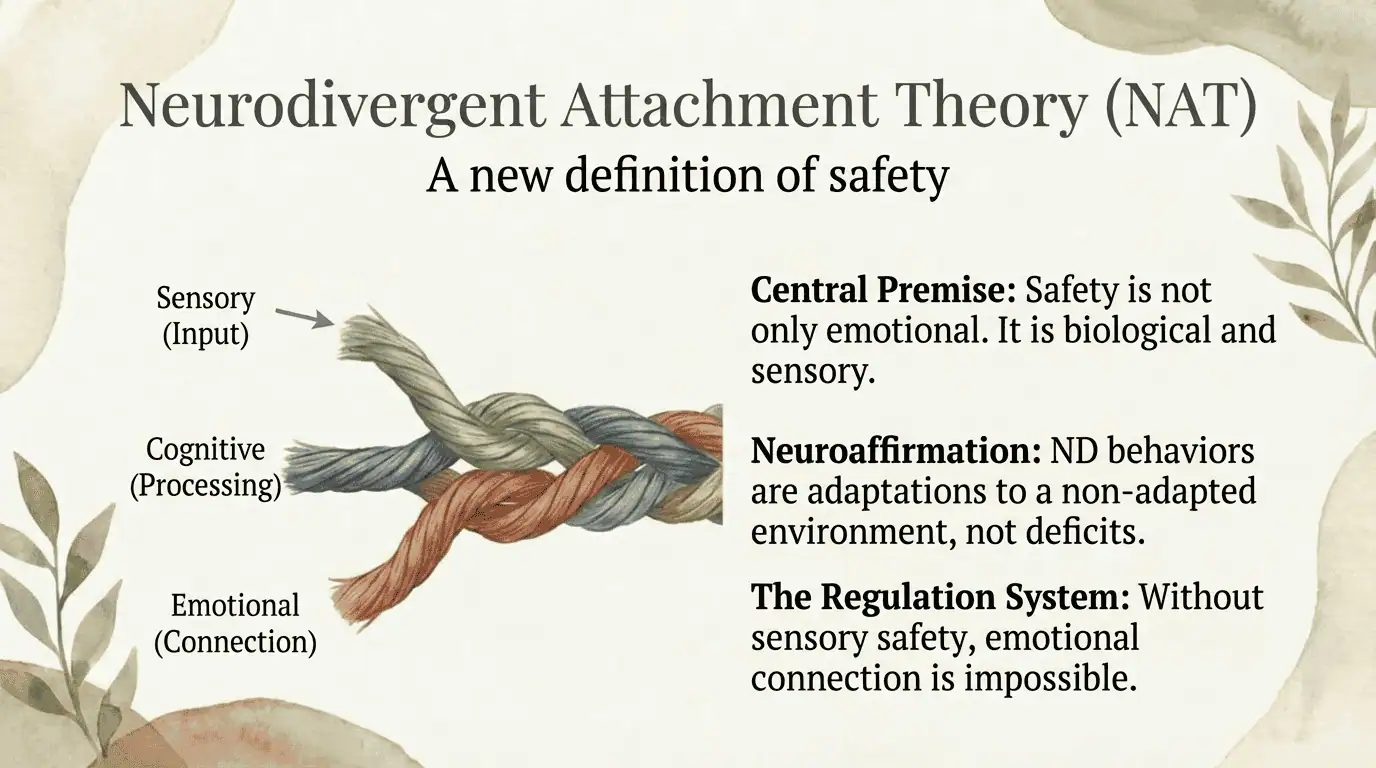
Neurodivergent Attachment Theory (NAT), the central framework of the neurodivergent attachment model, introduces a key idea: safety is not merely an emotional state — it is biological and sensory. The NAT model operates on three interconnected levels: Sensory (Input), Cognitive (Processing), and Emotional (Connection). The neuro-affirmative premise: neurodivergent behaviors are adaptations to an unadapted environment, not deficits. Without sensory safety, emotional connection is impossible.
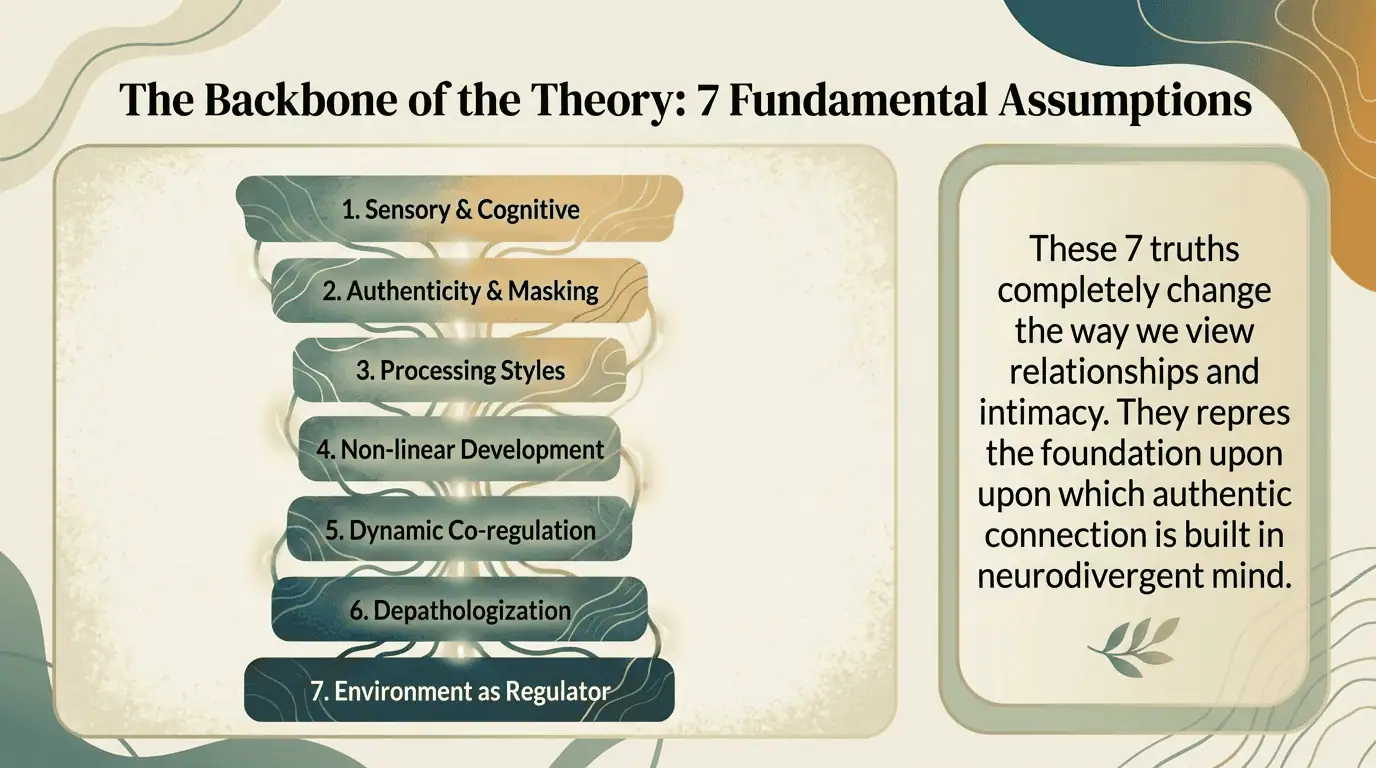
NAT is based on seven fundamental assumptions that form the "backbone" of the theory, shifting emphasis from behavior to biology: (1) Attachment is sensory and cognitive, not merely emotional; (2) Authenticity and masking define relational safety; (3) Expression of attachment varies depending on processing style; (4) Neurodivergent development is nonlinear and contextual; (5) Co-regulation is dynamic, not hierarchical; (6) Neurodivergence is not equivalent to disorganized attachment; (7) Environment is a regulator of attachment safety. These seven premises are detailed below, in a dedicated section.
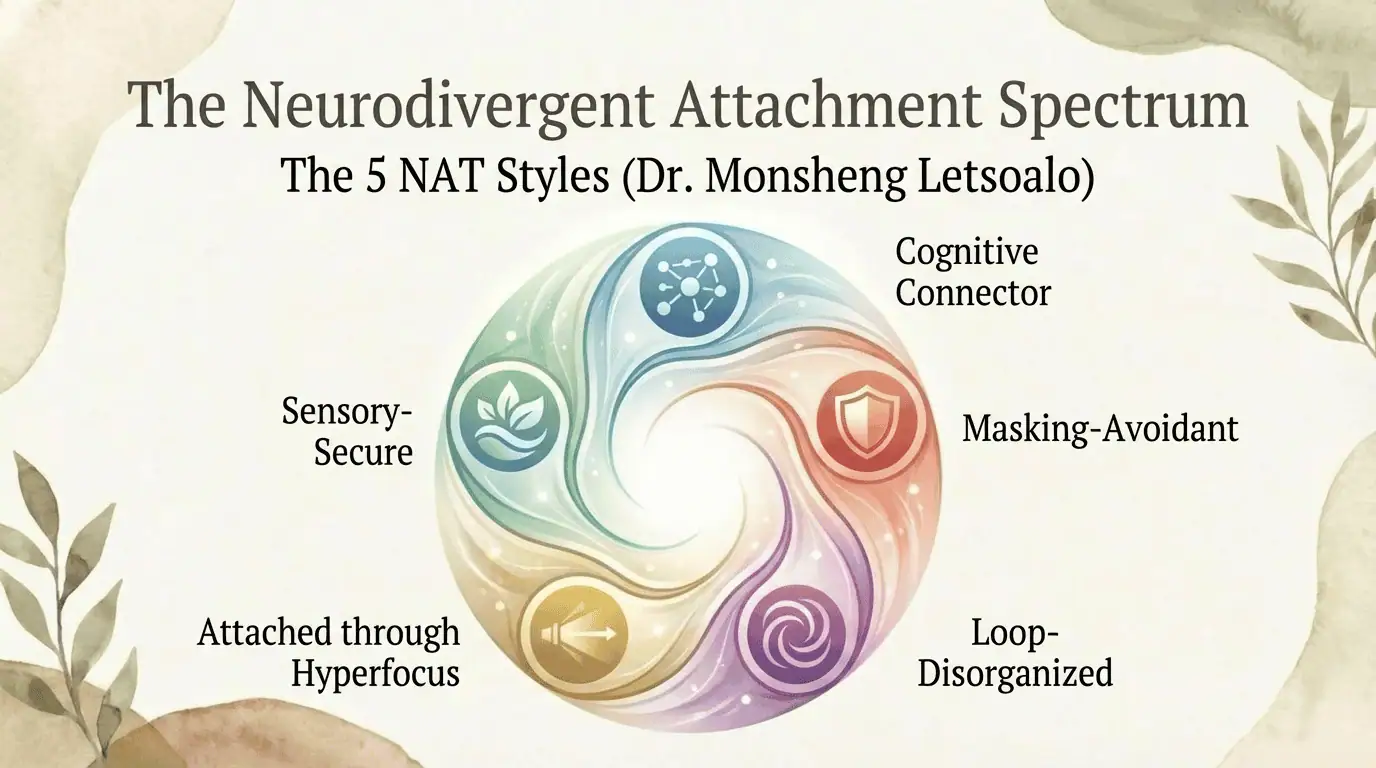
NAT proposes five attachment styles designed specifically for neurodivergent experience: Sensory-Secure, Masking-Avoidant, Hyperfocus-Attached, Looping-Disorganized, and Cognitive-Connector. These styles are not rigid labels, but points on a fluid spectrum that recognizes the diversity of ways neurodivergent people experience and express attachment.
It is important to emphasize: these styles are not diagnostic and do not replace clinical evaluation. They offer a new language — one that validates neurodivergent relational experiences without pathologizing them. A person can recognize traits from multiple styles, and the predominant style can shift depending on context, level of sensory stress, or stage of relationship.
The 5 Neurodivergent Attachment Styles (NAT)
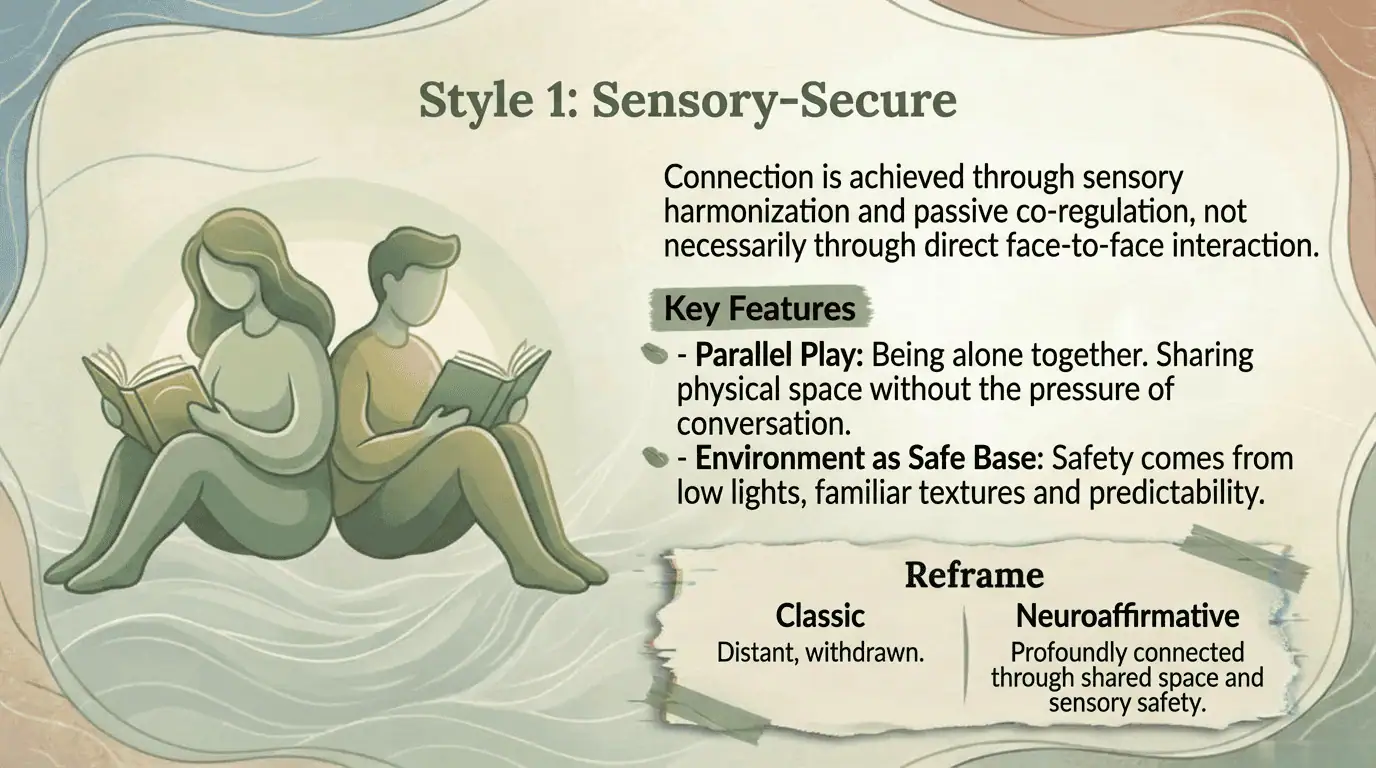
Style 1: Sensory-Secure. Connection is realized through sensory harmony and passive co-regulation. Parallel play — being alone together, sharing physical space without conversational pressure — is the primary form of intimacy. The environment becomes a "secure base": low lights, familiar textures, predictability.
Reframe: Classic = "Distant, withdrawn" → Neuro-affirmative = "Deeply connected through shared space and sensory safety." For people with this style, the most intimate moments can look completely different from what dominant culture defines as "closeness": two partners reading in the same room, without speaking — but deeply connected through shared physical presence. Attachment security is rooted in physical and sensory environments — comfort is built through individualized sensory maps, shared breathing rhythms, and non-verbal indicators of safety. The therapeutic approach emphasizes sensory regulation techniques, creation of physically safe environments, and co-regulation practices (for example, rhythmic breathing).
I have worked with couples where the most intimate moment described was not a declaration of love, but an hour spent reading in the same room, without a word. When I asked "what made that moment special?", the answer was invariably: "I didn't have to perform." This is sensory safety in action.
From a clinical perspective, this style is frequently encountered in people with a sensory processing profile that is predominantly proprioceptive or vestibular. Therapists can facilitate sensory mapping of the couple — an exercise in which each partner identifies what sensory stimuli create safety (warm lighting, the weight of a blanket, ambient music) and what stimuli create threat (fluorescent lights, simultaneous conversations, unexpected touches). This map becomes a practical tool for navigating intimacy.
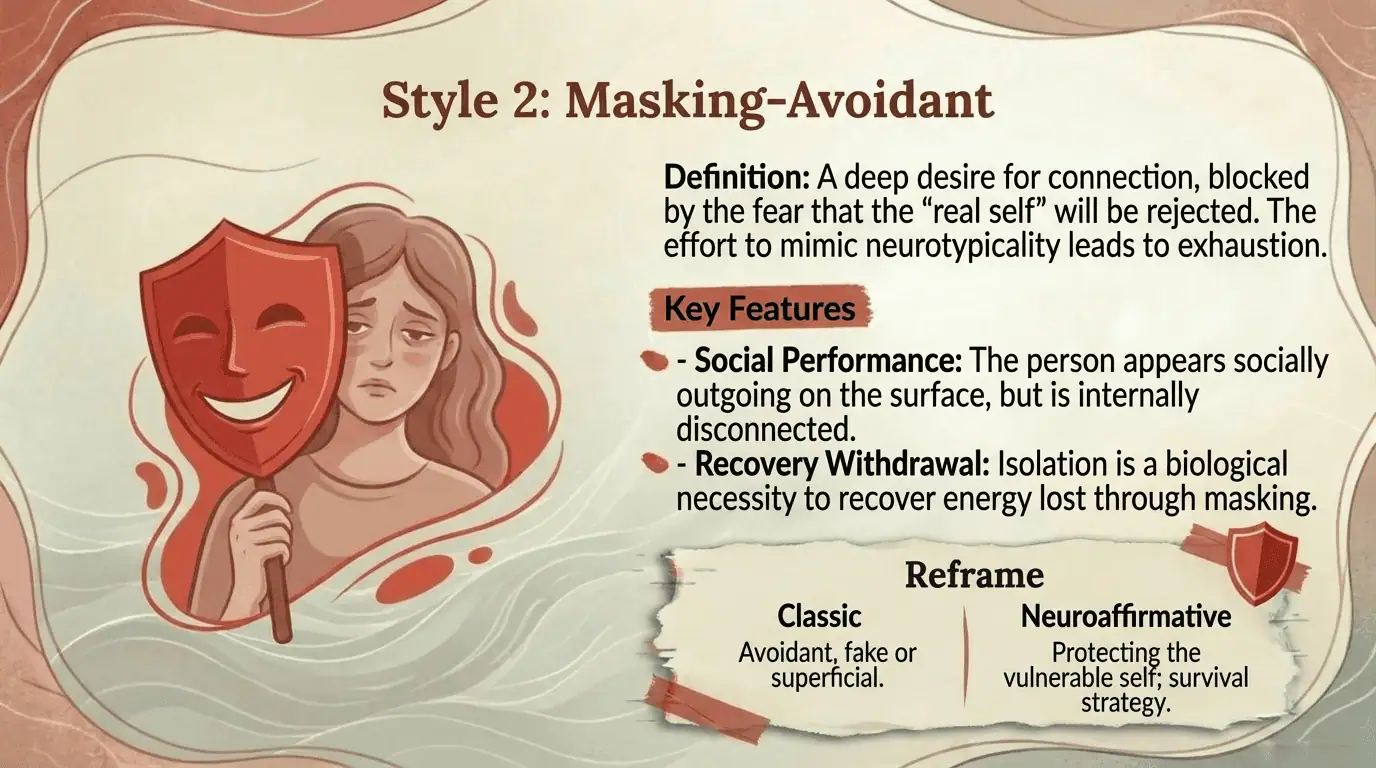
Style 2: Masking-Avoidant. A deep desire for connection, blocked by fear that the "real self" will be rejected. The effort to mimic neurotypicality leads to exhaustion. Social performance makes the person appear superficially sociable, but internally disconnected. Recovery withdrawal — isolation — is a biological necessity to recover energy lost through masking.
Reframe: Classic = "Avoidant, false, or superficial" → Neuro-affirmative = "Protecting a vulnerable self; survival strategy." Chronic masking — suppression of neurodivergent traits learned frequently in early childhood (Hull et al., 2017) — is associated with identity confusion, exhaustion, depression, and increased suicide risk (Cage & Troxell-Whitman, 2019). The central paradox: the more effective the masking, the more isolated the person feels — the partner becomes attached to the performed version, not the real one.
The therapeutic approach focuses on unmasking processes, validation of identity, and creation of non-judgmental spaces where the client can gradually reveal their authentic self without fear of rejection. Psychoeducation about the emotional impact of masking is essential.
An important clinical aspect: the unmasking process is not linear and can be accompanied by a period of grief — grief for years spent in performance, for relationships built on a false identity, for energy spent surviving rather than living authentically. Therapy must create space for this grief, recognizing it as a necessary stage of healing, not a problem to be solved. The partner can be prepared to support this process through specific psychoeducation about masking and by developing tolerance for uncertainty — because the partner who "comes out from under the mask" may look different from the one initially known.
The unmasking process is one of the most intense I facilitate in my practice. There is a moment — often unexpected — when the client who has performed their entire life allows themselves, for the first time, to not smile. To not make eye contact. To sit in silence. And in that silence, a person emerges whom even they did not know.
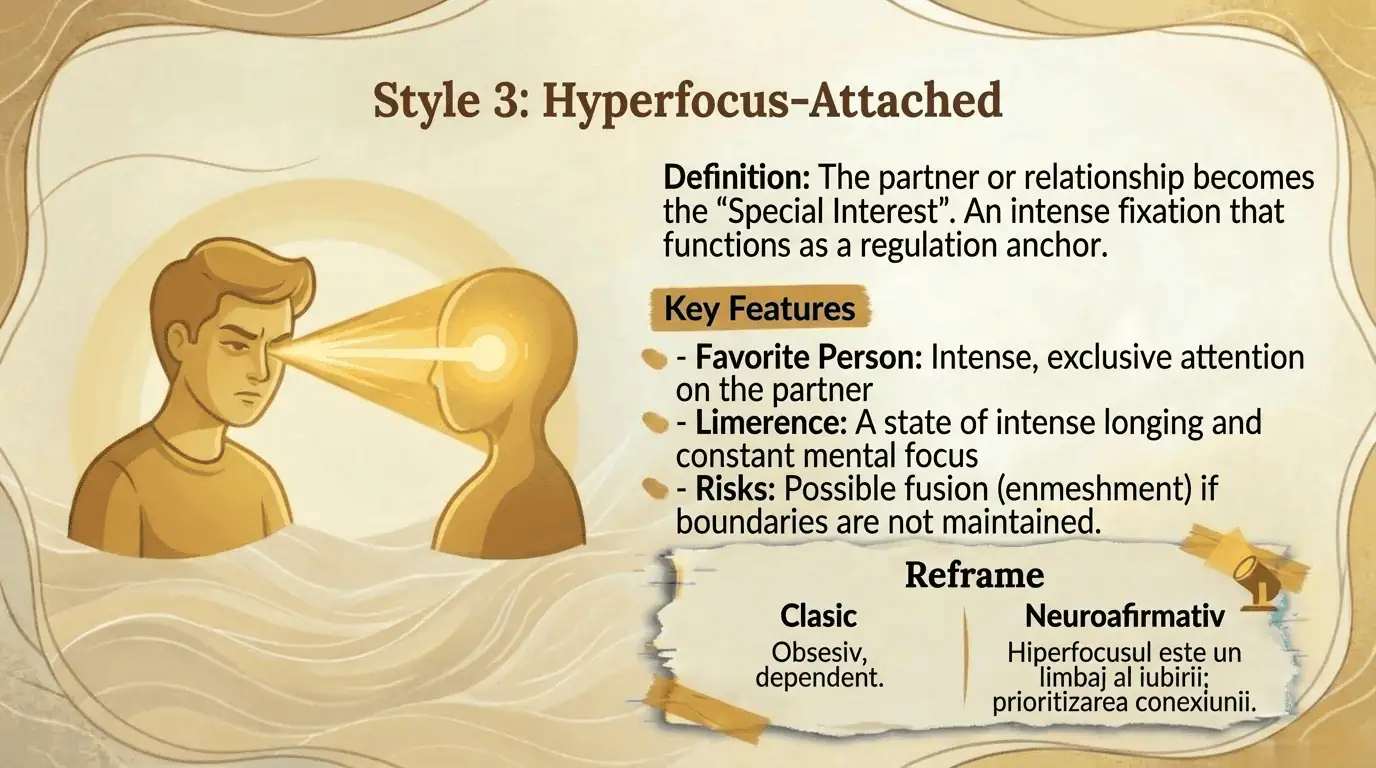
Style 3: Hyperfocus-Attached. The partner or relationship becomes the "Special Interest" — an intense fixation that functions as a regulation anchor. Features include: Favorite Person (intense, exclusive attention), Limerence (a state of intense desire and constant mental focus). Risks: possible enmeshment if boundaries are not maintained.
Reframe: Classic = "Obsessive, dependent" → Neuro-affirmative = "Hyperfocus is a language of love; prioritization of connection." This style is frequently associated with ADHD and autism. The intensity of attention offered to the partner is not pathological — it is the expression of a nervous system that experiences connection with the same depth as it experiences any special interest. It can lead to strong and loyal relationships, but can also contribute to anxiety when access to the attachment figure is interrupted.
I frequently work with ADHD clients for whom the partner has become a "special interest." The intensity is not pathological — but it can be overwhelming for the other person. Therapy is not about "reducing" the intensity, but about channeling it: how to love with the same depth, but with boundaries that protect both partners.
Therapeutic strategies include helping people develop healthy boundaries, diversifying sources of emotional regulation, cognitive-behavioral techniques and mindfulness for managing anxiety, and open communication about the partner's need for space.
A frequent phenomenon in this style is the "hyperfocus → attention deficit" cycle specific to ADHD: in the initial phase of the relationship, the partner is the new and fascinating interest, receiving extraordinary attention. As novelty fades, attention can migrate to other stimuli, leaving the partner feeling abandoned. Psychoeducation about this cycle — normalizing it and creating concrete strategies for intentional reconnection (short daily rituals, scheduled "check-ins," structured "date nights") — can prevent catastrophic interpretations from both directions.
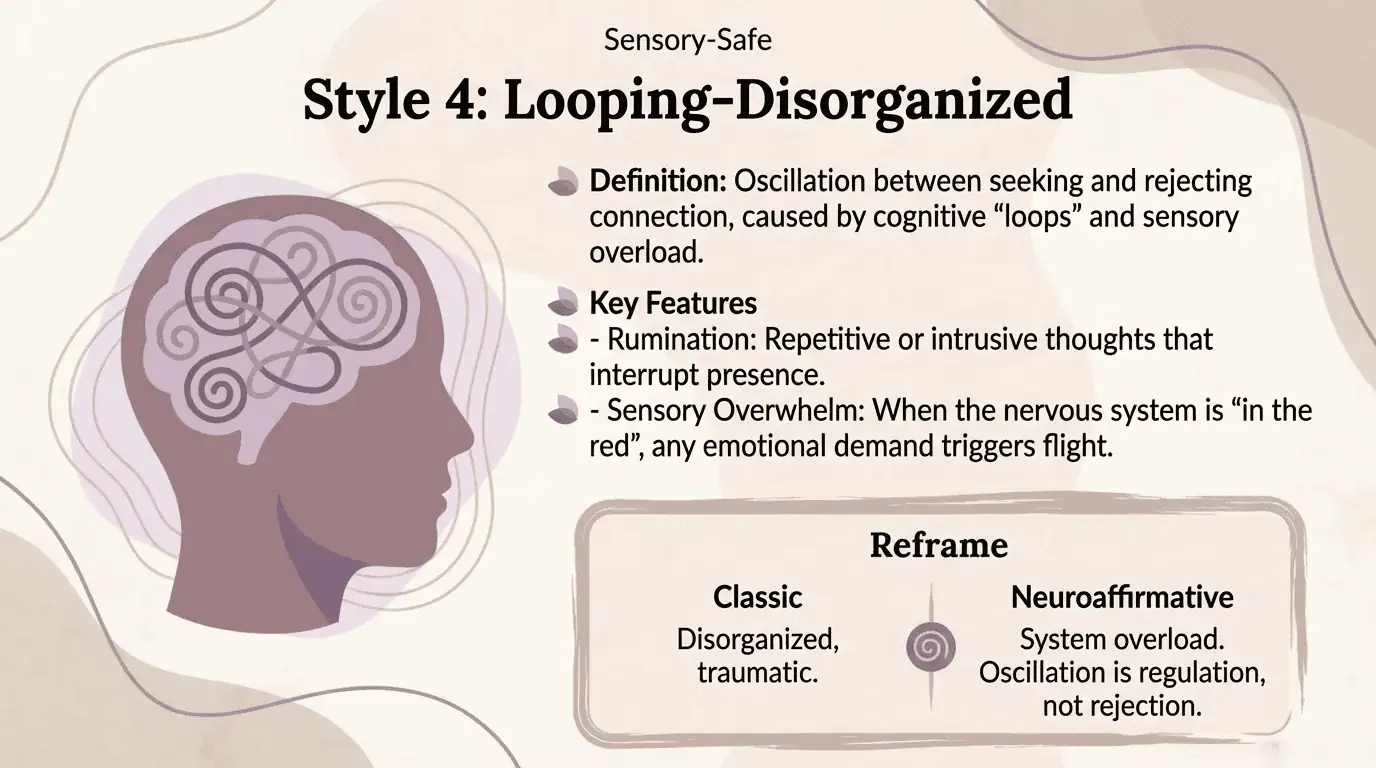
Style 4: Looping-Disorganized. Oscillation between seeking and rejecting connection, caused by cognitive "loops" and sensory overload. Rumination — repetitive or intrusive thoughts — interrupts presence. Sensory overwhelm makes any emotional demand trigger flight when the nervous system is "in red."
Reframe: Classic = "Disorganized, traumatic" → Neuro-affirmative = "System overload. Oscillation is regulation, not rejection." The crucial distinction from the classical model: in traditional attachment theory, disorganized attachment is almost always associated with trauma. In NAT, looping can be purely neurological — the result of a nervous system that oscillates rapidly between activation states. A person can deeply desire connection one moment and urgently need isolation the next — not from fear of abandonment, but because the sensory threshold has been exceeded.
Trauma-informed therapeutic approaches that emphasize stabilization, grounding, and integration are essential, incorporating rhythm, gentle reflection, and somatic therapies to support coherence.
The clinical distinction between neurological looping and traumatic disorganization is one of NAT's most important contributions. In practice, differentiation can be made through: activation context (sensory vs. relational), speed of recovery after overload, presence or absence of flashbacks and dissociation, and response to environmental modification. If reducing sensory stimuli rapidly restores connection capacity, the cause is likely neurological, not traumatic. Of course, the two can coexist — many neurodivergent people also have relational trauma, accumulated precisely from repeated experiences of being misunderstood.
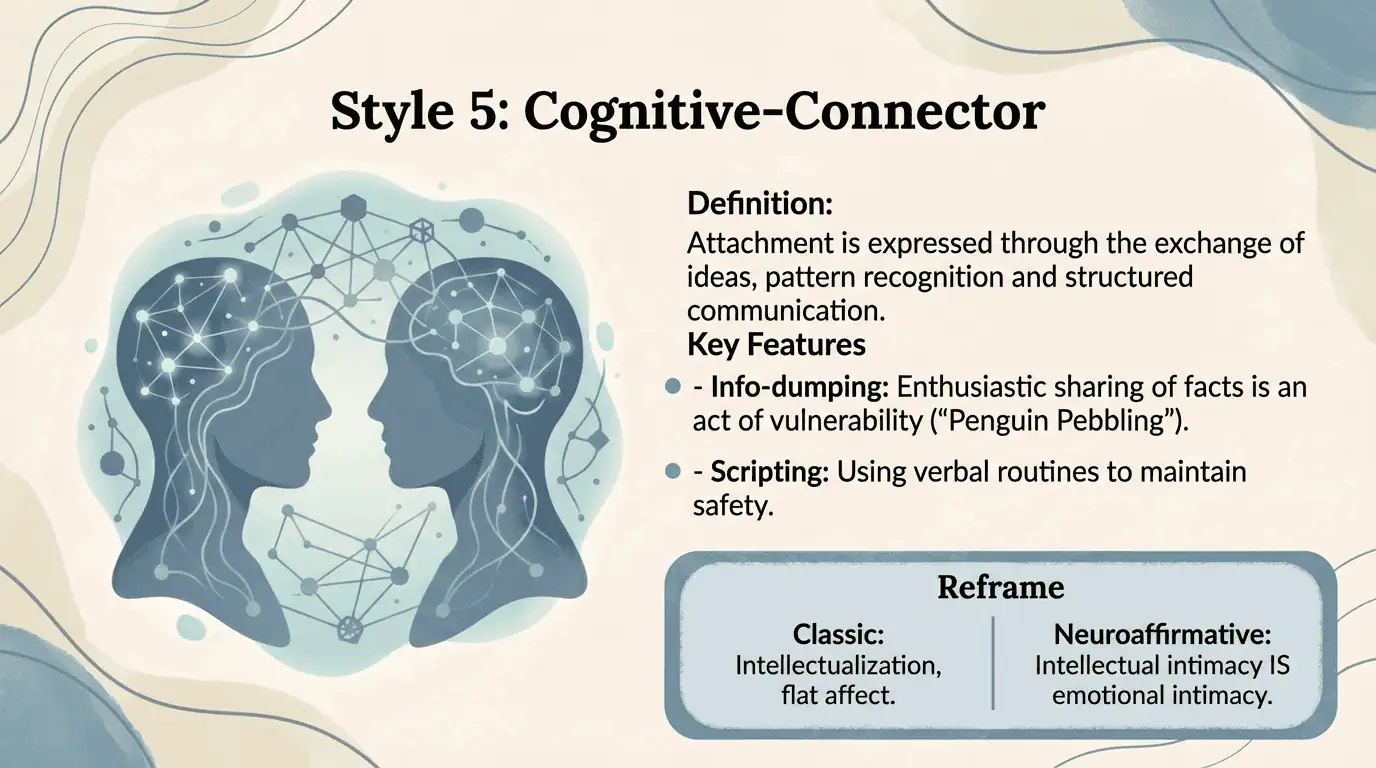
Style 5: Cognitive-Connector. Attachment is expressed through exchange of ideas, pattern recognition, and structured communication. Info-dumping — enthusiastic sharing of facts — is an act of vulnerability ('Penguin Pebbling'). Scripting — using verbal routines — maintains conversational safety.
Reframe: Classic = "Intellectualization, flat affect" → Neuro-affirmative = "Intellectual intimacy IS emotional intimacy." This style is often the most misunderstood in couple therapy. When a neurodivergent partner responds to "I love you" with an interesting fact, this is not emotional avoidance — it is reciprocity in their native connection language. "Penguin Pebbling" is the neurodivergent equivalent of a bouquet of flowers: "I found something special and thought of you."
Therapy can benefit from intellectual strengths and scripted communication styles to build rapport, and structured dialogue, joint problem-solving, and shared routines can enhance relational trust.
For therapists working with this style, an essential adaptation is explicit validation of cognitive communication as a legitimate form of intimacy. Many cognitive connectors have a history of being criticized for "intellectualization" or "emotional avoidance" — when, in fact, their processing naturally passes through the cognitive channel before reaching the emotional one. Offering structure (specific questions instead of "how do you feel?"), using metaphors and analogies, and explicit appreciation of the effort of info-dumping as a gesture of connection can transform the therapeutic experience.
Translating Behavior into Neurodivergent Attachment
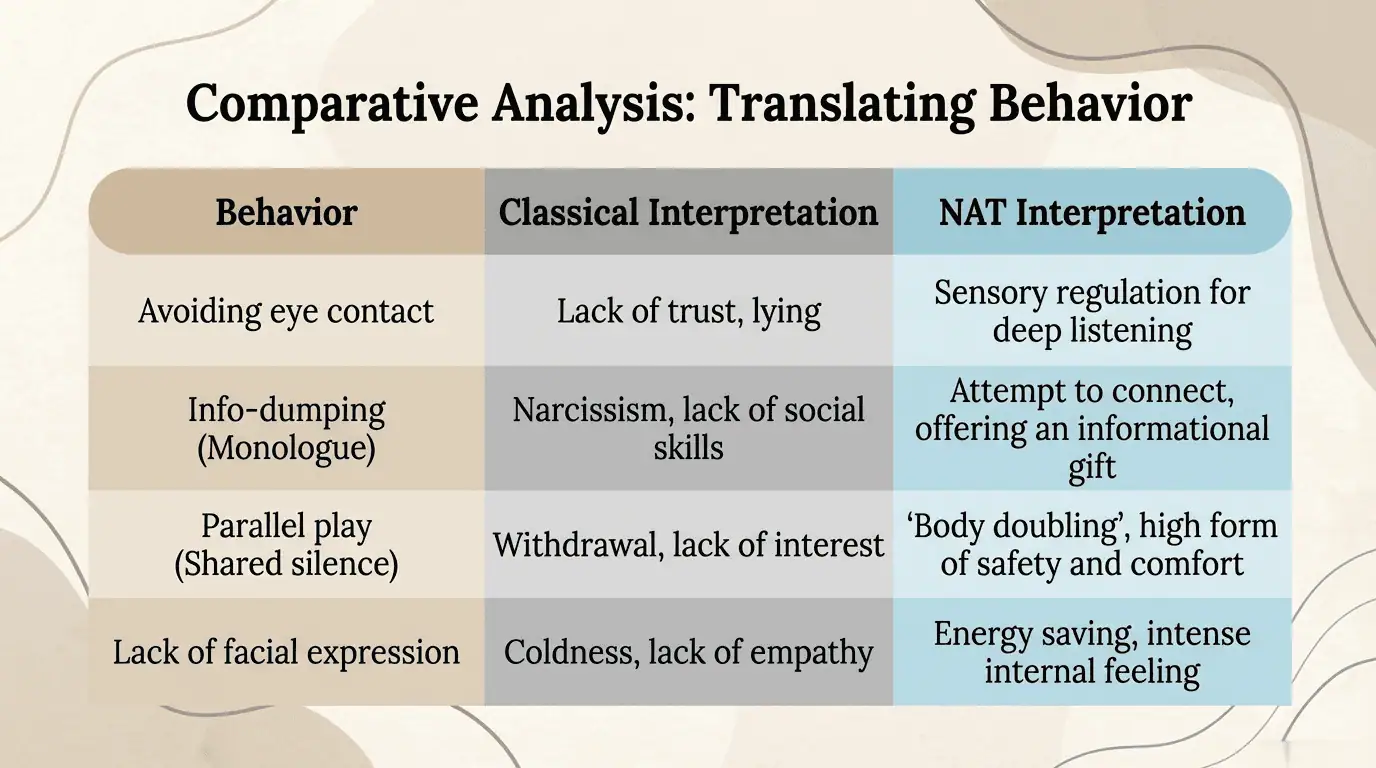
This table functions as a small "Google Translate" for neurodivergent behaviors in relationships. Eye contact avoidance does not mean lack of trust — it can be sensory regulation for deep listening. Info-dumping is not narcissism — it is an attempt at connection. Parallel play is not withdrawal — it is "body doubling," a high form of safety. Lack of facial expression is not coldness — it is energy conservation, with intense internal feeling.
This "translation" is essential for both therapists and neurotypical partners. Without it, neurodivergent behaviors are filtered through neurotypical lenses and interpreted as relational deficits. With it, the same behaviors become visible as legitimate — and often profound — forms of connection. The goal is not to "excuse" behaviors that may be difficult for the partner, but to create a common language that allows negotiation and mutual adaptation, rather than unilateral pathologization.
This "translation" competency is what Crompton et al. (2020) describe indirectly through their research on autistic-to-autistic communication: when both partners share the same processing system, information transfer is as efficient as between neurotypical people. Problems arise at the interface between different processing systems — not because of a deficit in one part, but because of the lack of a common "dictionary." NAT provides this dictionary.
In clinical practice, the translation process can be structured through specific exercises: "translation journal" (in which each partner notes a behavior they interpreted negatively and then explores an alternative interpretation), "double interview" sessions (in which the therapist facilitates articulation of the intention behind the behavior), and creation of a personalized "relationship guide" — a living document that codifies the translations discovered in therapy.
Therapeutic Implications of Neurodivergent Attachment
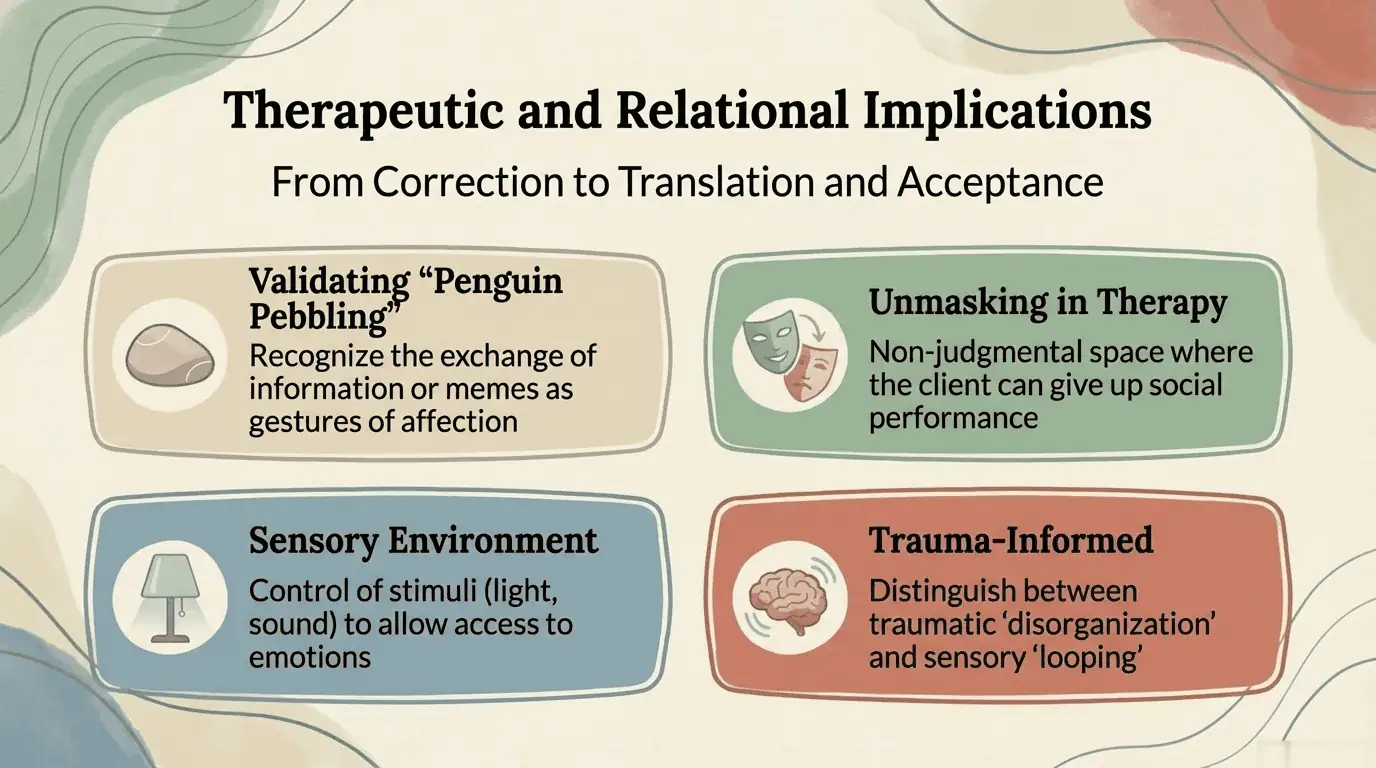
From correction to translation and acceptance. In practice, this means: Validation of "Penguin Pebbling" — recognizing information exchange as gestures of affection; Unmasking in Therapy — creating a non-judgmental space where the client can release social performance; Sensory Environment — controlling stimuli (light, sound) to allow access to emotions; and a Trauma-Informed approach that distinguishes between traumatic "disorganization" and sensory "looping."
For practitioners, NAT offers a concrete framework: instead of working "on" the client to bring them to a neurotypical standard of attachment, we work "with" the client to discover and validate their own relational language.
This can include practical adaptations of the therapeutic framework — sessions with natural lighting, permission for stimming during conversation, asynchronous communication between sessions, or using visual metaphors instead of direct verbal processing of emotions. Each adaptation communicates a fundamental message: "You don't need to change to be loved."
The implications for therapist training are significant. Most couple therapy training programs are built on the neurotypical model of relational emotionality: emphasis falls on verbal expression of emotions, on eye contact as a sign of presence, on direct emotional vulnerability. NAT suggests that the neuro-affirmative therapist must extend their repertoire of recognition of connection — to see intimacy in info-dumping, safety in parallel play, and vulnerability in the sharing of a special interest.
Concretely, adapting the therapeutic framework can include: offering written questions before the session to allow for anticipated processing; using visual tools (diagrams, metaphors, emotion cards); arranging seating at a 90° angle instead of face-to-face; allowing stimming and movement during the session; and flexibility in session format (combinations of online and in-person sessions, adapted durations, sensory breaks).
The 7 Fundamental Assumptions of the Neurodivergent Attachment Model (NAT)
These seven premises represent the "backbone" of Neurodivergent Attachment Theory. They completely change how we view emotional safety, shifting emphasis from behavior to biology. If the previous sections showed how neurodivergent attachment manifests through the 5 styles, the 7 assumptions below explain the why — the biological and conceptual foundation on which the entire theory is built.
1. Attachment is Sensory and Cognitive, Not Merely Emotional
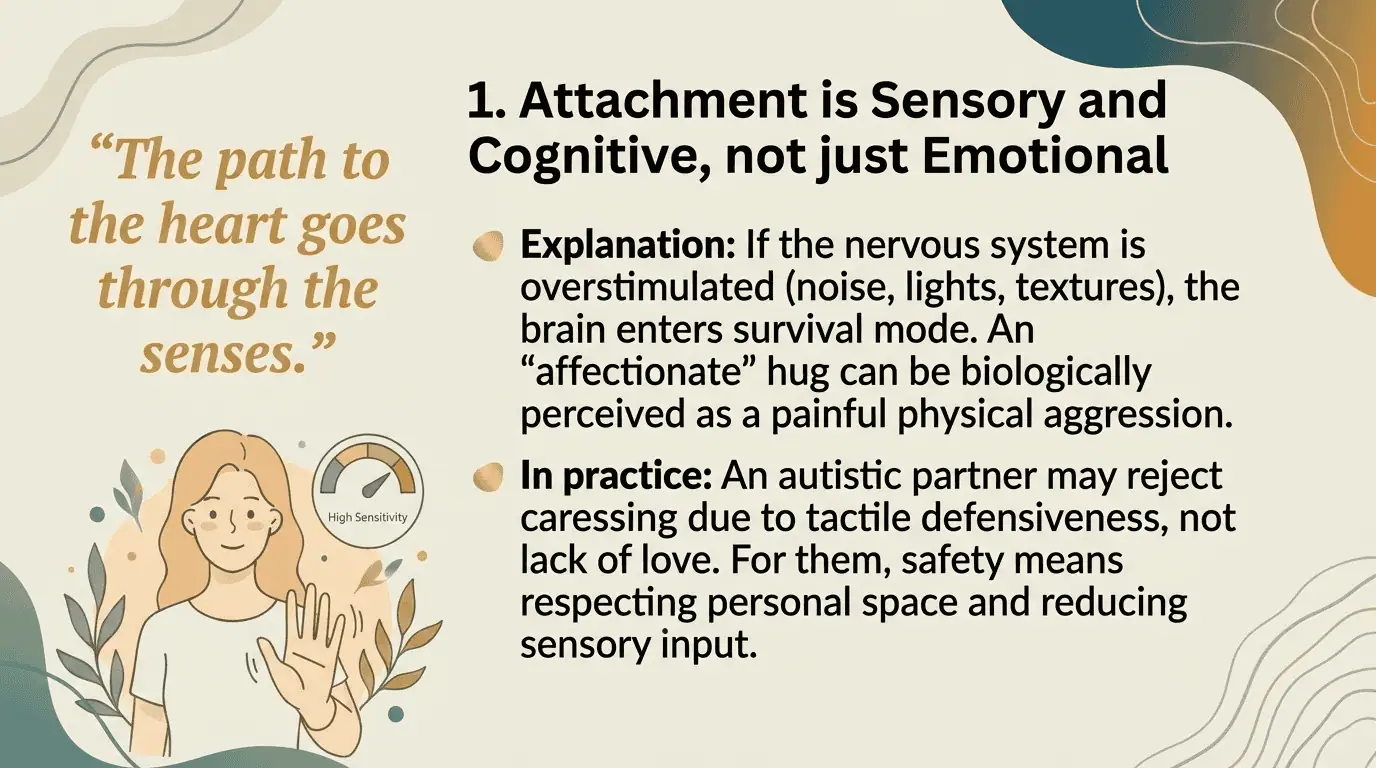
This is, perhaps, the most radical paradigm shift. In the classical model, attachment is about pure emotion. NAT tells us that for a neurodivergent person, the path to the heart passes through the senses and through the mind.
If the nervous system is sensorially over-solicited (too much noise, unpleasant touch, strong lights), the brain enters survival mode. In those moments, a "loving" touch — such as a tight embrace — can be perceived as physical assault rather than love. Co-regulation can occur through shared rituals, parallel play, or non-verbal proximity.
Example: An autistic partner may reject caressing not because they are upset, but because they have heightened tactile sensitivity (tactile defensiveness). Safety for them means respecting personal space, not invading it. This assumption has profound implications for clinical evaluation. Standard attachment assessment tools (AAI, ECR) do not measure the sensory dimension of safety. A client who reports "discomfort with physical closeness" on an attachment questionnaire will likely be classified as "avoidant" — when, in fact, the discomfort is sensory, not relational. NAT suggests the need for assessment tools that include sensory profile alongside traditional relational dimensions.
2. Authenticity and Masking Define Relational Safety
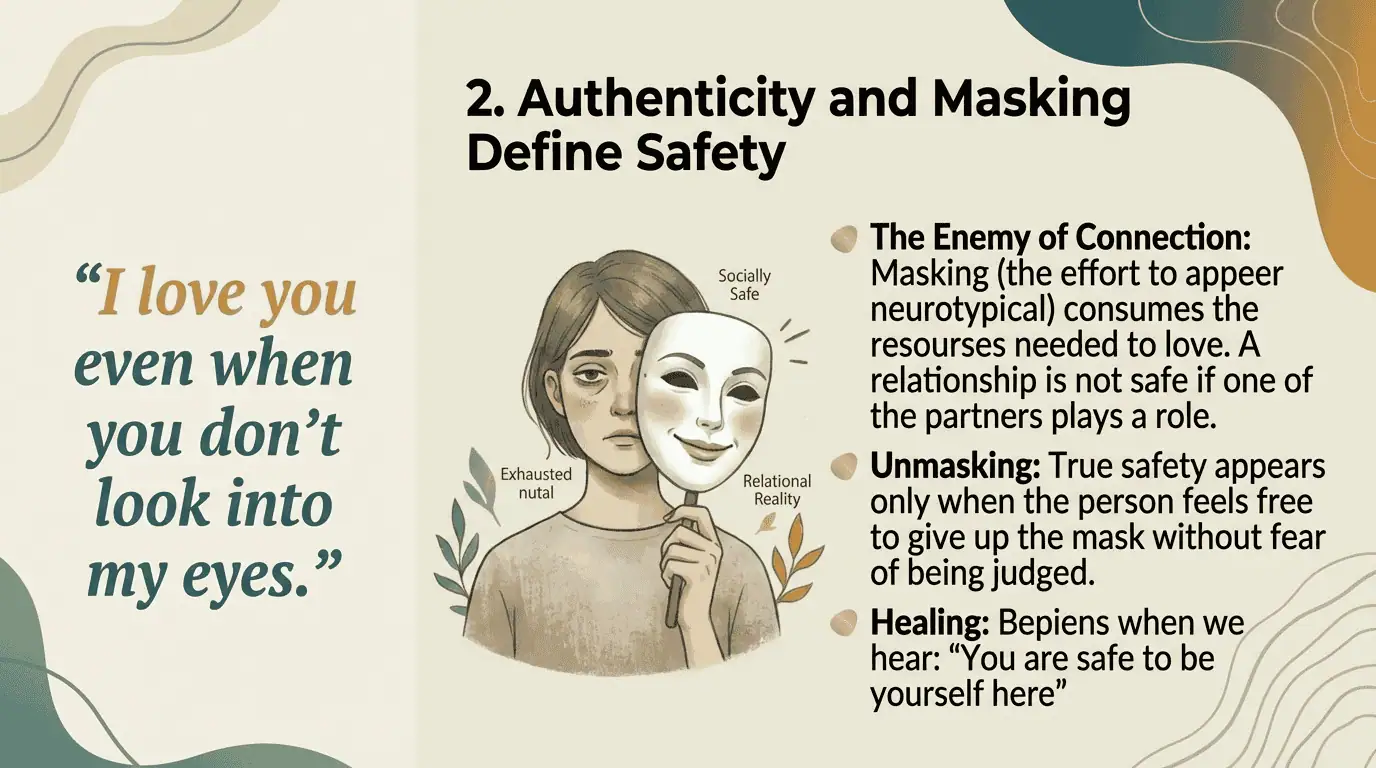
This assumption directly links mental health to relationship. Masking — the conscious or unconscious effort to appear neurotypical — is the enemy of secure attachment. Many neurodivergent people learn from childhood that to be accepted they must hide their traits (force eye contact, suppress self-regulation movements).
NAT posits that a relationship cannot be truly safe if one partner is playing a role. True safety appears only when the person feels free to release the mask ("unmasking") without fear of judgment or abandonment.
Therapeutic perspective: Healing begins when the partner says: "I love you and I love you when you're not making eye contact" or "You're safe being yourself here." Chronic masking — suppression of neurodivergent traits learned frequently in early childhood (Hull et al., 2017) — is associated with identity confusion, exhaustion, depression, and increased suicide risk (Cage & Troxell-Whitman, 2019). In a couple relationship, masking creates a paradoxical dynamic: the neurotypical partner feels connected to a version that is not real, while the neurodivergent partner feels alone in a relationship where they are "present" only through performance. Therapeutic unmasking is a gradual process that requires relational safety built step by step — not a sudden "revelation," but a delicate dance between vulnerability and acceptance.
3. Expression of Attachment Varies Depending on Processing Style
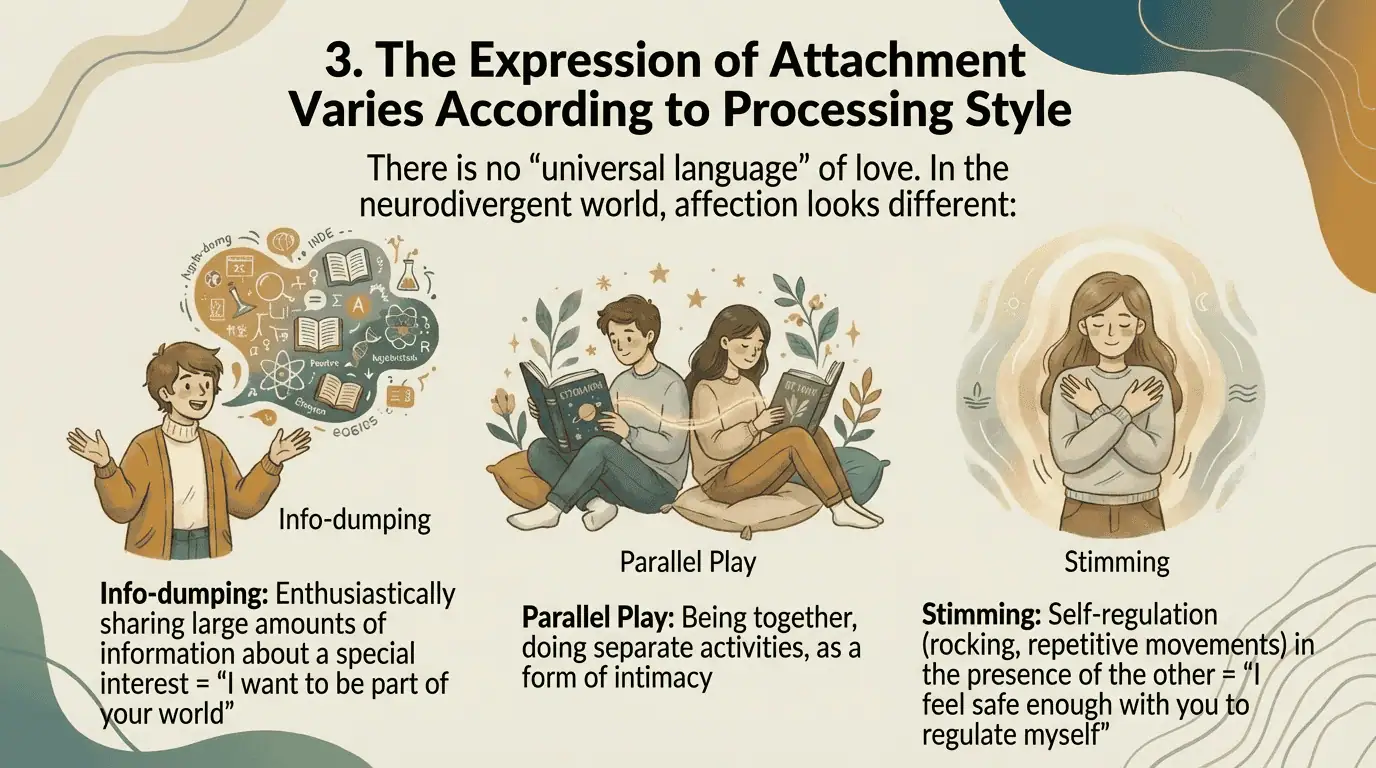
There is no "universal language" of love. NAT rejects the idea that only eye contact and talking about feelings are evidence of attachment. Neurodivergent people have unique ways of saying "I love you." These can include: Info-dumping, Scripting (using movie lines to express a complex emotion), or Stimming in the presence of the other (which indicates that you feel safe enough to regulate yourself).
Reframing: What seems "cold" or "weird" to a neurotypical mind is, in fact, a profound invitation to connection in the neurodivergent world. This assumption extends the concept of "love languages" (Chapman, 2015) beyond the neurotypical framework. Chapman describes five universal languages, but assumes that all people express and receive them in similar ways. NAT adds a layer of complexity: not only do people prefer different languages, but the same language can be expressed through different neurological channels. "Quality time" for a cognitive connector can mean solving a puzzle together, not a conversation about feelings. "Acts of service" can include creating a comfortable sensory environment, not just cleaning or cooking.
4. Neurodivergent Development is Nonlinear and Contextual
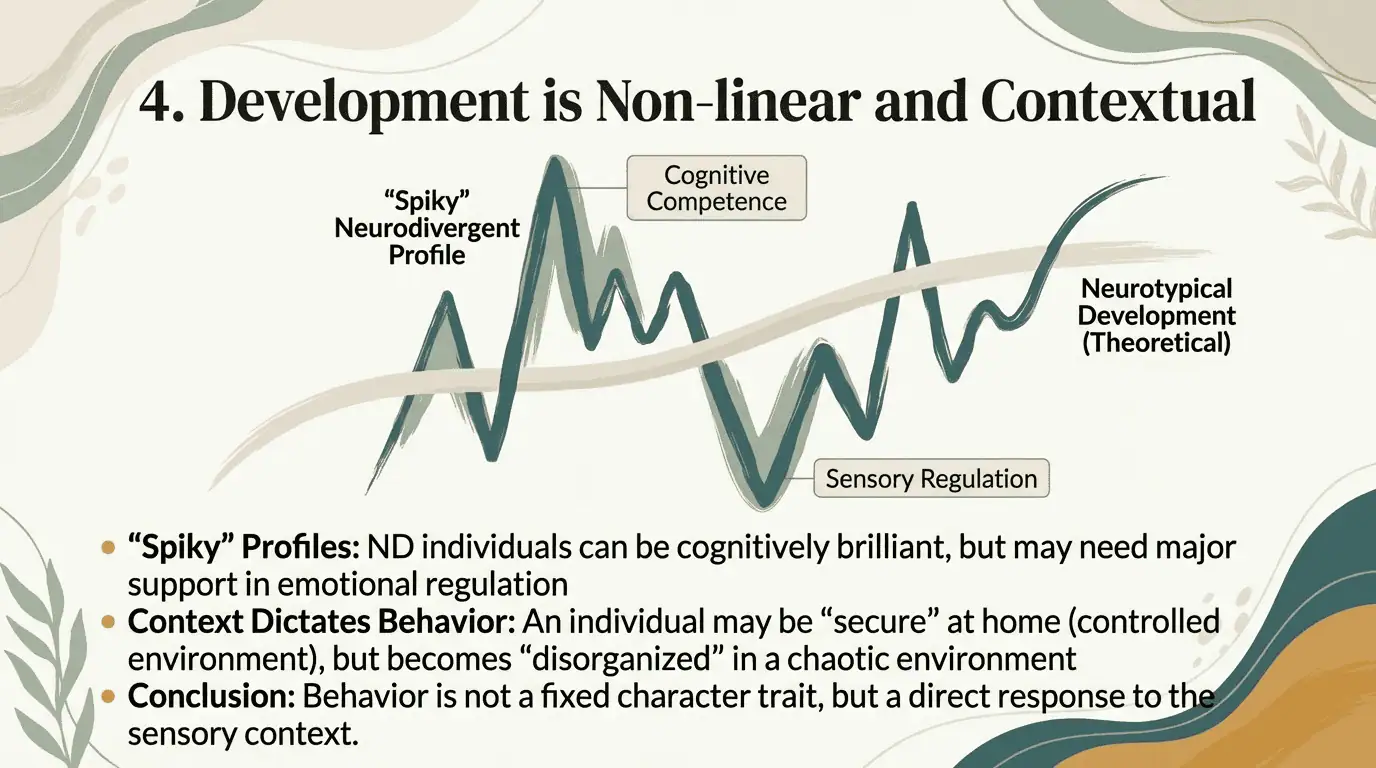
This assumption combats the idea that emotional maturity looks the same in all adults. Neurodivergent people often have "spiky profiles" — they can be genius in one cognitive domain but may need major support in emotional or sensory regulation.
Moreover, attachment style can fluctuate dramatically depending on environment. A person may appear "secure" at home (where the environment is controlled), but becomes "disorganized" or "avoidant" in a noisy mall.
Conclusion: Behavior is not a fixed trait of character, but a response to sensory and social context. This contextual fluidity of attachment can be bewildering for neurotypical partners: "Yesterday you were so close, today you seem like a different person." Psychoeducation about spiky profiles and contextual variability helps both partners normalize fluctuations and develop flexible response strategies. Instead of "what's wrong with you/us?", the question becomes "what changed in the environment?" — a reframing that shifts focus from pathology to ecology.
5. Co-regulation is Dynamic, Not Hierarchical
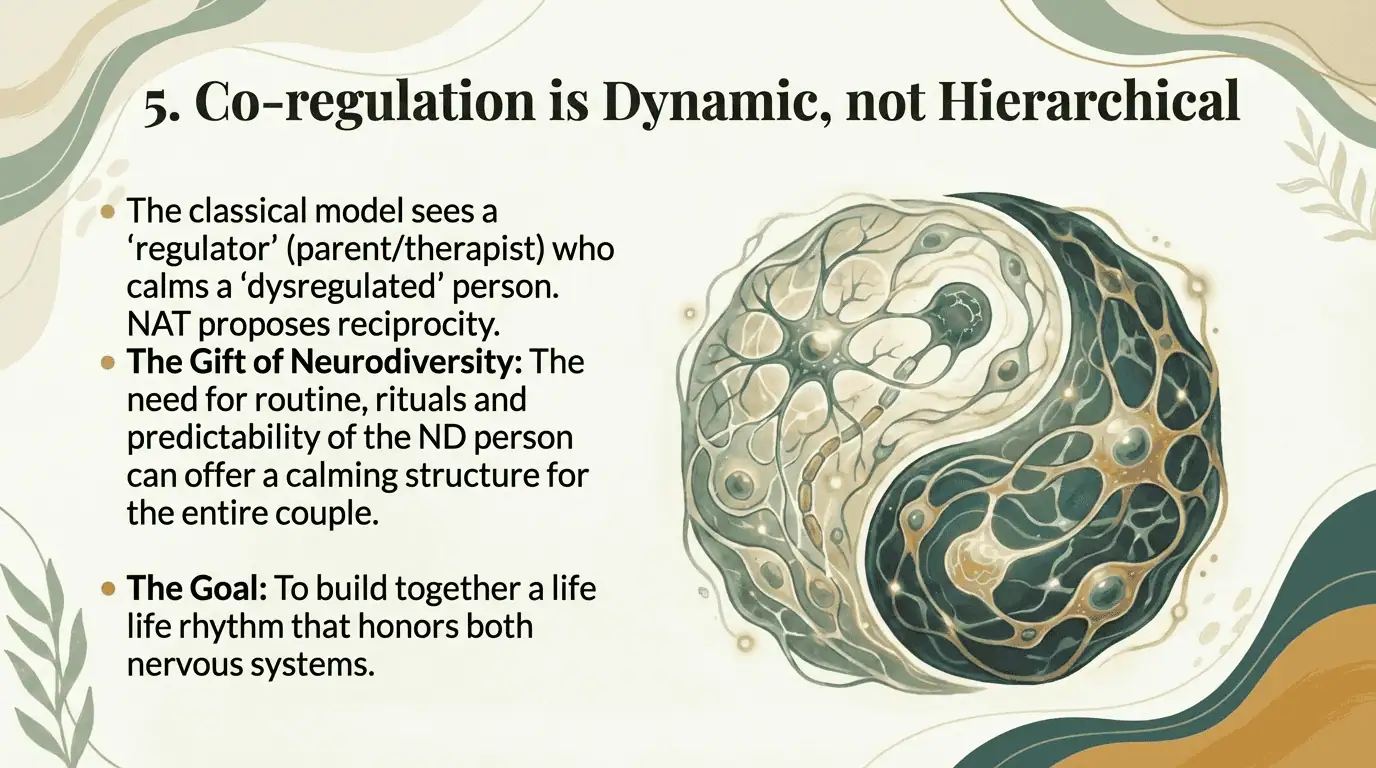
The classical model often views one person as the "regulator" (parent/therapist) calming a "dysregulated" person (child/patient). NAT proposes reciprocity. Neurodivergent people contribute unique forms of stability. For example, their need for routine, rituals, and predictability can provide soothing structure for the entire couple or family. Co-regulation does not mean merely calming a crisis, but building together a rhythm of life that honors both nervous systems.
In neurodiverse couples, the neurotypical partner is not automatically the "regulator" and the neurodivergent partner is not automatically "the one needing regulation." The dynamic is bidirectional: the neurodivergent partner can offer structure, predictability, and analytical depth, while the neurotypical partner can offer social flexibility and navigation of unfamiliar contexts. Recognition of each partner's unique contribution to relational balance is essential for an egalitarian dynamic.
6. Neurodivergence is NOT Equivalent to Disorganized Attachment
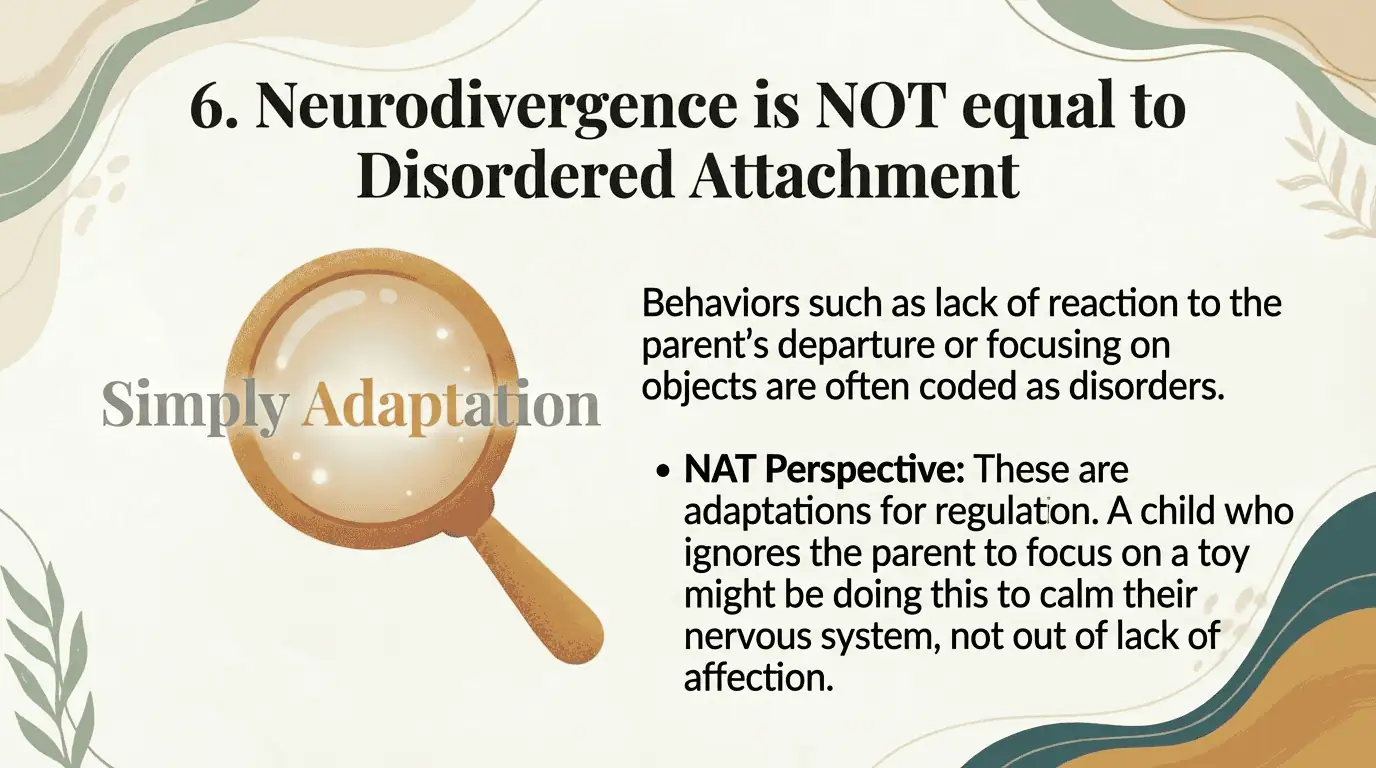
This is a critical assumption for depathologization. In standard evaluations, behaviors such as lack of response to parental departure or repetitive movements are coded as signs of attachment disorder. NAT affirms that these behaviors are adaptations, not defects. A child who focuses on a toy and ignores the parent might be doing so to self-regulate, not because they lack emotional connection with the parent.
Essential perspective: Safety must be redefined through the terms of neurodiversity, not through comparison with statistical norm. This confusion between neurodivergence and disorganized attachment has serious clinical consequences: autistic children diagnosed with Reactive Attachment Disorder (RAD), neurodivergent adults evaluated with "insecure attachment" based on miscalibrated tools, and families blamed for "failing" to produce secure attachment. NAT offers necessary correction: neurodivergence does not cause disorganized attachment, but only a different expression of attachment that requires appropriate assessment tools.
7. Environment is a Regulator of Attachment Safety
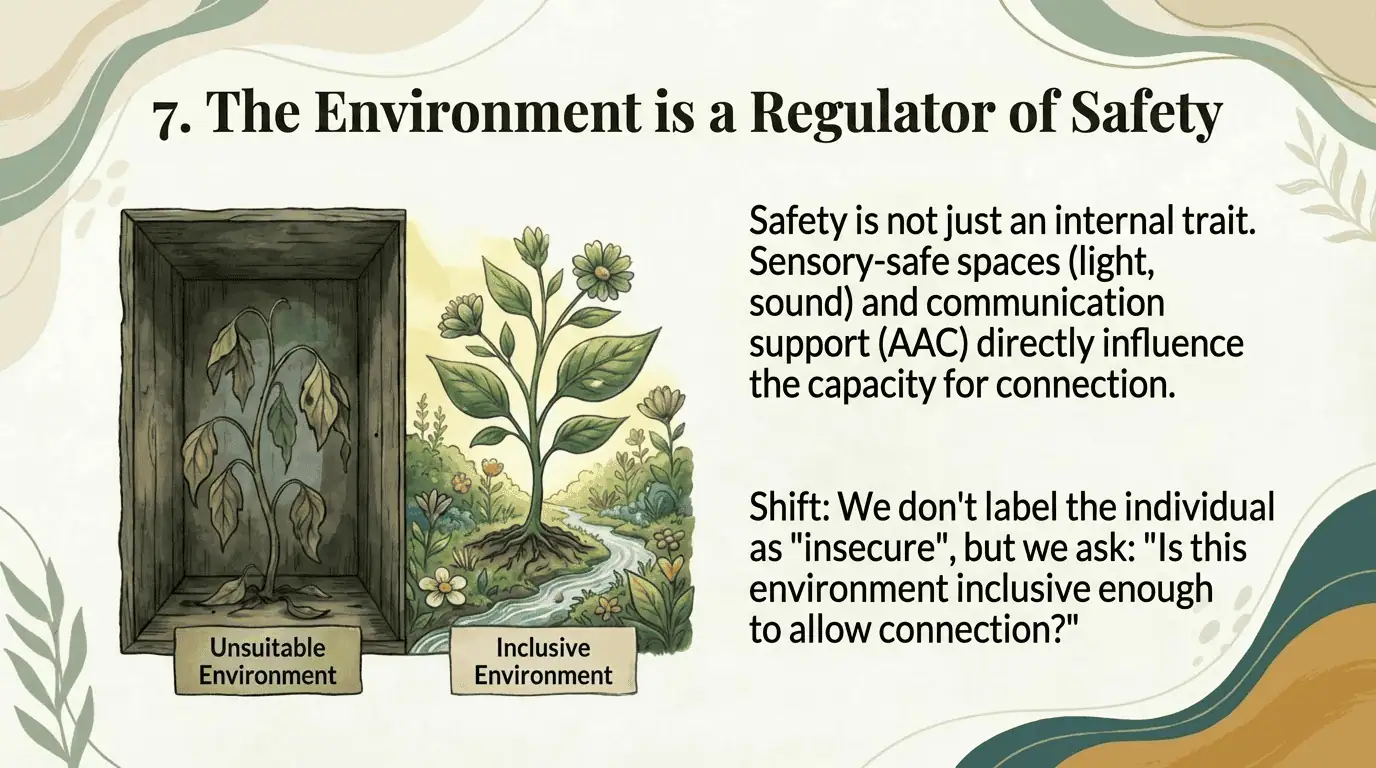
Safety is not only between two people; it is between people and their environment. For a neurodivergent person, the physical environment (lights, sounds, textures) is a "third partner" in the relationship. If the environment is sensorially hostile, secure attachment is impossible to maintain. Creating sensory-safe spaces (quiet, predictable) is an attachment strategy as valid as couple therapy.
Practical example: Sometimes, reducing background noise can save a difficult conversation. Before judging a relationship as "defective," check the environment. This assumption reframes the foundation of couple therapy: instead of beginning with "What do you feel toward each other?", we can begin with "How is the environment in which you take place?" Schore (2001) demonstrated the importance of environment in the development of affective regulation; NAT extends this perspective to adult relationships, proposing that the couple's "sensory niche" — the physical environment in which the relationship unfolds — is an active factor in the quality of attachment, not merely background.
What Do These 7 Assumptions Tell Us?
Validation is healing When you understand that your need to sit alone in a dark room is not "rejection," but "biological regulation" (Assumption 1), you let go of shame.
Translation of love: Learn to recognize non-traditional languages of love (Assumption 3). If your partner sends you a meme or explains how an engine works, that is an attempt at connection. Environment matters Before judging a relationship as "defective," check the environment (Assumption 7). Sometimes, reducing background noise can save a difficult conversation.
Authenticity before performance: A lasting relationship requires releasing the mask. Encourage moments when you can be "weird" together, without the pressure to appear normal (Assumption 2). These assumptions, taken together, offer a complete framework for truly neuro-affirmative therapeutic practice. They are not merely theoretical principles — they are a practical guide that transforms how we evaluate, understand, and support neurodivergent relationships. The next part of this material (published separately) explores how these principles apply in the practical life of couples: love languages, communication, intimacy, and concrete day-to-day strategies.
Ready to take the next step?
If what you've read resonates with you, you are not alone. Neurodivergent attachment theory validates your experience — and there are neuro-affirmative strategies that can help.
Book an Initial Consultation → Content synthesized and written by Giancarlo Cristea, neuro-affirmative integrative psychotherapist, based on the research of Dr. Monsheng Letsoalo, McNulty's work (2020), and neuro-affirmative literature.
Bibliography
Ainsworth, M. D. S., Blehar, M. C., Waters, E., & Wall, S. (1978). Patterns of attachment: A psychological study of the strange situation. Lawrence Erlbaum.
Bowlby, J. (1969). Attachment and loss: Vol. 1. Attachment. Basic Books.
Cage, E., & Troxell-Whitman, Z. (2019). Understanding the reasons, contexts and costs of camouflaging for autistic adults. Journal of Autism and Developmental Disorders, 49(5), 1899-1911.
Chapman, G. (2015). The 5 love languages: The secret to love that lasts. Northfield Publishing.
Crompton, C. J., Ropar, D., Evans-Williams, C. V. M., Flynn, E. G., & Fletcher-Watson, S. (2020). Autistic peer-to-peer information transfer is highly effective. Autism, 24(7), 1704-1712.
Hull, L., et al. (2017). "Putting on my best normal": Social camouflaging in adults with autism spectrum conditions. Journal of Autism and Developmental Disorders, 47(8), 2519-2534.
Letsoalo, M. (2025). Neurodivergent Attachment Theory. Global Scientific Journal, 13(5), 2082-2104.
McNulty, K. (2020). Love and Aspergers: Practical strategies to help couples understand each other and strengthen their connection. Rockridge Press.
Milton, D. E. M. (2012). On the ontological status of autism: The 'double empathy problem'. Disability & Society, 27(6), 883-887.
Schore, A. N. (2001). Effects of a secure attachment relationship on right brain development, affect regulation, and infant mental health. Infant Mental Health Journal, 22(1-2), 7-66.
Walker, N. (2021). Neuroqueer heresies: Notes on the neurodiversity paradigm, autistic empowerment, and postnormal possibilities. Autonomous Press.


Next Steps
If this resonated, here are practical ways to go deeper.