The Anatomy of Neurodivergent Burnout — Part 5: Prevention
Prevention strategies for neurodivergent burnout: structural accommodations, nervous system regulation, and building a sustainable life system.
Introduction: Why Prevention Is Harder Than Recovery
There is a cruel paradox at the heart of neurodivergent burnout: recovery, though painful and long, has at least a brutal clarity — you're on the ground, you can't function, you have no choice. But prevention? Prevention means stopping before collapse, when you're still functioning, when you can still say "I'm fine," when the world around you confirms that you're "managing." Prevention means simultaneously contradicting your own perception and everyone else's expectations.
For neurodivergent people, this challenge is exponentially amplified by three factors:
- Atypical interoception — you don't feel your exhaustion until your body screams through collapse (Mahler, 2024; Price, 2022)
- Automated masking — the performance of normalcy is so deeply ingrained that even you don't know when you're doing it (Hull et al., 2017; Cook et al., 2021)
- Internalized ableism — the inner voice saying "you should be able to" is louder than any monitoring system (Botha & Frost, 2020) Recovery teaches you to get up. Prevention teaches you to stop falling. And for that, you need not willpower — but systems.
◆ ◆ ◆
1. The Early Warning System: Recognizing Signs BEFORE Collapse
Why You Don't Feel Your Own Exhaustion
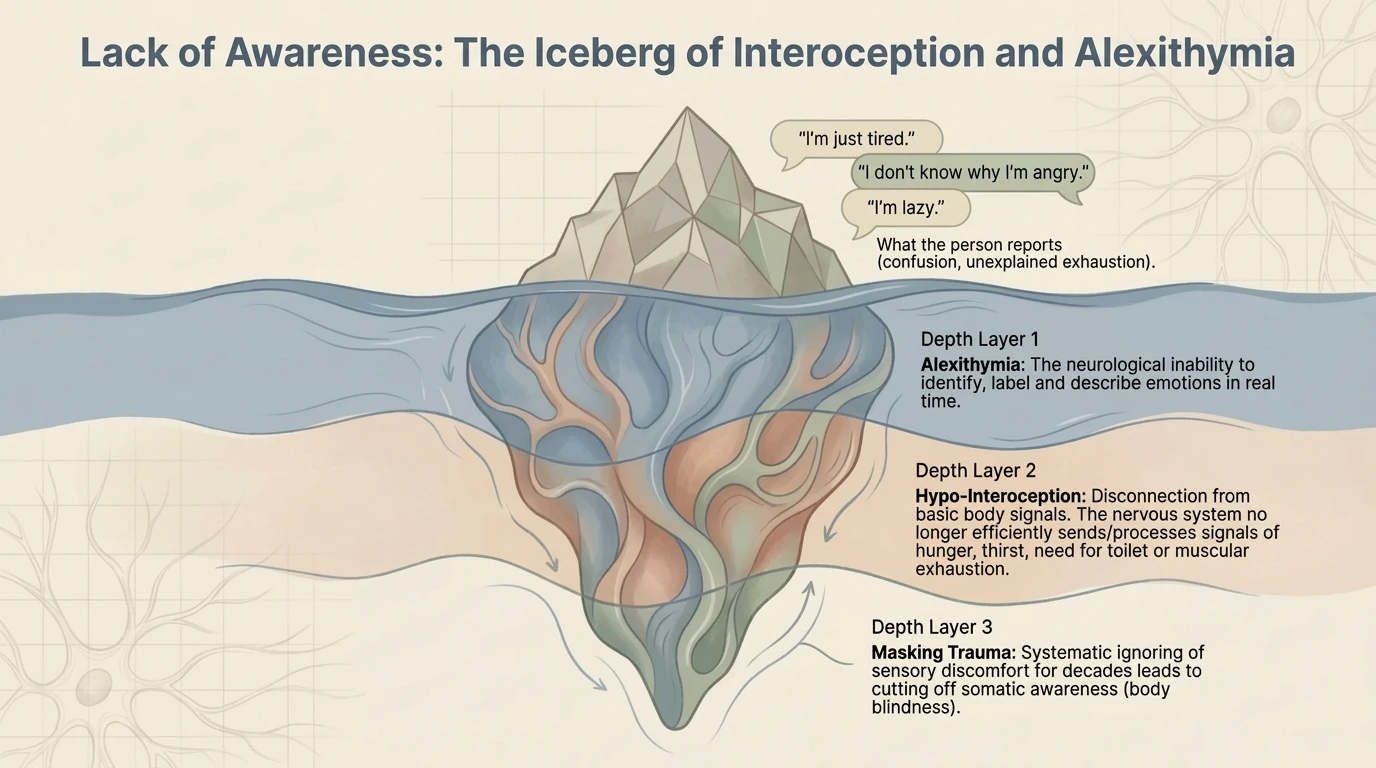
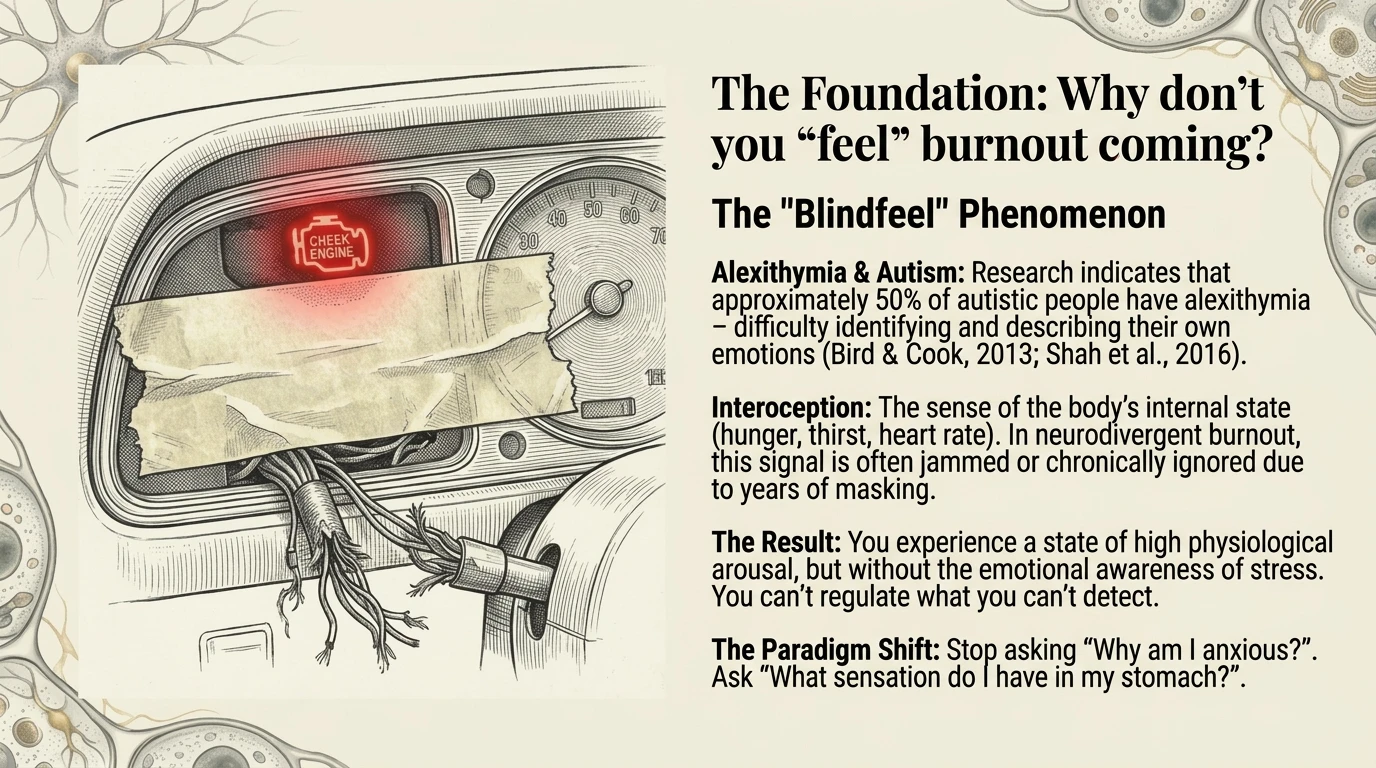
We discussed interoception in Part 3 — the ability to receive and interpret signals from inside the body. In 50-85% of autistic people, alexithymia makes these signals either absent or impossible to decode (Kinnaird et al., 2019). This isn't carelessness. It's a nervous system that doesn't deliver information on time.
That's why preventing neurodivergent burnout cannot depend on "listening to yourself." You need to build an external monitoring system — a traffic light that works even when you can't see the colors.
The Triad of Invisible Collapse
According to the anatomy of collapse model, unseen exhaustion is the sum of three forces acting simultaneously: Masking (suppressing neurodivergent traits to appear typical — drains the prefrontal cortex), Executive Fatigue (the constant effort to organize and plan in a chaotic world), and Sensory Overload (continuous processing of hostile environments without recovery breaks). When all three operate simultaneously, the nervous system "runs at maximum speed, without instruments, straight into the wall." The extended formula is: (High Stress + Lack of Accommodations + Masking) x Time = BURNOUT.
Early Warning Signs: Body vs. Mind
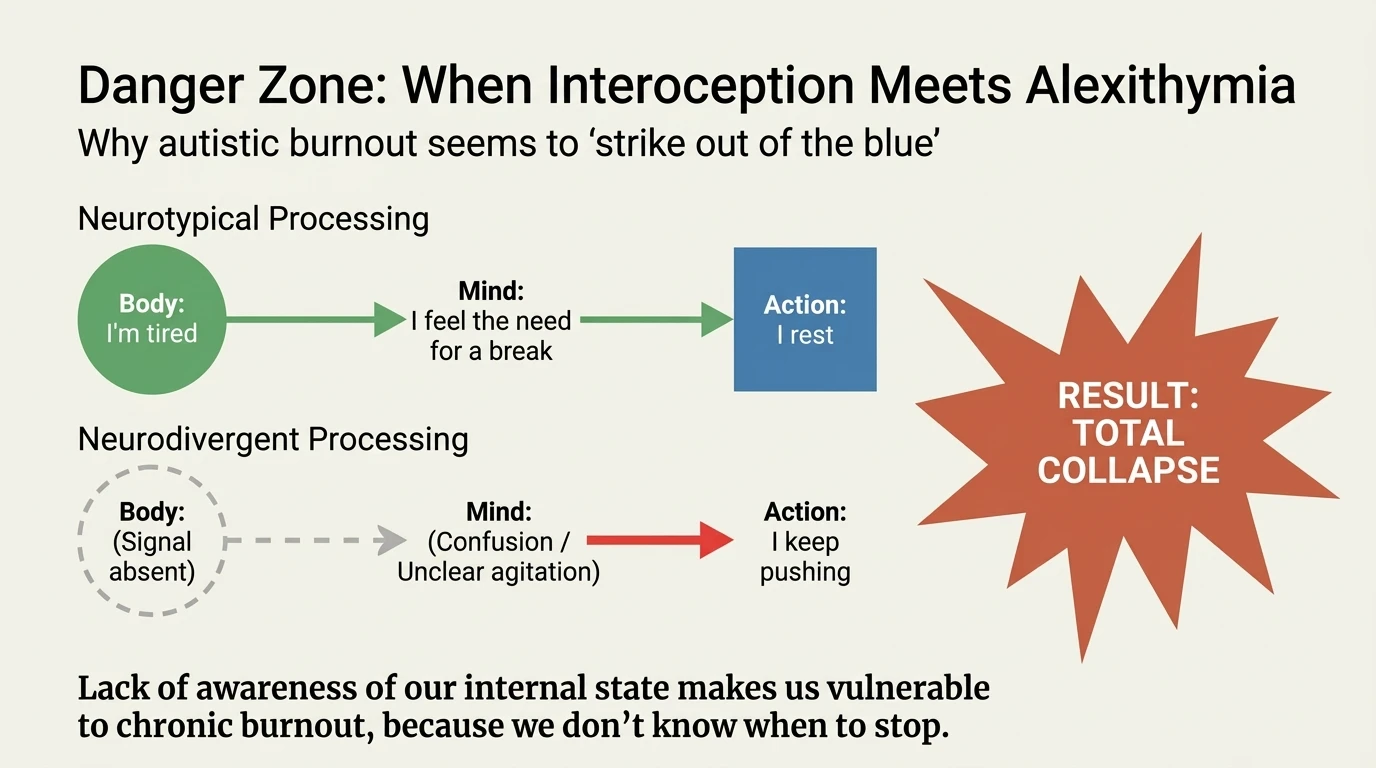
Burnout doesn't arrive overnight. It installs itself over weeks or months, with signals that you'll recognize in retrospect. The challenge is recognizing them prospectively — when you can still do something.
Body signals
First to appear, last to notice
- —Headaches or jaw tension become chronic
- —Fatigue does not improve with sleep — you sleep 10 hours and wake exhausted
- —Sensory sensitivity increases: sounds that were tolerable become unbearable
- —Eating and hydration become random — you forget to eat for hours
- —Stimming intensifies or, conversely, disappears completely (both are alarms)
- —Gastrointestinal problems without identifiable medical cause
Cognitive signals
Easier to observe, harder to recognize as burnout
- —Executive functions collapse: trivial decisions become overwhelming
- —Working memory declines — you forget what you wanted to do between rooms
- —Words stop coming: speech pauses lengthen, vocabulary simplifies
- —Special interests lose their intensity — the first serious red flag
- —Brain fog becomes permanent, not episodic
Relational signals
The ones others notice before you do
- —You withdraw from conversations, not just social events
- —Message responses lag hours, then days
- —Tolerance for demands vanishes: any request feels like aggression
- —Chronic irritability — you have been different lately becomes a refrain
Interoception as a Preventive Tool
If you can't feel your own body, you can learn. Not perfectly, not overnight — but enough to catch the signals before collapse.
Daily interoception micro-exercises (adapted from Kelly Mahler, 2024):
-
Muscle check: clench fists for 5 seconds, release, notice the contrast — repeat with shoulders, jaw, abdomen
-
Temperature scan: hold a cold glass, then a warm mug — notice where in the body you feel the change
-
Heart hunt: after 10 jumping jacks, place hand on chest, count beats for 15 seconds — build the connection to heart rate
-
Hunger noticing: before eating, close eyes and describe what you feel in the abdomen — not what you "should" feel The P.A.T.H. Exercise (adapted from Faith G. Harper, Unfuck Your Body, 2019): a structured interoception tool for people with alexithymia. The acronym guides four sensory channels:
-
P — Pressure: Where do you feel pressure in your body right now? In the shoulders, the jaw, the abdomen?
-
A — Air: How is your breathing? Shallow, deep, choppy? In the chest or the abdomen?
-
T — Tension: Where are you holding tension without realising? Deliberately clench that area for 5 seconds, then release.
-
H — Heat: Which areas of the body are warm? Which are cold? Body temperature is an interoceptive signal many ignore. P.A.T.H. works because it doesn't ask you to "feel what you feel" — an impossible instruction for someone with alexithymia. Instead, it directs attention toward concrete physical sensations, gradually building a sensory vocabulary that replaces the interoceptive void.
These exercises aren't relaxation. They're interoceptive training — rebuilding a connection that may never have fully functioned.
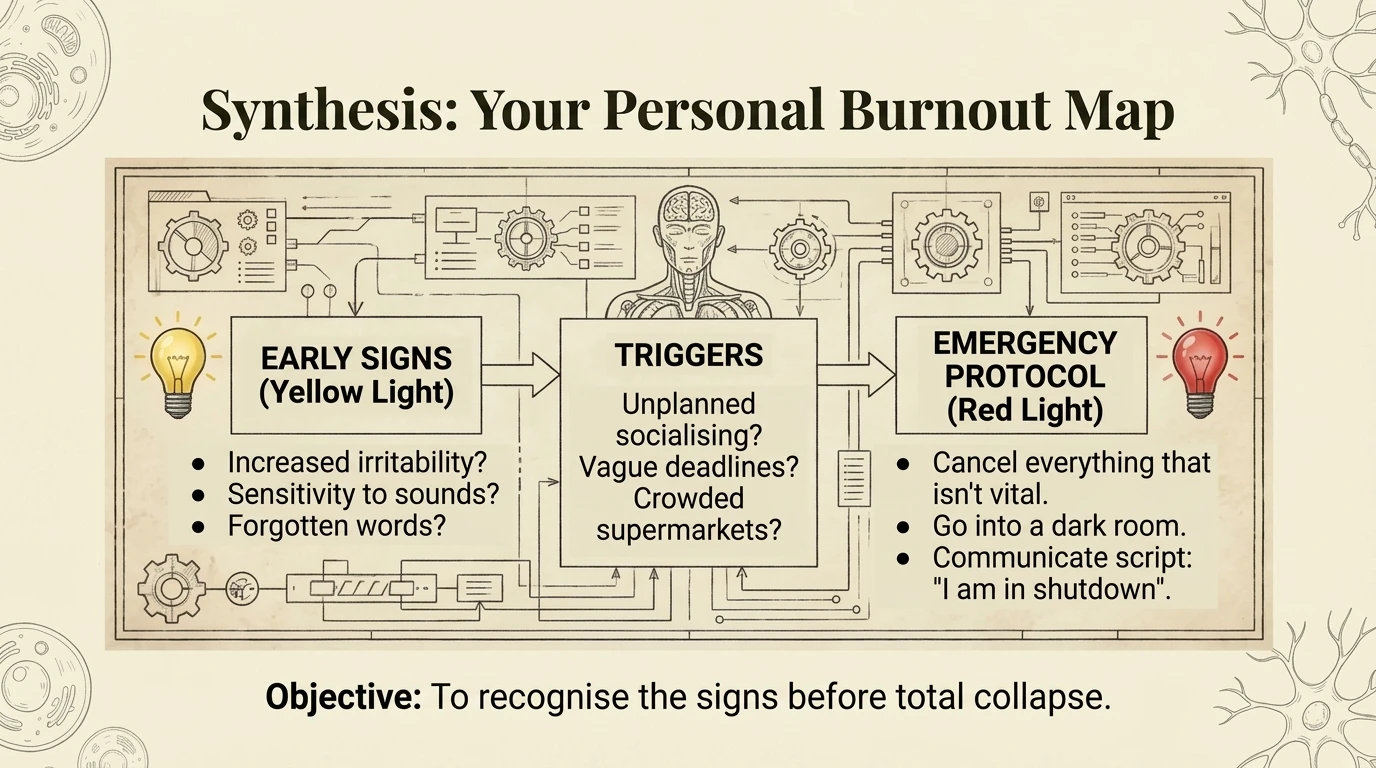
The Traffic Light System
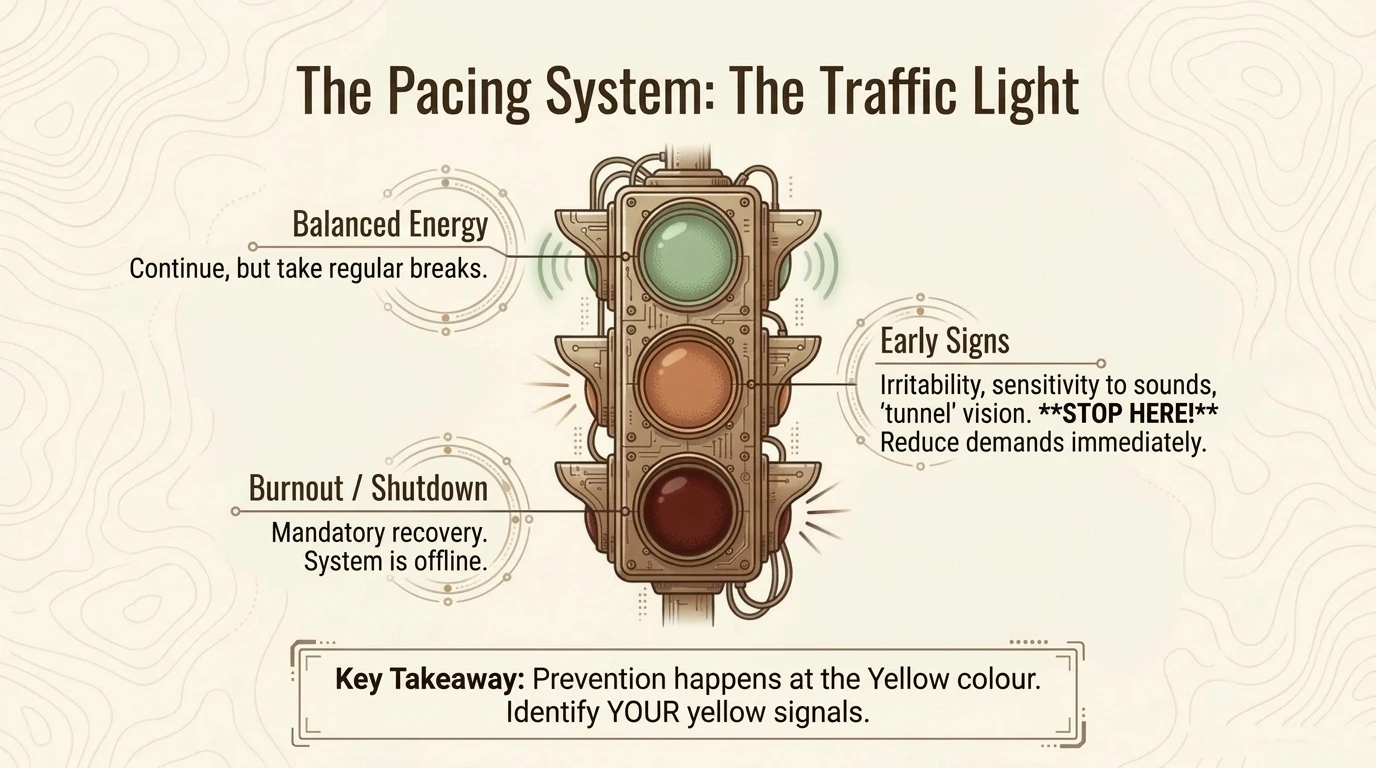
A simple, visual tool recommended by clinicians specialising in autistic burnout (Raymaker et al., 2020):
- Green: Energy is sufficient. You can complete the day's tasks without forcing yourself. Stimming is natural, special interests are active, sleep is restorative.
- Yellow: First signs of overload. Sensory sensitivity increases, executive functions stiffen, demand tolerance drops. This is the moment to act — not to "push through a little more."
- Red: Functional collapse is imminent or has begun. Skill loss, frequent shutdowns or meltdowns, inability to speak. Requires immediate withdrawal and radical rest. Assess yourself in the morning. Note it. Check at noon. Look for patterns. A month of traffic light journaling will show you exactly what moves you from green to yellow — and those transitions are your intervention points.
◆ ◆ ◆
2. Daily Energy Accounting
The Maja Toudal Framework
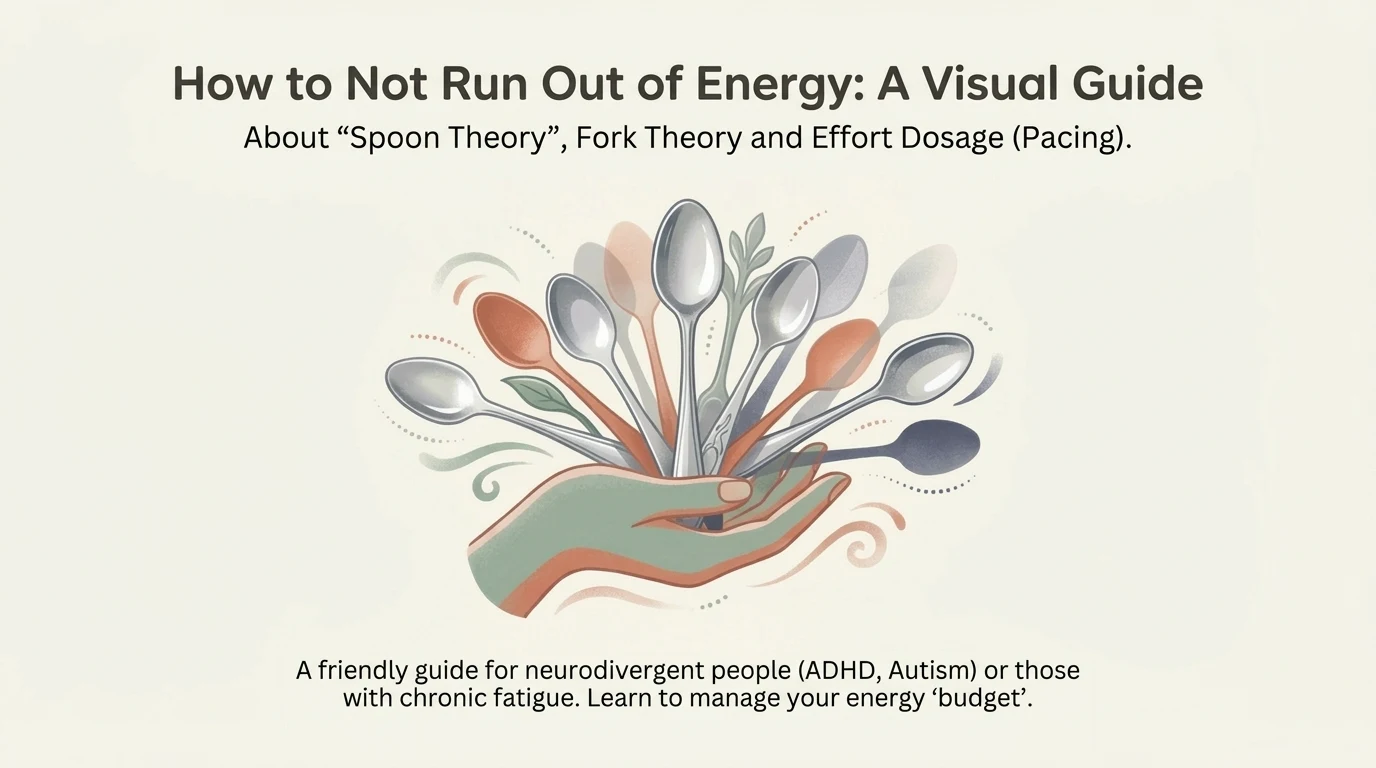
Maja Toudal, an autistic clinical psychologist, created a system that treats energy like a financial ledger (Toudal, cited in Neurodivergent Insights, 2023). The core idea: you don't have one type of energy. You have four. And each depletes and recharges differently.
The four energy types:
- Body Energy — physical, sensory, motor energy. Depleted by movement, pain, sensory overload. Recharged by sleep, food, sensory comfort.
- Brain Energy — cognitive energy, executive functions, decision-making. Depleted by planning, multitasking, navigating bureaucracy. Recharged by familiar repetitive activities, special interests, absence of demands.
- Emotional Energy — emotional processing, empathy, affect regulation. Depleted by conflict, uncertainty, excessive empathy. Recharged by co-regulation with safe people, processing (writing, therapy), nature.
- Masking Energy — social performance, stimming suppression, forced eye contact. Depleted by any interaction where you're not fully yourself. Recharged ONLY by mask-off time — not by "pleasant socialising" (which still costs masking if you're not with fully safe people).
The Realistic Daily Budget
In the morning, assess each energy type on a 0-10 scale. Plan your day based on what you have, not what you wish you had.
If you wake with Body Energy 8/10 but Masking Energy 3/10, your day can include physical activity but NOT social meetings with strangers. If Brain Energy is 4/10, it's not the day for financial decisions or forms.
The Two-Thirds Principle (Raymaker et al., 2020): Plan to do only about two-thirds of what you think you can manage that day. The one-third margin is your insurance policy — it covers the unexpected, transitions, and hidden costs you didn't calculate.
Beyond Spoon Theory
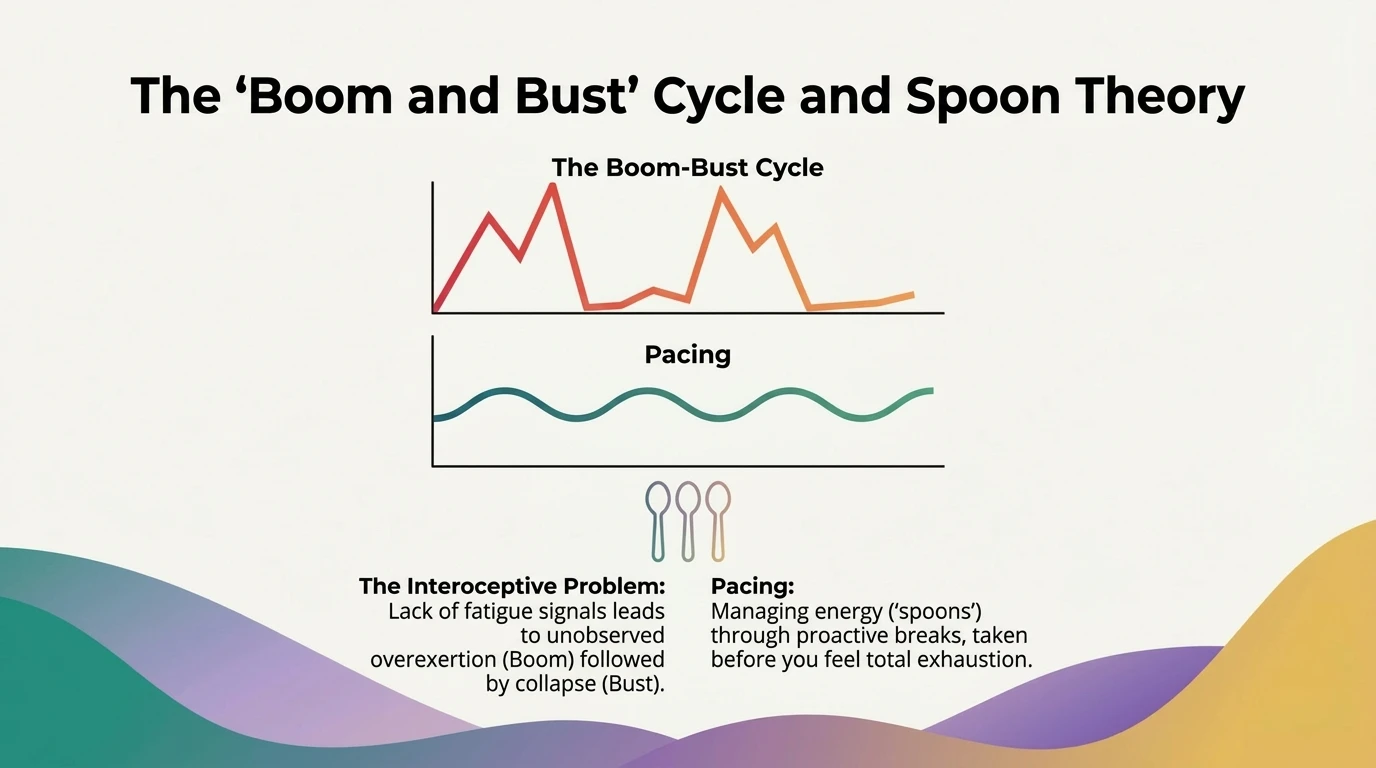
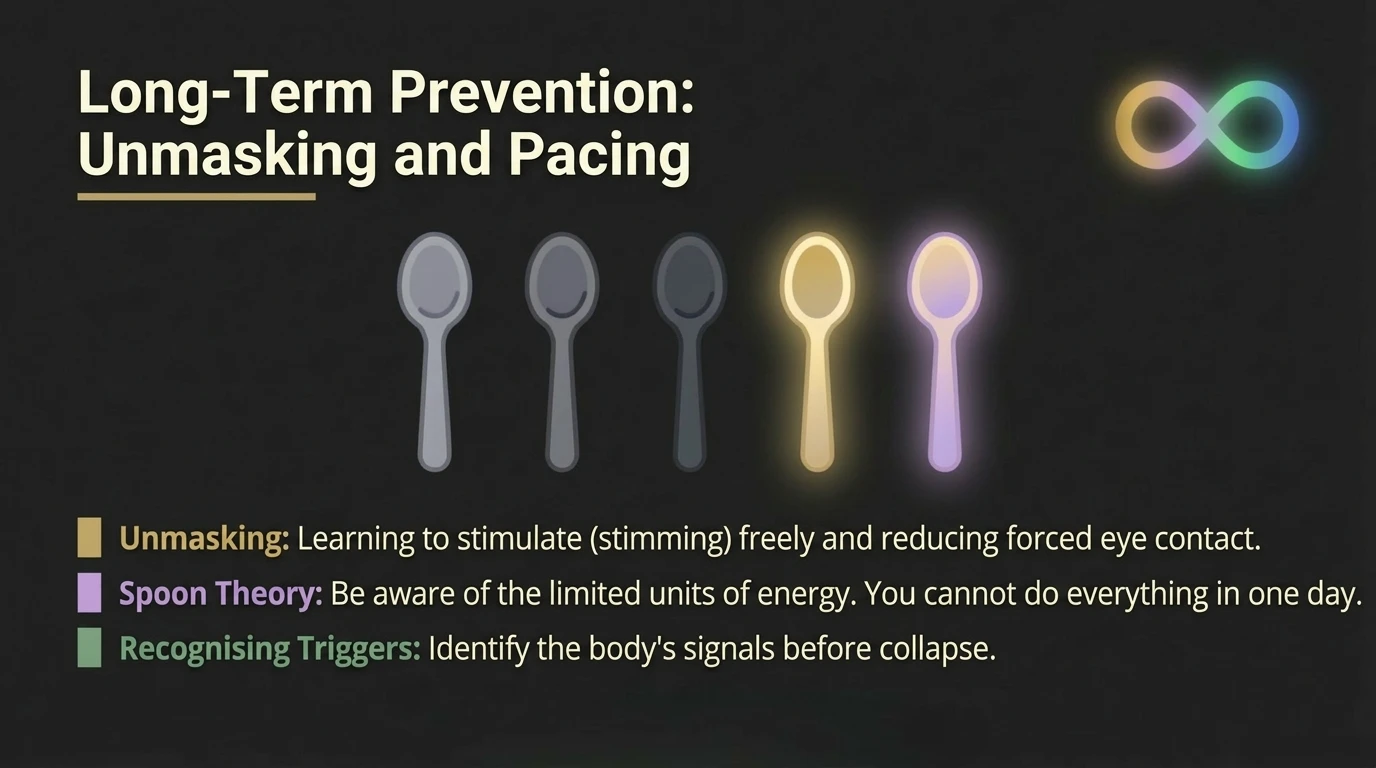
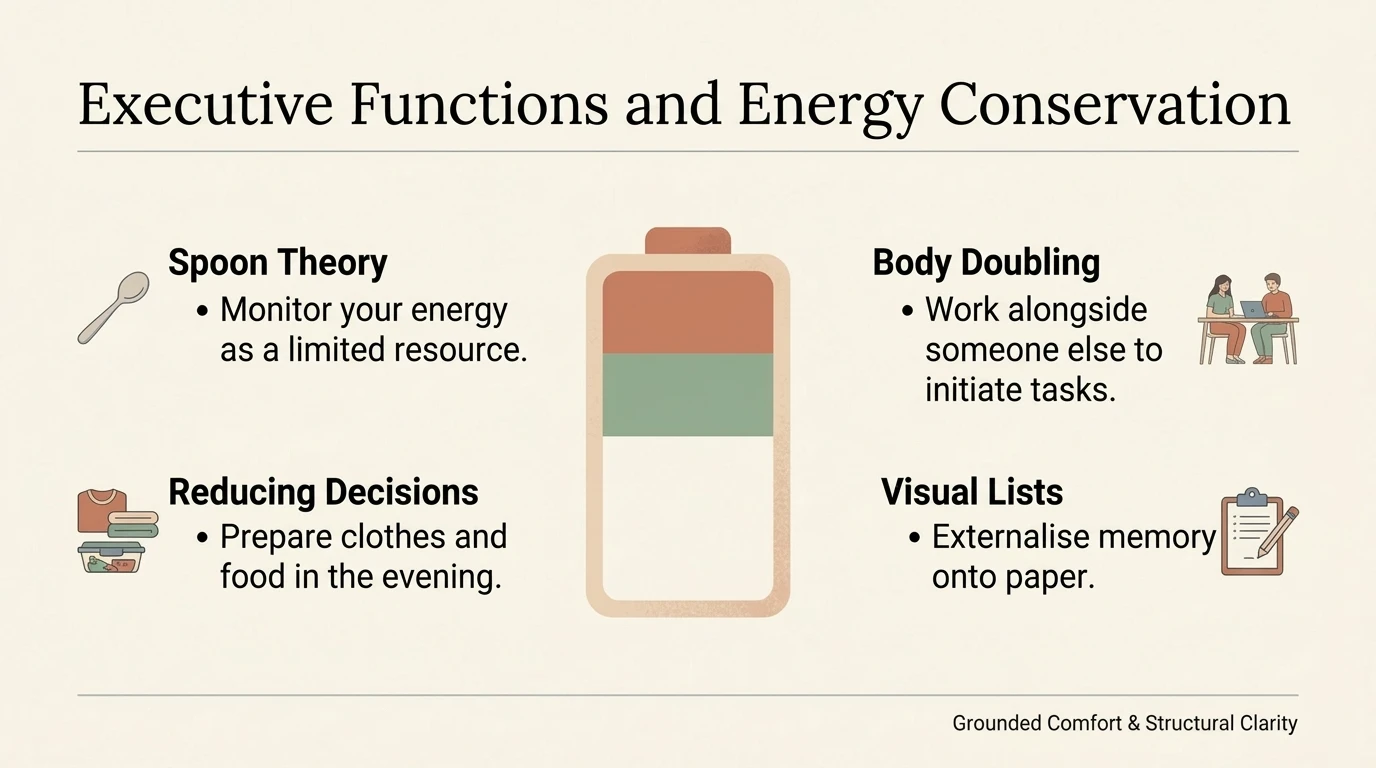
Spoon Theory (Miserandino, 2003) was revolutionary — imagine starting your day with 12 spoons of energy. Every action (getting out of bed, showering, work) costs a spoon. Neurotypical people have unlimited spoons (or at least enough). We have a fixed reserve. When they're gone, they're gone. The difference lies in being forced to make conscious choices where the rest of the world doesn't even have to think.
The concept of "Borrowing from Tomorrow" illustrates the danger perfectly: if you've run out of spoons but push through, you don't create energy from nothing — you borrow from tomorrow's supply. The consequence: tomorrow you start already depleted, with only 6 spoons instead of 12. The continuous borrowing cycle inevitably leads to burnout.
Fork Theory (Bross, 2018) complements the model by focusing on accumulated stressors — the "forks" stuck in you. "Stick a fork in me, I'm done." If spoons are your reserves, forks are the stress factors that "stab" you. A fork can be unnoticed hunger, a clothing label that scratches, or a repetitive noise. The fork limit: you can endure one or two, but at the tenth fork the collapse (meltdown) arrives, no matter how small the last problem is.
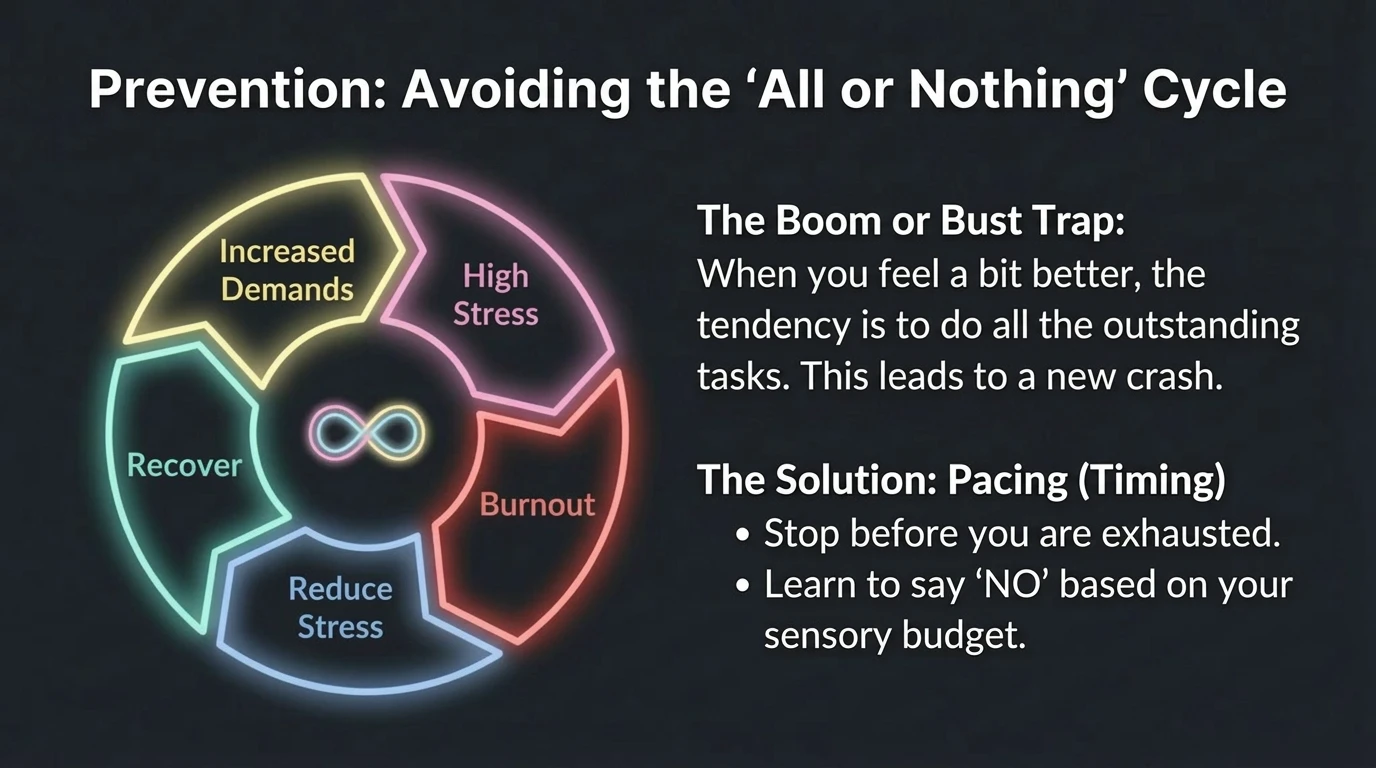
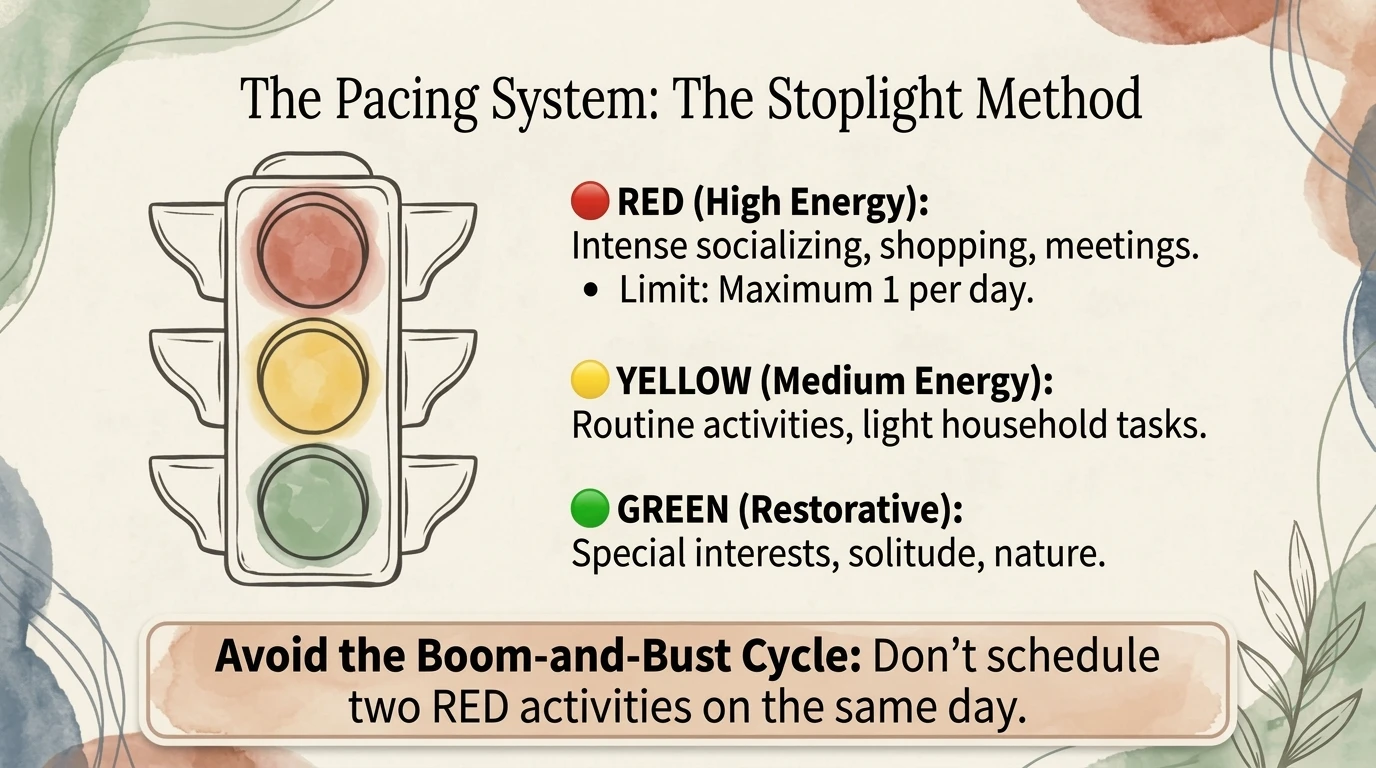
The Boom-and-Bust Cycle — the most common destructive pattern: Lyric Rivera (Workplace NeuroDiversity Rising, 2022) describes the cycle nearly all my neurodivergent clients recognise: on good days, you do everything — compensating for lost days, overexerting from enthusiasm or guilt, finally feeling "normal." Then the crash follows: entire days in bed, functional incapacity, shame. The cycle repeats, each crash deeper than the last. Pacing means resisting the temptation to "make the most" of good days — doing 60-70% of capacity even when you feel you can do 100%, so that tomorrow you still have 60-70% instead of zero.
Combined: spoons = what you have to spend. Forks = what costs you without your noticing. Energy Accounting = the ledger that tracks both.
Pacing: The Art of Living Within Your Energy Envelope
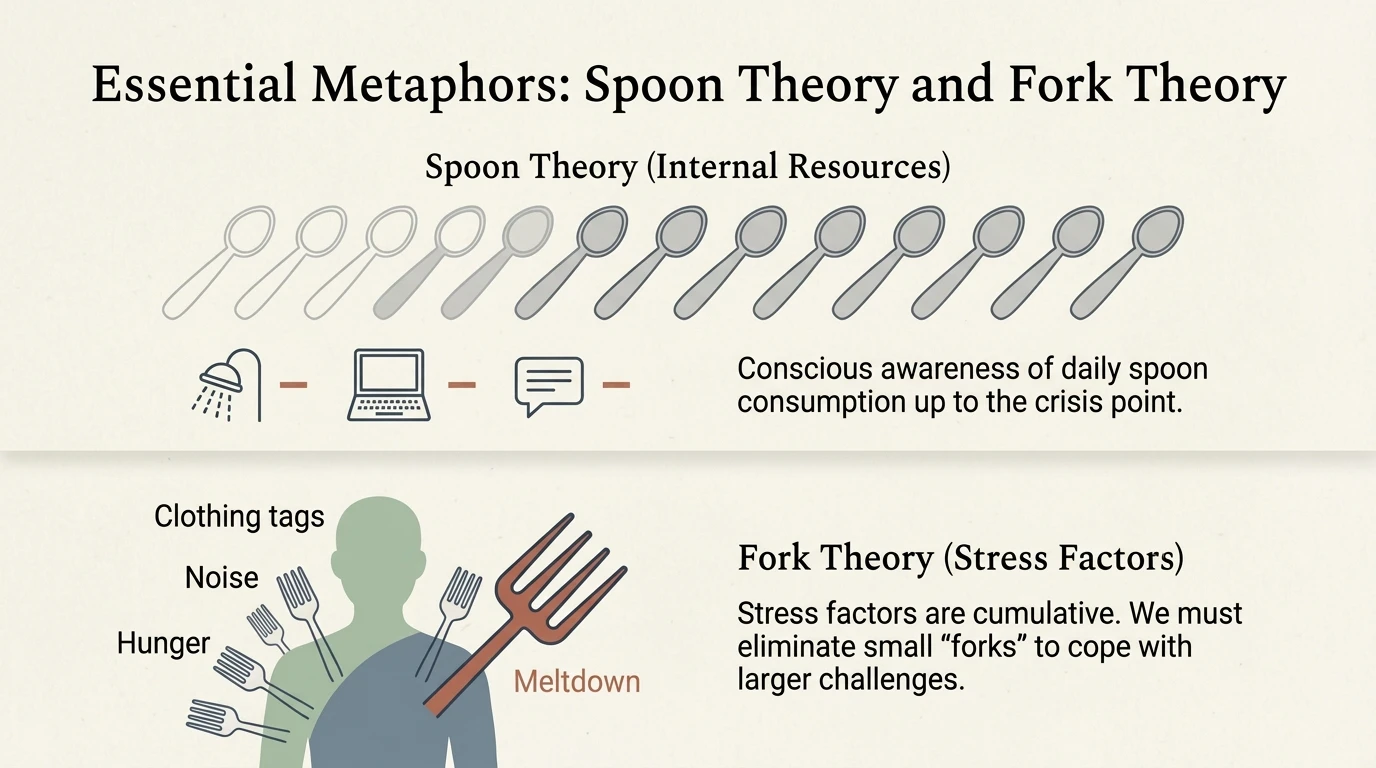
Pacing means managing the balance between activity and rest to avoid collapse. It is the art of living within your "energy envelope." It doesn't mean doing nothing. It means doing the essential things without completely emptying your battery. The key: finding calm in chaos.
◆ ◆ ◆
3. Architecting a Sustainable Life
Not "Balance" — Sustainability
The concept of "work-life balance" is a neurotypical illusion. It assumes you work 8 hours, rest 8 hours, live 8 hours — everything neatly balanced. For a neurodivergent nervous system, this arithmetic is absurd: those 8 work hours cost 12 hours of energy, rest requires active effort (finding the right environment, processing the day's sensory load), and "life" includes all the executive demands neurotypicals handle on autopilot.
Sustainability doesn't mean balance. It means a rhythm you can maintain indefinitely without going into energy debt.
Redesign the Environment, Don't Force Yourself to Adapt
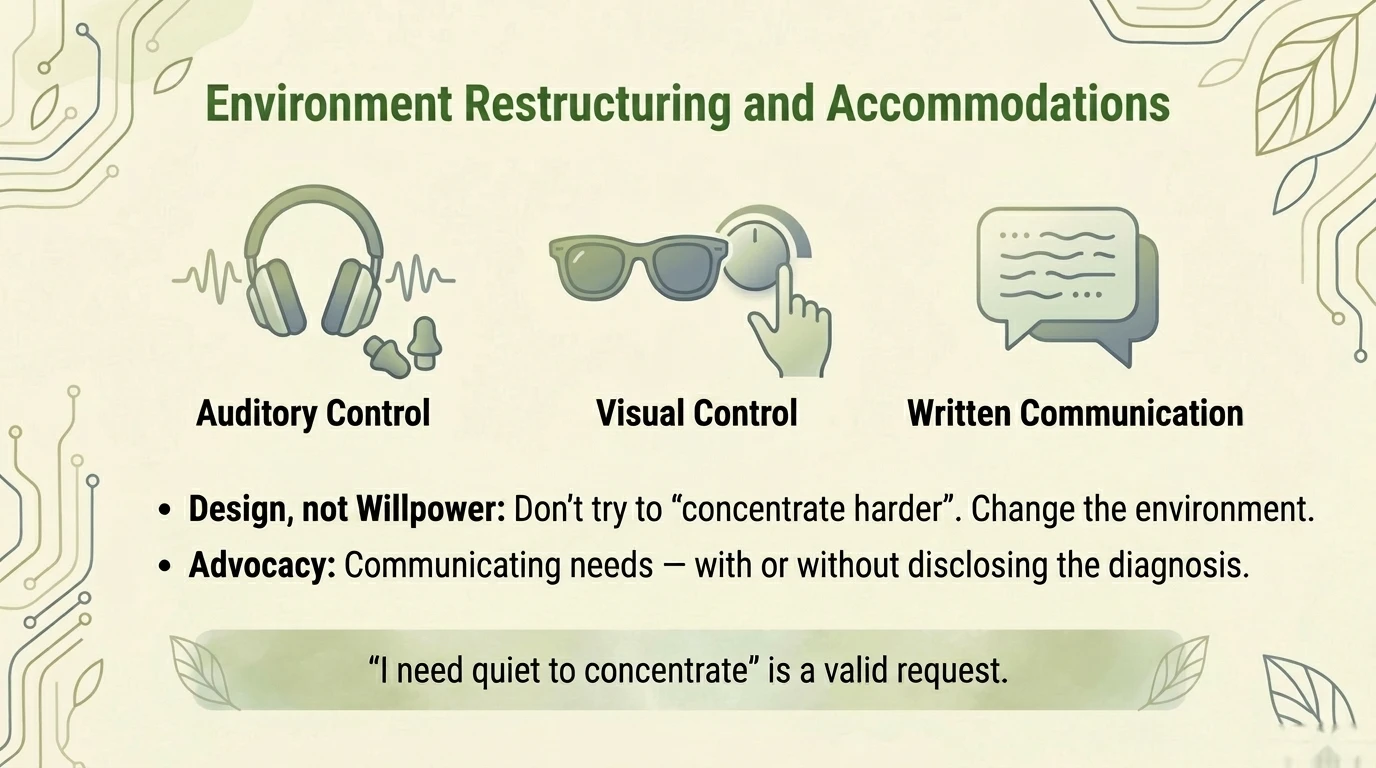
Burnout is an environmental problem, not a personal deficiency (Mantzalas et al., 2022). Therefore, primary prevention means modifying the environment. Willpower doesn't work against biology. Accommodations do.
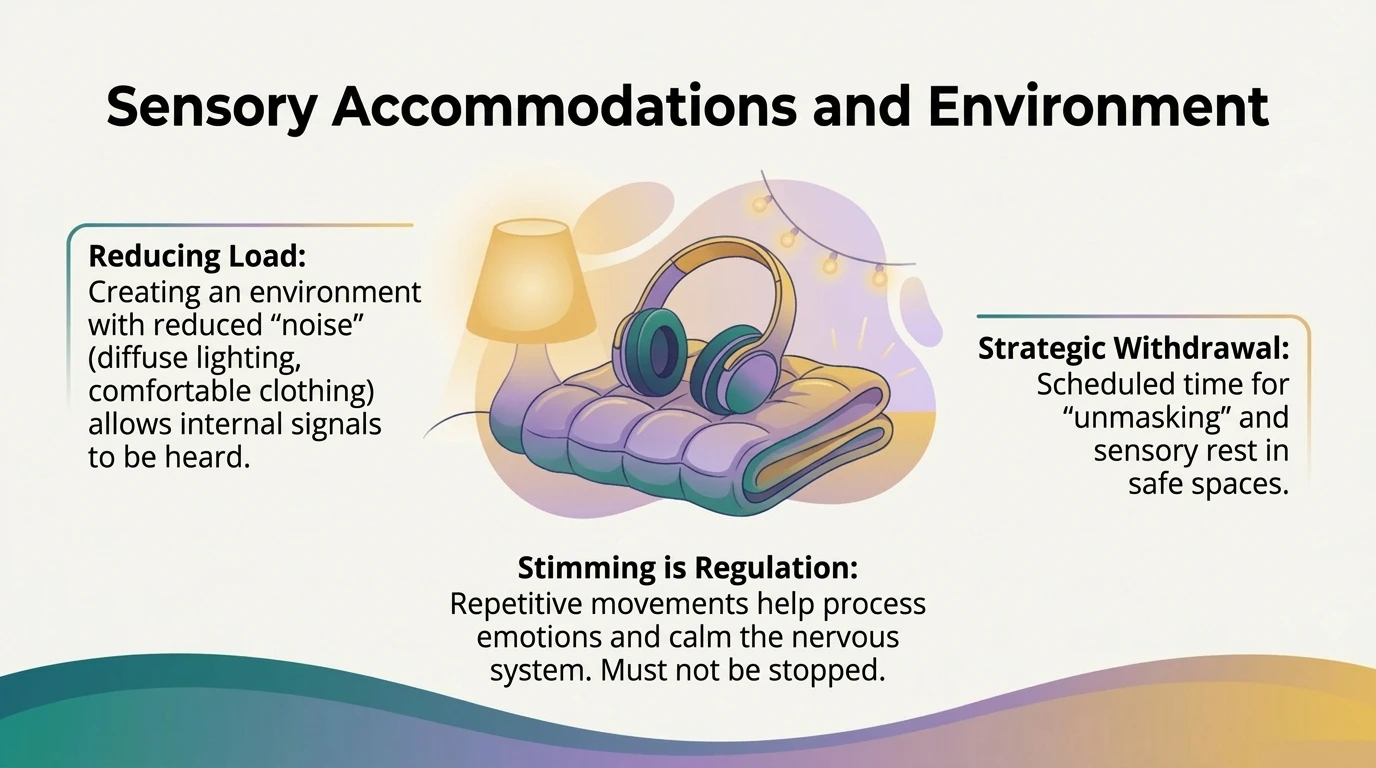
At home — The Sensory Sanctuary:
- Dimmable lights or warm-temperature lamps (2700K), never fluorescent
- Sound insulation in the bedroom or office
- Stickers over standby LED lights on appliances
- Clear zones: a space where there are no demands — not even implicit ones
- Weighted blanket, fidget objects within reach, comfortable textures At work — Accommodations (with or without disclosure):
Without disclosure (no need to explain why):
-
Active noise-cancelling headphones
-
Asynchronous communication when possible (email instead of meetings)
-
Deep work time blocks in the calendar (no interruptions)
-
Positioning with back to wall (reducing peripheral stimuli) With disclosure or medical support:
-
Hybrid or remote work
-
Flexible schedule respecting individual circadian rhythm
-
Reduced fluorescent lighting or relocation to a quieter space
-
Written instructions instead of verbal for complex tasks (reduces working memory load)
-
No-meeting time blocks, permission to turn off camera Workplace self-advocacy: It's not weakness to reveal your medical diagnosis. Focus on your work style and efficiency, not on the label.
Routines That Respect the ND Circadian Rhythm
Research suggests that autistic people and those with ADHD frequently have a delayed circadian rhythm — evening chronotypes forced to function in a morning world (Hrozanova et al., 2020; Coogan & McGowan, 2017). Forcing a morning schedule can itself be a burnout factor.
A sustainable routine:
- Aligns with the person's natural energy, not social convention
- Includes transition time between activities (not back-to-back)
- Schedules cognitive tasks during the individual peak window
- Reserves evenings for decompression, not "catching up" on missed tasks
- Accepts that a productive day does NOT mean a full day
Exit Plans: When the Environment Is Unsustainable
Sometimes modifying the environment isn't enough. A toxic workplace, an exhausting relationship, a hyperstimulating living situation — some situations need exit, not adaptation.
An exit plan isn't an escape plan. It's a safety tool prepared before crisis:
- Emergency savings (even small amounts increase sense of control)
- Professional alternatives explored before collapse
- Support network activated proactively, not reactively
- Personal limit defined: "If signal X appears Y times, I activate the plan"
◆ ◆ ◆
4. Masking Budget: When, How Much, and How to Reduce
The Real Cost of Masking
Masking — suppressing natural autistic behaviours and performing neurotypical ones — is the single largest energy drain in a neurodivergent person's life (Hull et al., 2017; Cook et al., 2021). Research directly correlates it with autistic burnout, chronic exhaustion, and suicidality (Cassidy et al., 2018; Mantzalas et al., 2022).
But "stop masking" isn't useful advice. Masking arose from necessity — for physical safety, social acceptance, economic survival. Eliminating it completely can be as dangerous as maintaining it.
"Safe to Unmask" vs. "Strategic Masking" Contexts
Not all environments are equal. The goal isn't total elimination of masking but masking in moderation — strategic, conscious, with planned recovery (Price, 2022; Cook et al., 2021).
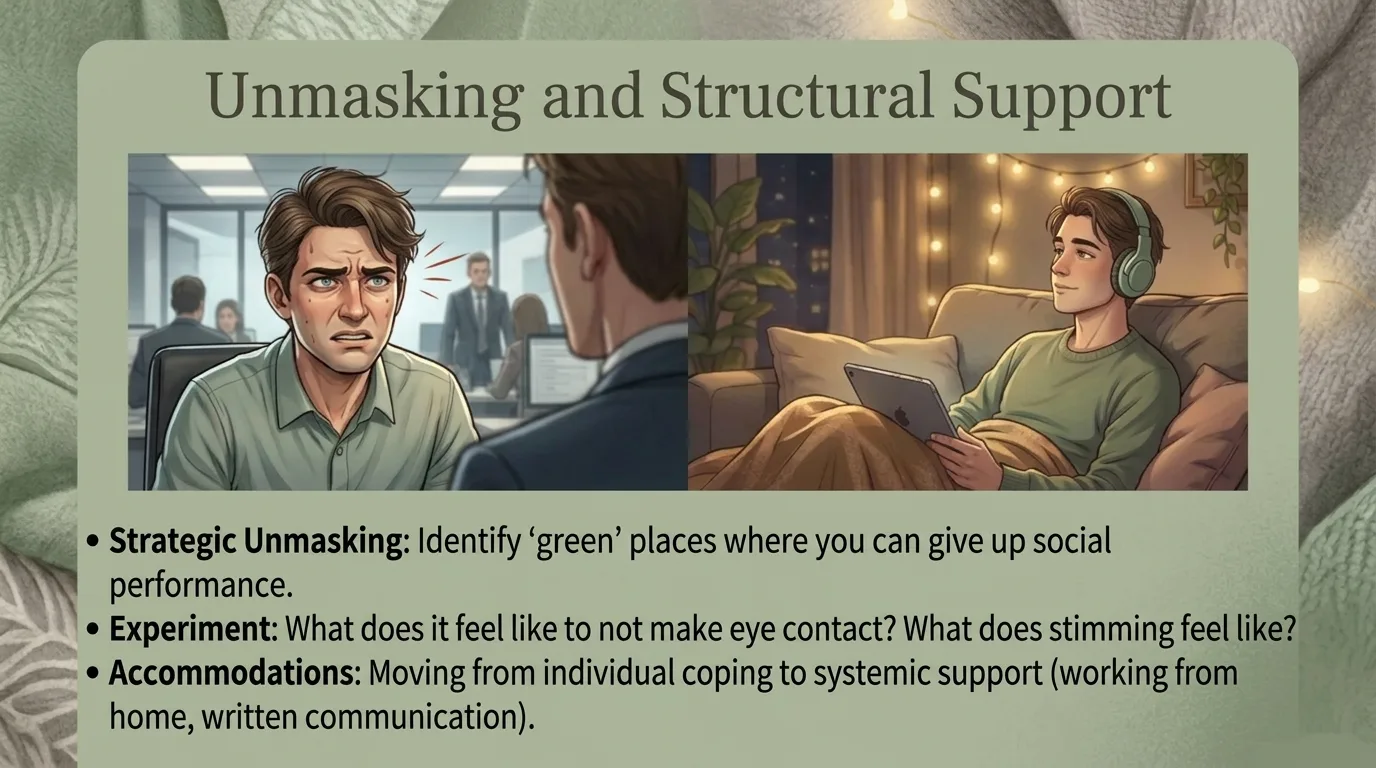
Safe to unmask (zero masking, active recovery):
-
At home, alone or with a fully accepting partner/family
-
With "strawberry people" — Devon Price suggests adding a strawberry emoji next to these contacts: the people with whom you can be completely yourself (Price, 2022)
-
In the neurodivergent community (inter-autistic co-regulation)
-
With your ND-informed therapist Moderate masking (conscious, planned, with time limits):
-
At work (with scheduled decompression breaks)
-
In conventional social interactions (with a prepared exit plan)
-
In medical or bureaucratic contexts (strategic masking to get what you need) Dangerous masking (avoid or minimise):
-
Masking while in yellow/red on the traffic light
-
Masking without planning post-interaction recovery
-
Masking forced by others ("act normal")
The Gradual Unmasking Protocol
Unmasking is not merely a psychological choice — it is a neurobiological necessity. Chronic masking permanently activates prefrontal cortex inhibition circuits, consuming glucose and cognitive resources at an unsustainable rate. Neuroimaging studies show that autistic individuals who mask intensely exhibit increased activation in the anterior cingulate cortex and insula — regions associated with conflict monitoring and self-regulatory effort (Hull et al., 2019; Lai et al., 2019). In other words, the brain constantly works in overdrive to maintain a performance that appears "effortless" from the outside.
Unmasking doesn't happen overnight. It's a process:
- Identify: Which behaviours are authentic and which are mask? (Many late-diagnosed people don't know.)
- Start in safe environments: Allow yourself to stim at home. Drop forced eye contact with your partner. Say "I need quiet" without justifying.
- Expand gradually: One authentic behaviour at a time, in one context at a time. Not everything, everywhere, all at once.
- Monitor: Observe what happens when you reduce masking — energetically, emotionally, relationally.
- Accept: Some contexts will require strategic masking. That's not failure — it's conscious survival. Important intersectional note: For neurodivergent people who also belong to other marginalised groups (LGBTQ+, ethnic minorities, etc.), masking also serves as protection against direct discrimination. The unmasking decision must always be evaluated in the context of real safety, not just the therapeutic ideal (Cook et al., 2021; Pearson & Rose, 2021).
◆ ◆ ◆
5. Safety Nets: What to Have Ready
The Co-Regulation Network (People, Not Just Strategies)
Individual strategies are necessary but insufficient. The human nervous system is built for co-regulation — to calm in the presence of other safe nervous systems (Porges, 2011).
"Strawberry People" — Identify 2-3 people with whom you can be completely yourself. They don't need to be many. They need to be safe. Actively invest in these relationships — they are energy deposits, not withdrawals.
Inter-autistic resonance — Spending time with other autistic people allows effortless communication and completely eliminates masking costs (Crompton et al., 2020). If you don't have access to a physical autistic community, online communities can serve the same co-regulation function.
Body doubling — the physical or virtual presence of a safe person working alongside you activates executive functions without imposing social demands (ACM Transactions on Accessible Computing, 2024). You don't need to interact. Presence is enough.
Executive function externalisation — a partner, trusted friend, or therapist can temporarily take over some planning and decision-making burden, reducing cognitive load during vulnerable periods.
The Sensory Sanctuary at Home
Not a whole room (though ideally, yes). It can be a corner:
- Controllable lighting (dimmable or completely off)
- Noise cancellation (headphones, sound insulation, white noise machine)
- Comfortable textures within reach (weighted blanket, fidget objects, pillow)
- Zero demands — not even implicit. Nobody asks you anything. Nobody expects anything.
- Preferred sensory stimulation available (warm lights, ambient music, familiar scent) This space is not a luxury. It is survival infrastructure.
The Written Crisis Plan (Meltdown/Shutdown Protocol)
The crisis plan must be established before exhaustion sets in — because during a meltdown or shutdown, access to higher executive functions and verbal language drops dramatically (Phung et al., 2021).
Components of an ND crisis plan:
-
Shorthand communication: create pre-established code words or emojis (e.g., a cloud = "I'm in shutdown, I need silence") for when verbal capacity is lost
-
TIPP Protocol (adapted from DBT for ND needs): Temperature — ice on face or hands (autonomic nervous system reset)
- Intense exercise — short, intense movement (30 seconds)
- Paced breathing — rhythmic breathing (exhale longer than inhale)
- Paired muscle relaxation — contract-release muscle groups
-
"Store and Restore": Proactively block calendar time — quiet hours BEFORE a demanding event, followed by a recovery window AFTER
-
Emergency contact list: Strawberry people, therapist, crisis lines — all in one accessible place (not in a file you have to search for)
-
Suicidality safety plan: Autistic burnout correlates with suicidal ideation in approximately 44% of those affected (Pelton & Cassidy, 2017; Raymaker et al., 2020). A complete crisis plan must explicitly address this reality.
ND-Informed Therapist as Backup
Not a therapist who "has heard of autism." A therapist who:
- Understands the difference between autistic burnout and clinical depression
- Doesn't apply behavioural activation during burnout
- Uses neuroaffirmative approaches (ACT, sensory-adapted DBT, somatic therapy)
- Accepts atypical communication (long pauses, non-verbalisation, written communication)
- Views masking as a survival mechanism, not a "social skill"
◆ ◆ ◆
6. Long-Term Monitoring: How Not to "Forget" You're Vulnerable
Why You "Forget"
After a recovery period, something insidious happens: you start feeling good. And your brain — adapted for survival, not prevention — interprets "good" as "normal" and "normal" as "done, no need to stay vigilant." Masking reinstalls itself silently. The boundaries you painstakingly set erode, one by one. And one day, with a terrible sense of deja vu, you find yourself on the ground again.
Long-term monitoring isn't paranoia. It's lucidity.
Monthly Check-In Template
Once a month, 15 minutes. Non-negotiable.
- Average energy per week (body/brain/emotions/masking) — 0-10 each
- Frequency of yellow/red states in the past month
- Special interests: still active? Or have they faded?
- Masking: has it increased? Where? Why?
- Body signals: new pains, chronic fatigue, increased sensory sensitivity?
- Relationships: have you withdrawn? Are you responding to messages?
- Executive functions: are simple decisions harder than last month?
- Global score: Green / Yellow / Red If two consecutive months are yellow, NOW is the time to reduce demands. Not next month.
Seasonal Patterns: The Burnout That Comes with the Calendar
Energy and sensory tolerance are not static. They fluctuate based on biological and environmental factors you can learn to anticipate:
Hormonal fluctuations: sensory sensitivities can intensify dramatically in the premenstrual week (Kanfiszer et al., 2017). Perimenopause and the postpartum period significantly increase burnout risk through their impact on cognition and executive functions.
Seasonal transitions: clock changes, summer-to-autumn transitions, shifts in temperature/light — each is a sensory cost the brain pays without notifying you.
Peak social periods: winter holidays, weddings, reunions, the start of the school or work year — all bring increased executive and social demands.
Anniversaries: the anniversary of a diagnosis, the anniversary of a previous burnout episode, losses — can reactivate vulnerability without an apparent trigger.
Polyvagal Ladder Journaling
Adapted from Deb Dana (2020), a simple daily tool:
- Morning: where are you on the polyvagal ladder? (Ventral vagal = safe, connected / Sympathetic = activated, anxious / Dorsal vagal = collapsed, shutdown)
- Three times daily: note current state + what triggered the shift
- Evening: review the day's path on the ladder
- Weekly: identify patterns — does the same person/situation/place trigger the same state?
- Monthly: check whether time in ventral vagal is increasing or decreasing This journal transforms something invisible — the state of the autonomic nervous system — into visible, actionable data.
◆ ◆ ◆
7. Additional Sustainability Tools
The Dopamine Menu (for ADHD/AuDHD Profiles)
Created by Jessica McCabe (How to ADHD), this tool directly addresses ADHD's dopamine deficit. It's a pre-curated list of stimulating activities organised like a restaurant menu:
- Appetisers (1-5 minutes): a favourite song, 10 jumping jacks, a short clip, a fidget
- Entrees (20-60 minutes): special interest, movement, an energising conversation
- Sides (activities to pair with boring tasks): music, body doubling, changing locations
- Desserts (high dopamine, needs boundaries): gaming, online shopping, doom-scrolling
- Specials (rare rewards, scheduled): trips, new experiences, events The goal: when you're depleted and the brain demands stimulation, you already have a list to choose from — eliminating the executive burden of deciding "what should I do?"
Monotropic Flow Protection
Based on monotropism theory (Murray et al., 2005), this framework works with autistic attention, not against it:
- Flow scheduling: block uninterrupted time daily for the special interest
- Interest bridging: connect required tasks to the current interest ("I need to do laundry — my favourite shirt is in there")
- Transition warnings: 10-5-2-1 minute countdown before needing to shift the attention tunnel
- Split prevention: eliminate unnecessary multitasking — it's sensorially and cognitively costly
- Recovery time: buffer after forced multi-channel experiences
Declarative Language (for PDA Profiles)
For people with PDA profiles (Persistent Drive for Autonomy), even self-imposed demands activate the threat system. Reframing into declarative language reduces the load:
| Demand Language | Declarative Reframe | |---|---| | "I need to take my medication" | "My medication is on the nightstand" | | "I should exercise today" | "My body might enjoy some movement" | | "Clean the kitchen" | "I notice there are dishes in the sink" | | "Reply to that email" | "There's an email waiting" |
This isn't trickery. It's neuroscience: the nervous system responds to the linguistic frame, not just the content (PDA Society UK, 2025).
◆ ◆ ◆
8. The Final Message of the Series
You Are Not Broken. You Are Exhausted in a World That Wasn't Built for You.
This is the "Anatomy of Neurodivergent Burnout" series — five articles, but one message: neurodivergent burnout is not a personal defect. It's not a lack of willpower, organisation, or resilience. It is the predictable, scientifically documented result of an atypical nervous system operating in an environment that didn't account for it.
Together we've covered:
- Part 1: What neurodivergent burnout is and why it's not occupational burnout
- Part 2: Stages and signs — from first crack to collapse
- Part 3: External factors, lost interoception, and systemic barriers
- Part 4: Recovery — clinical protocols, polyvagal theory, reintegration
- Part 5 (here): Prevention and sustainability — how not to get there again The equation isn't complicated:
Fewer demands exceeding capacity + Consistent monitoring + Adapted environment + Safety net = A nervous system that can function indefinitely.
But the equation is hard to implement in a world that wasn't built for you. And it's perfectly okay to need help.
A Call to Action
If you recognised yourself in this series — if the signs, stages, factors, and exhaustion sounded familiar — you don't have to do this alone.
A neuroaffirmative psychotherapist won't ask you to "be more resilient." Won't diagnose you with depression when you have burnout. Won't tell you "everyone's tired." They'll understand the difference. And they'll work with your nervous system, not against it.
Schedule an evaluation session. Not when you reach collapse — now, while you still can.
This concludes the complete "Anatomy of Neurodivergent Burnout" series. If you've made it this far, you've invested time and attention in understanding yourself. That is not a small thing. That is, in fact, the first step of prevention: knowing what you are, what you need, and giving yourself permission to ask.
Ready to take the next step?
Neuroaffirmative therapy means working with your brain, not against it. Schedule an initial consultation.
Schedule an Initial Consultation →
Resources and support:
National Suicide Prevention Lifeline (US): 988 (call or text, 24/7)
Crisis Text Line: text HOME to 741741
Samaritans (UK): 116 123 (24/7)
Autism Society: autismsociety.org
CHADD (ADHD): chadd.org
References
- ACM Transactions on Accessible Computing (2024). Body doubling with ND participants.
- Botha, M., & Frost, D. M. (2020). Extending the minority stress model. Society and Mental Health, 10(1), 20-34.
- Bross, L. A. (2018). The Fork Theory. jenrose.com
- Cassidy, S., et al. (2018). Risk markers for suicidality in autistic adults. Molecular Autism, 9(1), 42.
- Coogan, A. N., & McGowan, N. M. (2017). Chronotype and ADHD. ADHD Attention Deficit and Hyperactivity Disorders, 9(3), 129-147.
- Cook, J., et al. (2021). Camouflaging in autism: A systematic review. Clinical Psychology Review, 89, 102080.
- Crompton, C. J., et al. (2020). Autistic peer-to-peer information transfer. Autism, 24(7), 1704-1712.
- Dana, D. (2020). Polyvagal Exercises for Safety and Connection. W. W. Norton.
- Feldman Barrett, L. (2017). How Emotions Are Made. Houghton Mifflin Harcourt.
- Hrozanova, M., et al. (2020). Sleep and body clock disruption in autism. Molecular Autism, 11(1).
- Hull, L., et al. (2017). Social Camouflaging in Adults with ASC. J Autism Dev Disord, 47(8), 2519-2534.
- Kanfiszer, L., et al. (2017). The experience of autistic women at work. Disability and Society, 32(8).
- Kinnaird, E., et al. (2019). Investigating alexithymia in autism. European Psychiatry, 55, 80-89.
- Mahler, K. (2024). 30 Days of Interoception Activities. Kelly Mahler OTD.
- Mantzalas, J., et al. (2022). What is autistic burnout? Autism in Adulthood, 4(1), 52-65.
- Mantzalas, J., et al. (2024). Measuring autistic burnout. Autism Research, 17(3), 678-694.
- McCabe, J. / How to ADHD (2023). The Dopamine Menu. howtoadhd.com
- Miserandino, C. (2003). The Spoon Theory. butyoudontlooksick.com
- Murray, F., Lesser, M., & Lawson, W. (2005). Attention, monotropism and autism. Autism, 9(2), 139-156.
- Pahnke, J., et al. (2023). ACT for autistic adults. Autism (SAGE).
- PDA Society UK (2025). Understanding PDA. pdasociety.org.uk
- Pearson, A., & Rose, K. (2021). A conceptual analysis of autistic masking. Autism in Adulthood, 3(1), 52-60.
- Pelton, M. K., & Cassidy, S. A. (2017). Autistic traits and suicidality. Autism Research, 10(10), 1643-1662.
- Phung, J., et al. (2021). What is autistic burnout? A commentary. Autism in Adulthood, 3(3).
- Porges, S. W. (2011). The Polyvagal Theory. W. W. Norton.
- Price, D. (2022). Unmasking Autism. Harmony Books.
- Raymaker, D. M., et al. (2020). Having All of Your Internal Resources Exhausted Beyond Measure and Being Left with No Clean-Up Crew: Defining Autistic Burnout. Autism in Adulthood, 2(2), 132-143.
- Toudal, M. / Neurodivergent Insights (2023). Energy Accounting Worksheets. neurodivergentinsights.com
← Part 4: Recovery Complete Series

Next Steps
If this resonated, here are practical ways to go deeper.