CANNABIS & JUSTICE · PART 5
Justice vs Abuse — Legal Glossary: The Laws Behind the Victories
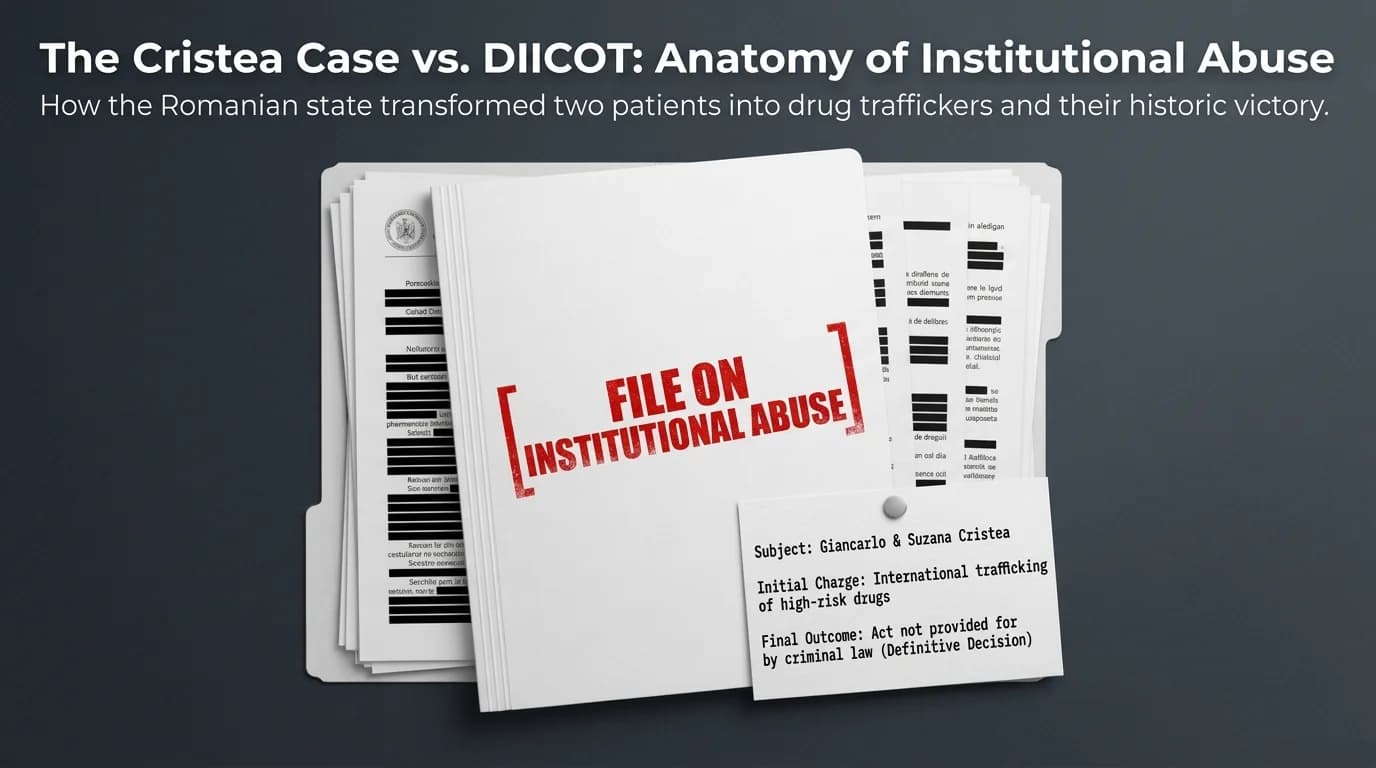
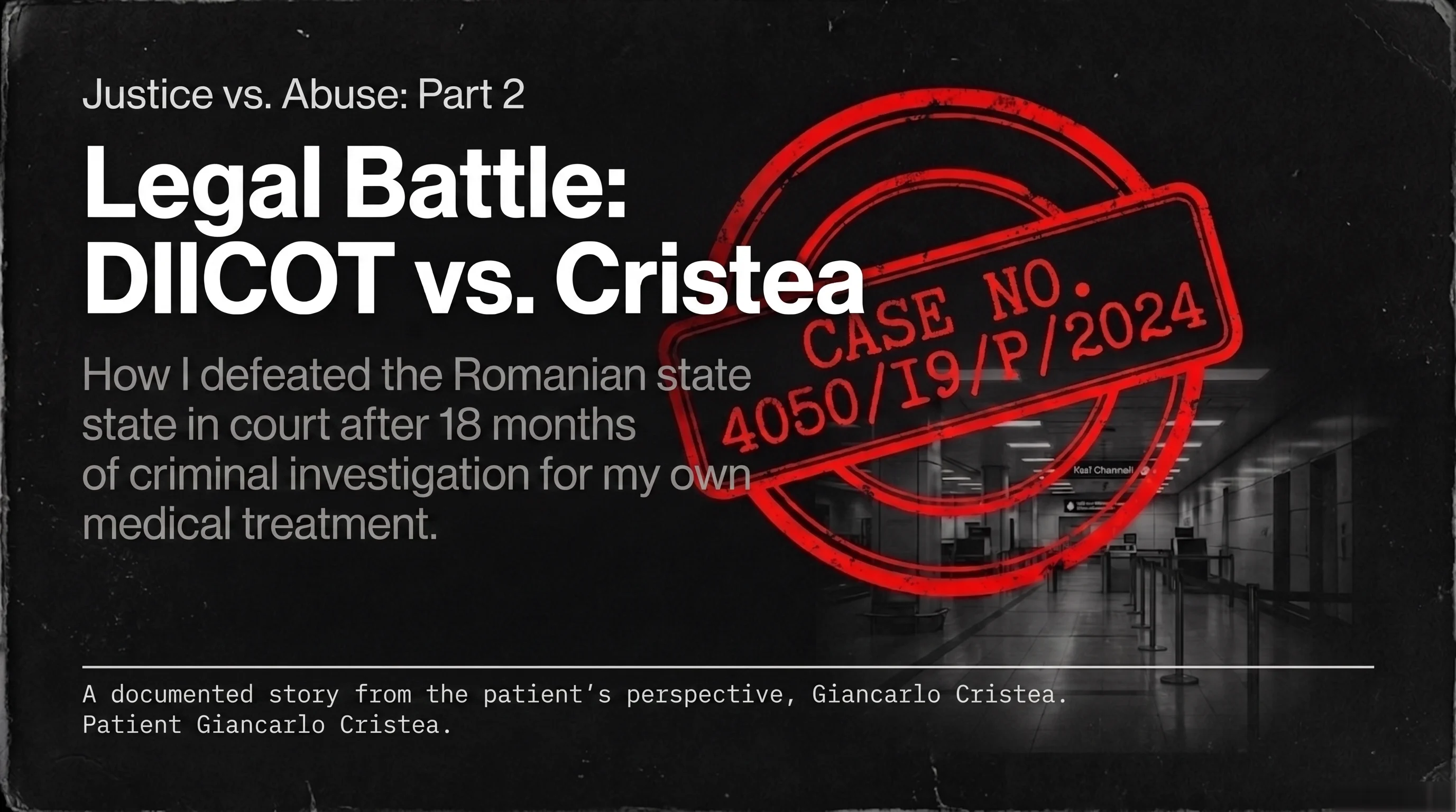
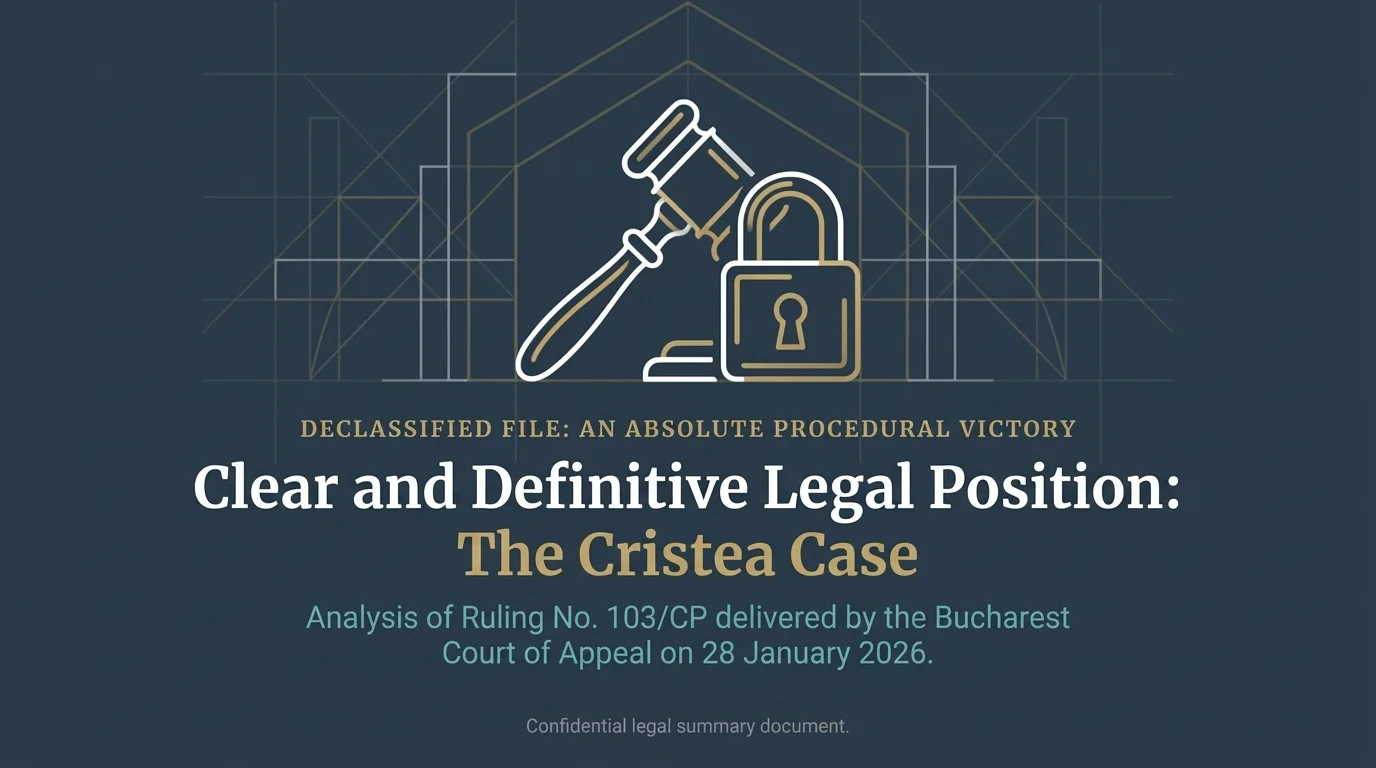
Romanian, European and international laws behind the three court victories against DIICOT — every law explained for non-lawyers.
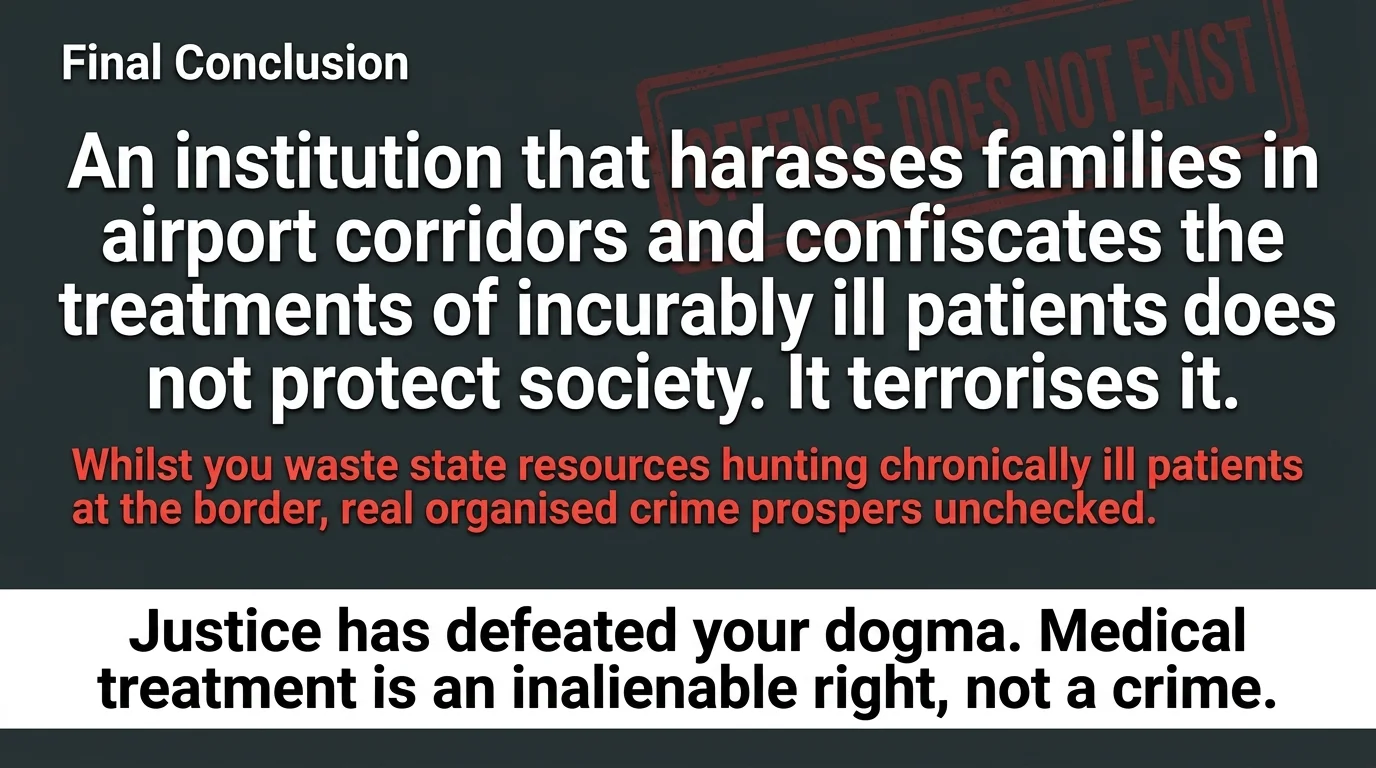
Legal Glossary
Every law, article, directive, and judicial decision that made the three 2025–2026 victories against DIICOT possible — and why each one matters.
Why this glossary
Across the three parts of Justice vs. Abuse and the Practical Guide, dozens of legal instruments were referenced: Law 143/2000, Government Decision 1915/2006 art. 49, Directive 2001/83/EC, art. 549¹ of the Criminal Procedure Code, ECHR art. 8, EU Charter art. 50. For a non-lawyer the list quickly becomes noise made of numbers. This page turns that noise into a map.
Each article gets three things: official name, plain-language explanation, link to the primary source (lege5.ro, EUR-Lex, HUDOC, or UNODC). The order is hierarchical — from Constitution and treaties downward, not alphabetical. Because that is how law actually works: top-down, by priority.
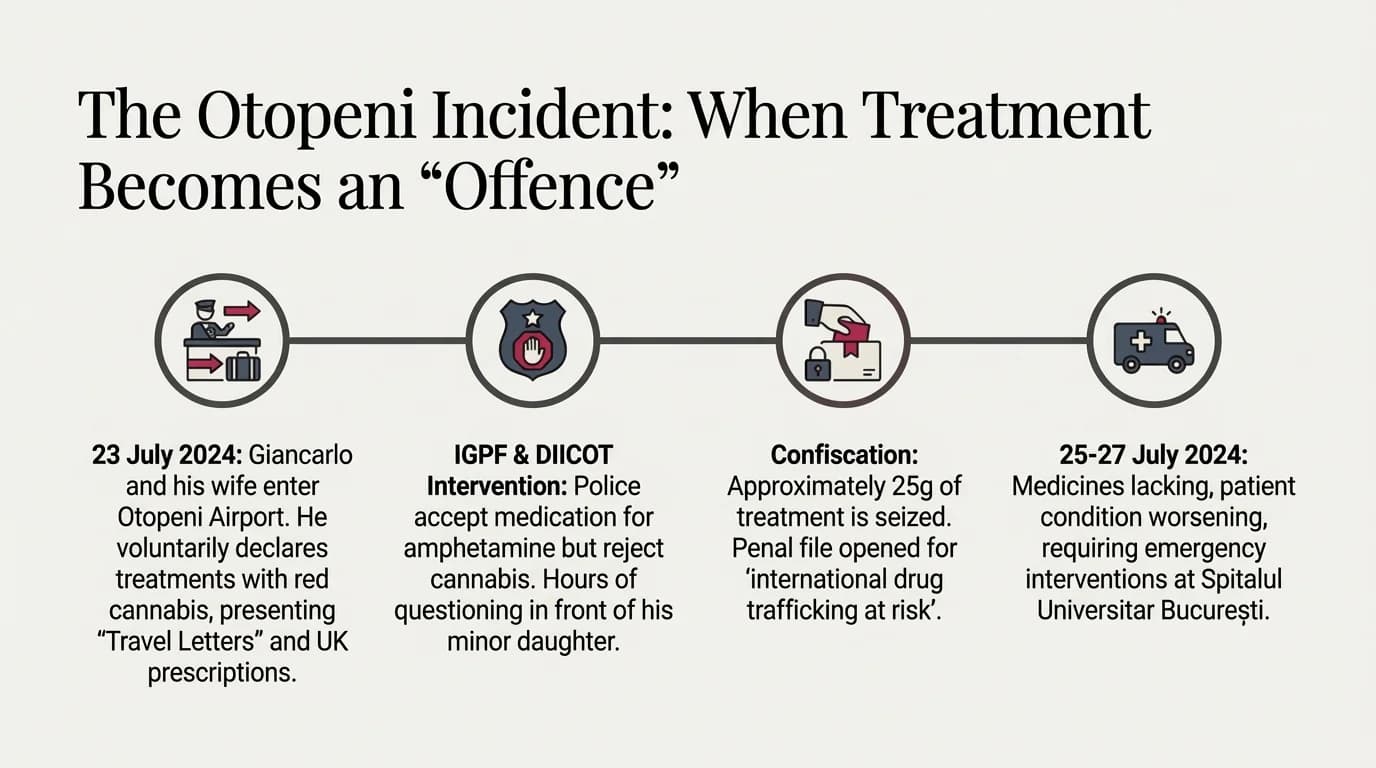
Part I — The Romanian Constitution
The base of the pyramid. Nothing ranks above it.
Art. 22 — The right to life, physical and mental integrity
The State guarantees the life and integrity of every person. When a patient with severe Crohn's disease is deprived of the medicine that keeps his body functional, that guarantee becomes directly relevant. It is not abstract.
Source: Romanian Constitution — consolidated text
Art. 20 — International human rights treaties
Para. (2): if an international pact to which Romania is a party offers greater protection than domestic law, the treaty prevails. The key that allows judges to apply the ECHR and the EU Charter over Law 143/2000.
Art. 148 — EU integration
Para. (2) states explicitly: Union law prevails over contrary provisions of domestic law. This is the constitutional anchor that lets a Romanian judge apply Directive 2011/24/EU even where Law 143/2000 does not expressly provide a medical exception.
Art. 23 para. (12) — Legality of criminal offences
Nulla poena sine lege. No penalty — including confiscation — without a law that defines the conduct as a criminal offence. If the conduct does not fall within Law 143/2000 because there is a valid EU medical prescription, the confiscation loses its constitutional basis.
Art. 34 — The right to health protection
The State must take measures to protect health. Blocking a lawfully EU-prescribed medicine is not a measure — it is a direct harm.
Art. 53 — The proportionality test
Five cumulative conditions for restricting a fundamental right: statutory basis, necessity in a democratic society, proportionality, non-discriminatory application, preservation of the essence of the right. Confiscation of prescribed medical cannabis fails the test on proportionality: 9.67g for a person with a confirmed diagnosis does not justify the maximum criminal mechanism.
Part II — Romanian statutes
Law 143/2000 on combatting illicit drug trafficking and use
The general framework for drugs in Romania. Contains Tables I, II, III of controlled substances. Cannabis (plant/resin/oil) sits in Table III (risk drugs). Pure THC (tetrahydrocannabinol) is in Table I (high-risk drugs, no recognised medical use under this Act). Lisdexamfetamine and methylphenidate are in Table II (high-risk drugs with recognised medical use). The parallel pharmaceutical regime — Law 339/2005 — places cannabis and its extracts/tinctures in Table II (medical interest, strict control), while pure THC remains Table I. In the UK (Misuse of Drugs Regulations 2001), CBPMs — cannabis-based products for medicinal use sit in Schedule 2 since 1 November 2018.
- Art. 3 — unauthorised import/export (the basis for DIICOT's initial charge)
- Art. 4 — production, possession with intent to traffic
- Art. 6 para. (3) — "The prescription by a physician, without medical necessity, of high-risk drugs…" — exploitable wording: by inversion, prescription that IS medically necessary is not an offence
Law 143/2000 does not distinguish between trafficking and medical use with an EU prescription. That lacuna is the reason these cases reached a judge in the first place. The court fills the gap by applying GD 1915/2006 + EU law.
Source: Law 143/2000 consolidated
Law 339/2005 on the legal regime of narcotic and psychotropic plants, substances and preparations
The parent act of GD 1915/2006. Regulates the lawful pharmaceutical circuit of narcotics and psychotropics for medical and scientific purposes. Articles 4–8 cover authorisation of import/export through ANMDMR.
Source: Law 339/2005
GD 1915/2006 — Implementing regulations for Law 339/2005
The single most important piece across all three victories.
- Art. 49 — "The natural person who carries, on entry into or exit from the country, narcotic or psychotropic preparations for personal treatment is required to present the medical document…"
Translated for non-lawyers: a patient may cross the border with their medicine — including narcotics and psychotropics — provided they carry the appropriate medical document. The text was written before DIICOT decided to ignore it. The Directorate-General for Customs Procedures confirmed this in writing in document DGPV no. 20264 / 22.09.2022; the Border Police General Inspectorate confirmed it in document no. 28850 / 23.09.2022.
Source: GD 1915/2006 consolidated
Law 95/2006 on healthcare reform
Title XVIII — Medicinal Products. Art. 699 defines medicinal product by direct reference to Directive 2001/83/EC. Art. 788 regulates import. The domestic legal basis for the argument prescribed cannabis = medicine, not a mere narcotic.
Source: Law 95/2006
Law 46/2003 — Patients' rights
Art. 3: the right to care of the highest available quality. Art. 13: the right to choose one's treatment. Read together with Constitution art. 34, the law turns access to medicine into an affirmative patient right — not a discretionary concession of the State.
Source: Law 46/2003
Law 448/2006 — Protection and promotion of the rights of persons with disabilities (Romanian national law)
The domestic framework implementing the rights of persons with disabilities (PWD) in Romania. Transposes CRPD principles into national law and governs benefits, services and the obligations of authorities toward PWD.
- Art. 6 — principle of non-discrimination: equal access to all civil, political, economic, social and cultural rights, without distinction based on disability.
- Art. 9 — the obligation of central and local public authorities to ensure access to medical services, including legally prescribed medicines, as part of social integration and the right to health.
2026 relevance: national anchor for the discrimination argument in the civil action against the National Customs Agency and DIICOT. Confiscation of prescribed medication from a patient with severe Crohn's — a condition that meets the CRPD art. 1 criterion of long-term impairment — simultaneously triggers Law 448/2006 art. 6 (discrimination) and art. 9 (denial of access to medical services). Read together with the CRPD and EU Charter art. 26, it builds a three-layer legal stack: international + EU + national.
Source: Law 448/2006 consolidated
Law 544/2001 — Free access to public-interest information
Art. 14: the activity of public officials in the exercise of their duties is not protected as personal data. The legal basis for publishing the name of a customs officer who confiscates a medicine — although, out of prudence, we sometimes choose to anonymise.
Source: Law 544/2001
Law 554/2004 — Administrative contentious
Governs legal action against harmful administrative acts issued by public authorities. It is the parallel track (alongside criminal) for contesting the confiscation protocol issued by the customs officer. Art. 1 para. (1): any person who considers themselves injured in a right or legitimate interest by an administrative act may ask the administrative-contentious court to annul the act, recognise the right, and compensate the damage.
Procedural path: (1) preliminary complaint to the issuing authority (30 days), (2) seising the Tribunal — Administrative Contentious Division (6 months from receipt of the reply or expiry of the deadline), (3) appeal to the Court of Appeal. Distinct basis from a civil damages action (Civil Code art. 1349, tort liability) or a criminal action (Criminal Code art. 297).
2026 relevance: civil / administrative-contentious action against the National Customs Agency to recover material damages (unrecoverable medicine, cost of repeat testing) and moral damages (documented psychological harm).
Source: Law 554/2004
LAW no. 45/2023 + LAW no. 172/2024
Two successive amendments to Law 143/2000 adopted between 2023 and 2024. They tightened the criminal regime for trafficking and refined the schedules. Neither of them created an exception for a patient with an EU prescription. They remain relevant as proof that Parliament had two recent opportunities to solve the problem — and chose not to.
PL-x 611/2019 — "The Victoria Bill"
Legislative proposal on medical use of cannabis, filed in 2019. Defeated in the Chamber of Deputies Health Committee on 12 February 2025. It was the initiative that would have solved the issue by statutory text rather than by case-law interpretation.
Decision no. 270/2025 — Interministerial Anti-drug Committee
Published in the Official Gazette no. 453 of 15 May 2025. Annex I, point 6 confirms the DIICOT structure at the time of the file: Drug Trafficking Countering Section, led by Chief Prosecutor Adriana Sache, with Deputy Chief Prosecutor Dănuț Cristea.
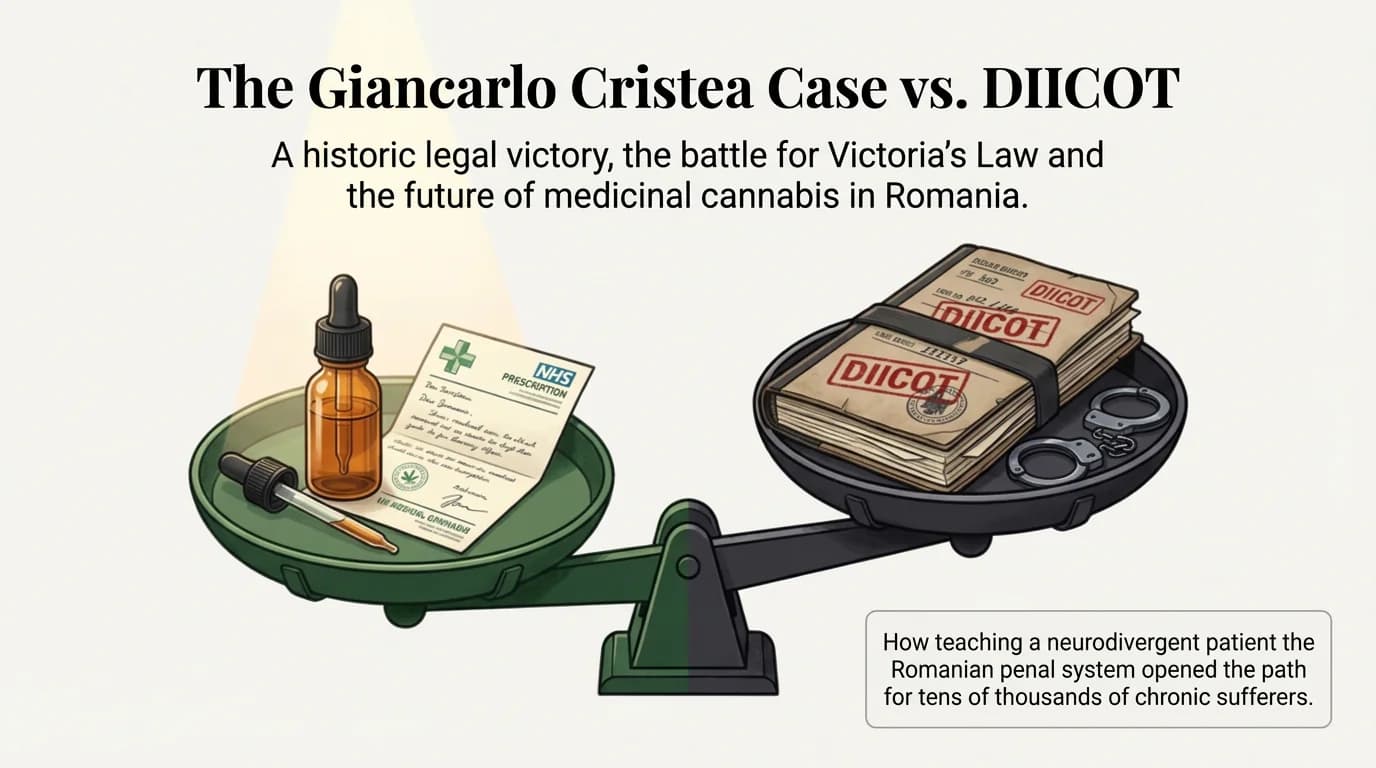
Source: Decision 270/2025
Part III — The Codes: Criminal, Criminal Procedure, Civil
Criminal Code
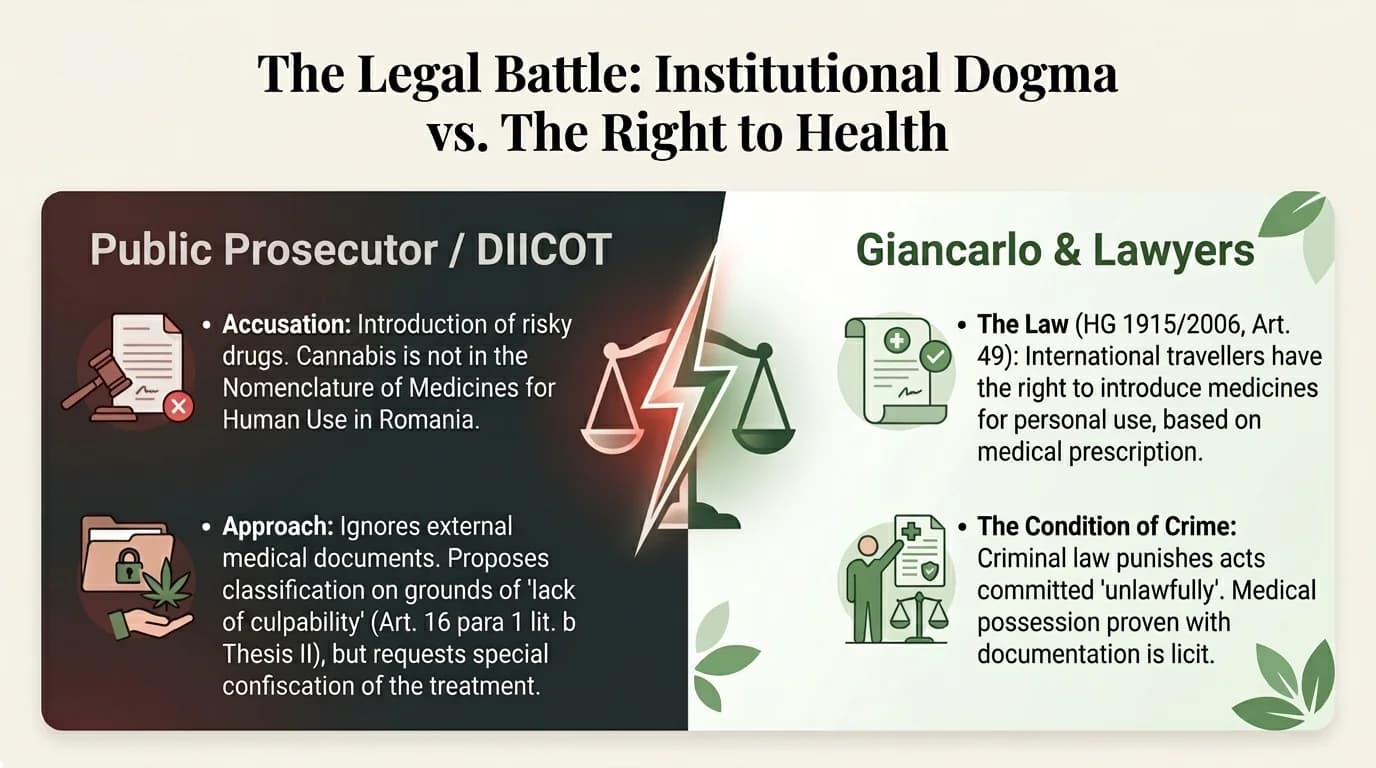
Art. 16 para. (1) letter b) Criminal Code — the ground of the case dismissals
"The act is not provided for by criminal law, or was not committed with the guilt required by law."
This is the exact wording that forced DIICOT to close file 45878/3/2024 in March 2025. Absence of guilt is the element that removes the act from the criminal sphere altogether — a patient with a valid prescription cannot commit drug trafficking "with guilt", because they do not pursue a trafficking purpose.
Thesis II of the same paragraph, invoked in V2 and V3: the patients' conduct was "by right" (cu drept) — a rare technical formulation meaning that the law itself positively protects their action.
- Art. 112 — Special confiscation. The mechanism by which the State takes over goods used in committing an offence. It applies only if the act is an offence. If it is not, confiscation is unlawful.
- Art. 112¹ — Extended confiscation. Extends confiscation to goods acquired in the preceding five years where there are reasonable suspicions of criminal origin. A frequently abused instrument.
Art. 297 Criminal Code — Abuse of office
"The act of a public official who, in the exercise of their duties, fails to perform an act or performs it in a defective manner and thereby causes damage or injury to the rights or legitimate interests of a natural or legal person, is punished by 2 to 7 years' imprisonment and a ban on holding public office."
Direct criminal basis for the prospective action against the National Customs Agency officers who confiscated the legally-prescribed EU treatment, ignoring GD 1915/2006 art. 49. Typical elements: (1) status of public official (customs officer ✓), (2) non-performance or defective performance of duty (confiscation without checking the medical documentation ✓), (3) material or moral damage (retained prescribed medicine ✓).
Constitutional note: Constitutional Court decision 405/2016 narrowed the scope of art. 297 — the defective act must be committed in breach of the law. In the cannabis cases, the breached law = GD 1915/2006 art. 49 + Directive 2011/24/EU = criterion met.
- Art. 298 — Negligence in office. "The breach, through negligence, by a public official of an official duty — by failing to perform it or by performing it defectively — where this causes damage or injury to the rights or legitimate interests of a natural or legal person, is punished by 3 months to 3 years' imprisonment or a fine." The procedural alternative where intent is lacking — it is sufficient to prove the officer should have known the medical regulation. Lower penalty, easier evidentiary standard.
Source: Criminal Code
Criminal Procedure Code
- Art. 305–307 — Commencement of criminal prosecution in rem vs. in personam. Relevance: moving from a general investigation to one directed at a specific person requires new elements.
- Art. 335¹ — Reopening of criminal prosecution after dismissal. Requires new facts, not re-re-classification of the same facts. Grounds for invoking ne bis in idem in V2.
- Art. 340–341 — Complaint before the preliminary-chamber judge. Art. 341 para. (6) letter c) allows the judge to set aside the prosecutor's decision and order dismissal.
- Art. 549 CPP — Procedure for the return of seized items. Direct basis for recovering the confiscated medicine.
Art. 549¹ para. (6) CPP — the article that decided Victory III
"The prosecutor may lodge a challenge within three days of the communication of the decision by which the proposal of confiscation was rejected."
DIICOT filed its challenge on 25 November 2025, but submitted the written grounds only on 13 January 2026 — a 49-day delay against the strict 3-day limit. The Bucharest Court of Appeal found inadmissibility on a strict procedural basis. A three-judge panel confirmed unanimously. Time itself was the winning argument.
Source: Criminal Procedure Code
Part IV — Primary EU law
Treaty on the Functioning of the European Union (TFEU)
- Art. 34 TFEU — free movement of goods. Prohibits quantitative restrictions and measures having equivalent effect. A Member State cannot block the circulation of a product lawful in another Member State without proportionate justification. A medicine lawfully prescribed in the UK / Germany / the Netherlands falls under this protection.
- Art. 36 TFEU — public-health exceptions — permit restrictions, but only if necessary and proportionate. Confiscating an individual prescribed treatment does not pass the test.
Charter of Fundamental Rights of the European Union
- Art. 1 — Human dignity. Umbrella argument: depriving a chronic patient of their functional medicine impairs dignity.
- Art. 3 — Right to physical and mental integrity.
- Art. 7 — Respect for private life. The EU counterpart of ECHR art. 8. Activated when the case has an EU element (cross-border transit).
- Art. 21 — Non-discrimination. Prohibits any discrimination, including on the ground of disability. Directly engaged for a patient with a documented chronic condition (Crohn's) who is subjected to the maximum criminal mechanism, whereas patients with other chronic conditions and controlled medication (opioids, benzodiazepines) are not. Differential treatment = indirect discrimination based on the type of disability.
- Art. 26 — Integration of persons with disabilities. "The Union recognises and respects the right of persons with disabilities to benefit from measures designed to ensure their independence, social and occupational integration and participation in the life of the community." Read together with CRPD art. 5 + Law 448/2006 art. 9, it produces a positive obligation of the State not to hinder access to the treatment that sustains the patient's functioning.
- Art. 35 — Health protection. The right of access to preventive care and medical treatment "under the conditions established by national laws and practices" — with the caveat that national legislation must be read in the light of EU law (Directive 2011/24/EU). Read directly with Directive 2011/24, it becomes the EU basis for recognition of the cross-border prescription in the civil action.
- Art. 41 — Right to good administration. Para. (2) letter a): the right to be heard before an individual adverse measure. Customs confiscation without effective hearing = breach.
- Art. 47 — Right to an effective remedy and a fair trial. Guarantees access to a court and a reasonable duration of proceedings. Complements art. 41: an administrative authority is not enough — there must also be a real judicial route to challenge. Direct EU basis for the dual track (criminal art. 297 CC + administrative-contentious Law 554/2004).
- Art. 50 — Ne bis in idem. No one shall be tried or punished twice for the same act. Invoked in V2 to block DIICOT's reopening of a file already closed.
Source: EU Charter of Fundamental Rights
Part V — Secondary EU law (directives, regulations)
| EU instrument | What it regulates | Direct relevance |
|---|---|---|
| Directive 2001/83/EC | General framework for medicinal products for human use | Defines 'medicinal product' — prescribed cannabis falls under it |
| Directive 2004/27/EC | Amends 2001/83/EC — updated definition of medicinal product | Extends protection to cannabis pharmaceutical preparations (Sativex, Epidyolex, Bedrocan) |
| Directive 2011/24/EU | Patients' rights in cross-border healthcare | ART. 11 — prescriptions issued in one EU state must be recognised in the others |
| Regulation (EU) 2012/52 | Mandatory elements of a cross-border prescription | If the script contains every listed element, confiscation is a direct breach |
| Regulation (EC) 726/2004 | EMA and centralised authorisation of medicines | Where the confiscated medicine is EMA-authorised, it cannot be reclassified as 'pure narcotic' |
| Directive 2004/38/EC | Free movement of EU citizens | Art. 27 — restrictions must be proportionate; confiscation fails the test |
| Framework Decision 2004/757/JHA | Harmonisation of drug-trafficking penalties | Art. 2 (2) — personal use as defined nationally is excluded; EU medical prescription = non-trafficking per definitionem |
The critical node: Directive 2011/24/EU + Regulation 2012/52 together form the European shield. Any EU state that ignores a valid prescription from another EU state directly breaches secondary EU law.
Sources: 2001/83/EC · 2011/24/EU · 2012/52/EU · 2004/757/JHA
Part VI — CJEU case-law
CJEU judgments are binding on all national courts. A Romanian judge departing from them risks a preliminary reference from the Constitutional Court.
— CJEU, Case C-663/18 (2020), Kanavape — ECLI:EU:C:2020:938An EU Member State may not ban the marketing of CBD lawfully produced in another Member State. The ruling confirms that the national cannabis regime is subordinated to the free movement of goods (TFEU art. 34) where the product is lawful at origin and no scientifically proven public-health risk exists.
— CJEU, Case C-137/09 (2010), Josemans — ECLI:EU:C:2010:774The Dutch coffee-shops case. The Court confirms that narcotics "in illicit circuit" do not benefit from free movement, but expressly distinguishes the regulated medical and scientific circuit. The critical a contrario: medically prescribed cannabis = lawful EU circuit. The very argument of the Cristea victories.
— CJEU, Case C-5/77 (1977), Tedeschi / DenkavitPrinciple of exhaustive harmonisation. Where the EU has harmonised a field (e.g. medicinal products through Directive 2001/83/EC), Member States may no longer invoke TFEU art. 36 for unilateral measures. Directly applicable: Romania cannot block an EMA-authorised medicine on "public health" grounds.
— CJEU, Case C-148/15 (2016), Deutsche Parkinson VereinigungNational restrictions on medicines must be proportionate under TFEU art. 34. Applies directly to personal importation of prescribed medicine — including controlled substances.
— CJEU, Cases C-358/13 and C-181/14 (2014), Markus D. and G.Psychoactive substances without medical purpose are not "medicinal products" within the meaning of Directive 2001/83. The essential a contrario: cannabis prescribed WITH documented medical purpose is a medicinal product — not a legal high.
— CJEU, Case C-120/78 (1979), Cassis de DijonFoundational principle of mutual recognition. A product lawfully marketed in one Member State enjoys a presumption of conformity in the others. Direct extension: a medicine lawfully prescribed in one EU state = presumption of legality on entering another EU state.
Part VII — ECHR (European Convention on Human Rights)
The Convention and the case-law of the Strasbourg Court apply in Romania via Constitution art. 20 — with priority whenever they offer greater protection than domestic law.
ECHR articles invoked in medical-cannabis cases
- Art. 6 — Right to a fair trial. Mandatory time-limits, adversarial proceedings, reasoned decisions. Invoked in V3 when the DIICOT challenge was rejected for exceeding the time-limit.
- Art. 8 — Right to respect for private life. Includes medical autonomy, bodily integrity, and access to treatment.
- Art. 13 — Right to an effective remedy.
- Art. 1 Protocol 1 — Protection of property. The confiscated medicine is property.
Key ECHR case-law
— ECtHR, Pretty v. UK (2002), Application no. 2346/02ECHR art. 8 includes the right to self-determination over one's own body and medical treatment. The foundation of patient therapeutic-choice protection — including cannabis when alternatives have failed.
— ECtHR, Hristozov v. Bulgaria (2012), Application no. 47039/11Access of seriously ill patients to treatments may fall under art. 8. The State enjoys a margin of appreciation, but that margin is not unlimited.
— ECtHR, Durisotto v. Italy (2014), Application no. 62804/13Where the State refuses access to a treatment, the refusal must be scientifically justified. Directly applicable: absence of evidence is no longer a valid argument against medical cannabis — evidence exists (EMA, Bedrocan, clinical trials).
— ECtHR, Storck v. Germany (2005), Application no. 61603/00Art. 8 protects in both directions: against forced medical treatment and, symmetrically, against blocking a chosen treatment. The dual face of autonomy.
— ECtHR, K.H. and Others v. Slovakia (2009), Application no. 32881/04The right of access to one's own medical file. Relevant when the patient's prescription and diagnosis are retained as evidence.
— ECtHR, Axel Springer AG v. Germany (2012), Application no. 39954/08 (Grand Chamber)Freedom of expression vs. privacy of public officials. The activity of a civil servant in the exercise of office is public-interest information — the legal basis for publicly naming customs officers and prosecutors in matters of public concern.
Part VIII — UN and international law
UN Convention on the Rights of Persons with Disabilities (CRPD, 2006)
Adopted by the UN General Assembly on 13 December 2006, entered into force in 2008. Ratified by Romania through Law 221/2010 — therefore part of domestic law, with priority over ordinary statute under Constitution art. 20 (2) whenever it offers a higher level of protection.
Articles directly applicable in the cross-border medical cannabis case:
- Art. 1 — Definition of disability. "Persons with disabilities include those who have long-term physical, mental, intellectual or sensory impairments which, in interaction with various barriers, may hinder their full and effective participation in society on an equal basis with others." The definition does not require an administrative certificate — it is a functional definition, based on the interaction between long-term impairment and social barriers. Severe, chronic Crohn's disease that dictates treatment continuity = a long-term impairment within the meaning of the CRPD.
- Art. 5 — Equality and non-discrimination. Prohibits discrimination on the ground of disability and imposes the duty of reasonable accommodation — adjustments needed to ensure the exercise of rights on an equal basis. Direct application: the duty of customs authorities to apply GD 1915/2006 art. 49 (personal-medicine procedure) as a reasonable accommodation, not as a discretionary favour.
- Art. 15 — Protection from torture and cruel, inhuman or degrading treatment. Confiscation of medication from a Crohn's patient with a documented consecutive flare-up can fall within this article. Deprivation of the medicine that keeps a chronic inflammatory disease in remission, where the authority knows or ought to know the consequences, crosses the threshold of "degrading treatment".
- Art. 25 — Right to health. "States Parties recognise that persons with disabilities have the right to the enjoyment of the highest attainable standard of health without discrimination on the basis of disability." Expressly includes access to prescribed medicines and health services "on the same basis as provided to other persons".
- Art. 28 — Adequate standard of living and social protection. An adequate standard of living includes access to health services as an integral component, not as a separate category. Depriving a patient of medication = reducing the standard of living below the "adequate" threshold within the meaning of the CRPD.
2026 relevance: direct basis for the civil action against DIICOT + the National Customs Agency, on two cumulative grounds: (1) disability-based discrimination (art. 5) and (2) denial of access to health care for a person with a disability (art. 25). Read together with Law 448/2006 (national framework) and EU Charter arts 21, 26, 35 (EU framework), it builds a multi-layered legal basis that is difficult to contest in court.
Source: UN CRPD — official text · Law 221/2010 (RO ratification)
Single Convention on Narcotic Drugs, 1961
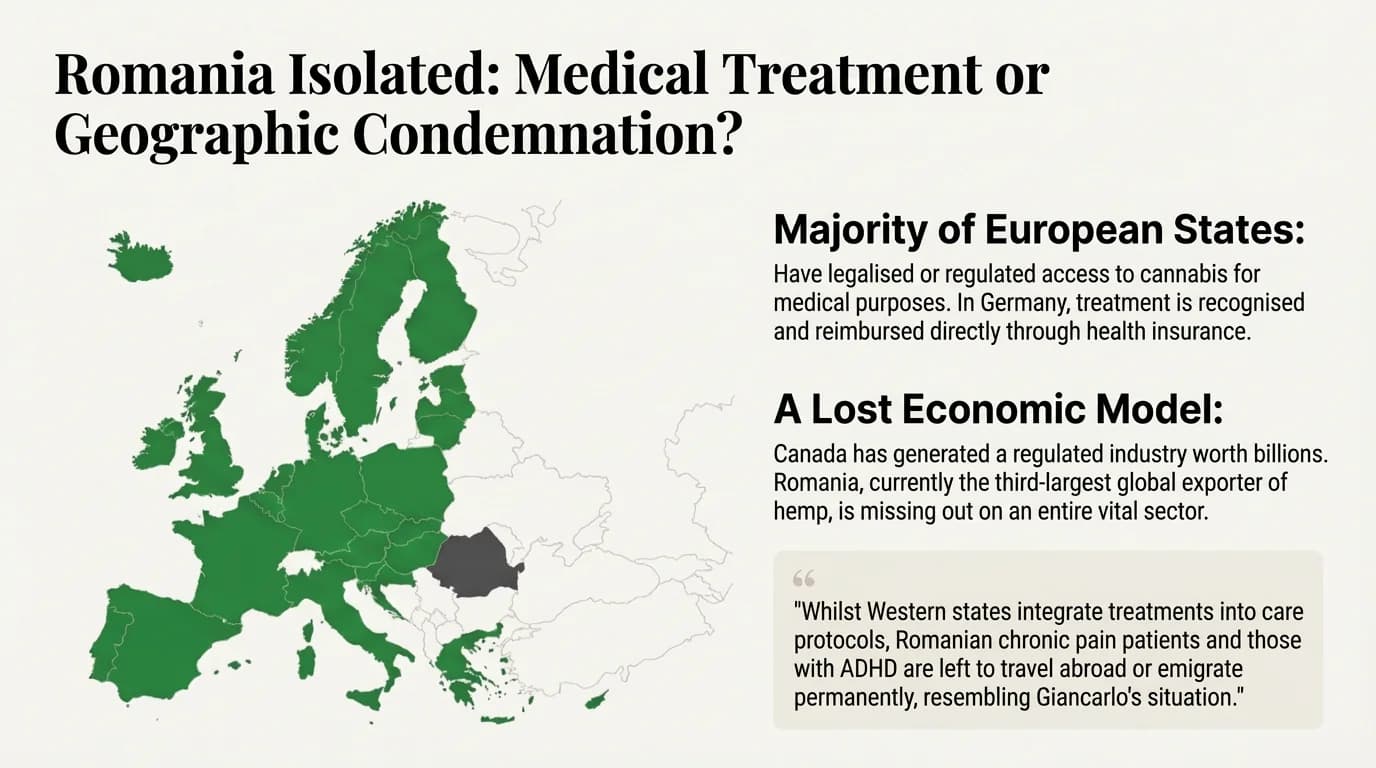
The global framework of drug control. Cannabis was originally on Schedule IV (the most restrictive, for substances with no medical value). December 2020: the UN Commission on Narcotic Drugs (CND) voted 27–25–1 to remove cannabis from Schedule IV, recognising its therapeutic value. Romania voted in favour. This is an international estoppel argument: Romania cannot domestically maintain the opposite of its external position.
Source: 1961 Convention + amendments · CND Resolution 63/17
Convention on Psychotropic Substances, 1971
The parallel framework for THC. THC sits on Schedule II, not on Schedule I (heroin, cocaine). The regimes are not identical. A direct proportionality argument: medical cannabis does not deserve treatment equivalent to heroin.
Source: 1971 Convention
1988 UN Convention against Illicit Traffic
Art. 3 para. (2): the penalisation of personal use remains at the discretion of States, subject to constitutional principles. Romania as a State Party must respect its own Constitution (arts 34 and 53). Legislative autonomy has an internal constitutional limit.
Source: 1988 Convention
WHO ECDD Report 2019
The 41st session of the WHO Expert Committee on Drug Dependence explicitly recommended: removing cannabis from Schedule IV of the 1961 Convention and restructuring the regime of pure-THC preparations. This was the fundamental scientific basis that tipped the UN position in the 2020 vote.
Source: ECDD 41 Report
Schengen Convention — art. 75
Allows the transport of prescribed narcotic medicines between Schengen states with a Schengen Certificate issued by the medical authority of the patient's state of residence. Romania does not yet honour the Schengen Certificate for medical cannabis — a concrete procedural weakness that amplifies the problem.
Part IX — Legal framework for driving under psychoactive substances
Section dedicated to the Drivers' Guide. Covers every normative act relevant for patients who drive while under controlled medical treatment (medical cannabis, methylphenidate, opioids, benzodiazepines). The framework changed fundamentally at the start of 2025 through ICCJ Decision (DCD) No. 25/2025.
Art. 336 Criminal Code — driving a vehicle under the influence of alcohol or other substances
The framework article for traffic offences concerning psychoactive states. Three relevant paragraphs:
- Para. (1) — driving under the influence of alcohol (≥ 0.80 g/L pure alcohol in blood). Penalty: 1–5 years imprisonment or fine.
- Para. (2) — driving under the influence of other psychoactive substances. The phrase "under the influence" was fundamentally reinterpreted by ICCJ DCD 25/2025: mere presence is no longer sufficient — the aptitude of the substance to affect capacity must also be demonstrated. Penalty: 1–5 years or fine.
- Para. (3) — driving under the conditions of para. (1) or (2) resulting in an accident with victims. Aggravated penalty.
Critical point: Law 187/2012 Art. 241 contains the legal definition of "psychoactive substance" — it covers drugs under Law 143/2000 tables I-III, substances under international UN 1961/1971 control, and medicines from categories II and III under Law 339/2005. Methylphenidate, morphine, diazepam, medical cannabis — all fall here.
Source: Criminal Code — Art. 336
Art. 336¹ Criminal Code — consumption after accident or stop
Criminalises the consumption of alcohol or psychoactive substances after a traffic accident or after being stopped for inspection, but before the biological sample collection. Purpose: to prevent "laundering" of the sample. Penalty: 6 months – 3 years imprisonment or fine.
Practical significance: a patient legitimately stopped (even if innocent on Art. 336 para. 2) may end up convicted under 336¹ if, between the stop and the sample collection, they take their routine prescribed dose. The solution — immediate lawyer contact and postponement of administration until after collection, if clinically feasible.
Art. 337 Criminal Code — refusal of sample collection
Distinct offence, 1–5 years penalty — equal to Art. 336 para. (2). The most common procedural trap for patients who, out of fear or ignorance, refuse collection hoping to avoid detection. Paradoxical effect: refusal eliminates any defence based on aptitude, dose, or prescription — because there is no result left to interpret. It punishes the presumption that the driver was impaired.
Practical rule: do not refuse collection — cooperate procedurally and build the defence on interpretation of the result, not on blocking it.
Art. 338 Criminal Code — leaving the scene of an accident
Criminalises leaving the scene of a traffic accident without authorisation, or altering/erasing traces. Penalty: 2–7 years imprisonment. Mentioned for completeness — may be charged cumulatively with Art. 336 or 336¹ in complex indictments.
ICCJ DCD No. 25/2025 — the dual requirement (presence + aptitude)
Issued on 27 January 2025 (Panel for Settling Points of Law), published in the Official Gazette No. 70 of 28 January 2025. Decision binding on all courts under CPP Art. 477 para. (3).
What it establishes: The typicity of the offence under Art. 336 para. (2) CP requires the cumulative fulfilment of two conditions:
- Presence in biological samples of a psychoactive substance (demonstrable through INML forensic expertise);
- Aptitude of that substance, at the identified concentration, to affect the capacity to drive (demonstrable through individual forensic medical expertise).
Consequence: the absolute presumption — "mere presence = offence" — has been replaced with a rebuttable presumption, which may be overturned by expertise. The prosecutor must demonstrate both elements, not just one.
Resolves a pre-2025 jurisprudential conflict between the Bucharest Court of Appeal (Dec. 61/A/18.01.2024 — absolute presumption), the Cluj Court of Appeal (Dec. 1759/A/2023 — absolute presumption), and the Brașov Court of Appeal (Dec. 859/Ap/14.11.2023 — rebuttable presumption, dual requirement). It imposed the Brașov line.
Impact: triggered the reaction of Prosecutor General Alex Florența + the rapid filing of Bill L030FS/2025 on 30 January 2025.
Source: ICCJ — DCD 25/2025 (Official Gazette 70/28.01.2025)
Bill L030FS/2025 — amendment to Art. 336 CP
Filed at the Senate on 30 January 2025, three days after the issuance of DCD ICCJ 25/2025. Direct legislative reaction — in both directions:
The repressive part:
- Changes the wording of para. (2) from "under the influence of psychoactive substances" to "has drugs in blood" — return to absolute presumption, eliminating the effect of DCD 25/2025.
- Increases the penalty to 2–7 years imprisonment (previously 1–5).
The protective part — new para. (4):
"The act provided under paras. (2) and (3) shall not be punishable if the presence in blood of psychoactive substances was determined by prior administration of medicines used under a medical prescription issued in accordance with the law, respecting the therapeutic dose and the other indications and recommendations regarding their administration."
Translation: patient with prescription + dose + indications respected = no offence. Recreational user = 2–7 years.
Status as of April 2026: under parliamentary debate. The outcome of the battle will determine whether the protection remains jurisprudential (DCD 25/2025) or becomes statutory (new para. 4).
Source: Romanian Senate — Legislative projects
CCR Decision No. 138/2017
The Romanian Constitutional Court (CCR) rejected the constitutional challenge regarding the wording of Art. 336 para. (1) CP (driving under the influence of alcohol with 0.80‰ threshold). CCR validated the absolute presumption for alcohol: beyond the threshold = offence, without the need to prove concrete impairment.
Why it matters in the context of medication: it created a constitutional precedent of acceptance of absolute presumptions in traffic law, which was later invoked by analogy also for para. (2). DCD ICCJ 25/2025 "broke" this analogy, holding that alcohol has an objective quantitative threshold, while the psychoactive substances under para. (2) do not, therefore the strict interpretation cannot be transferred mechanically.
Source: CCR — decision search
CCR Decision No. 101/2019
Rejected the constitutional challenge regarding Art. 336 para. (2) CP — the mere presence of psychoactive substances. CCR held at the time that the phrase "under the influence" was not unclear and that the legislator could criminalise on the basis of presence, in consideration of the specific risk of psychoactive substances.
Pre-2025 consequence: courts interpreted the presumption as absolute. ICCJ Decision 365/RC/2020 consolidated this line.
Post-DCD 25/2025 consequence: the interpretation is not constitutionally suppressed (CCR 101/2019 remains in force), but is functionally reinterpreted: "under the influence" is now understood to require aptitude for impairment, not mere presence. CCR 101/2019 + DCD 25/2025 coexist — the first validates the norm, the second determines the sense of its application.
Source: CCR — case-law
ICCJ Decision No. 365/RC/2020
A case decision of the ICCJ (Criminal Section) that held to the strict interpretation of Art. 336 para. (2) CP: absolute presumption — mere presence of the substance in blood is sufficient for typicity. Decision heavily cited by prosecutors between 2020 and early 2025.
Explicitly superseded by DCD ICCJ 25/2025. The binding nature of the DCD under CPP Art. 477 para. (3) means that all courts must apply the new interpretation, including in pending cases. 365/RC/2020 remains relevant only historically — as an explanation of pre-2025 jurisprudence.
Source: ICCJ — case-law
GEO 195/2002 — the Romanian Road Code
The framework act on road traffic. Articles relevant for controlled medication:
- Art. 87 — prohibition on driving under the influence of alcohol, narcotic products or substances, or medicines with similar effects. The contraventional side of Art. 336 CP — applied administratively in parallel with the criminal side.
- Art. 88 — procedure for clinical examination and biological sample collection. This is the procedural basis for the INML protocol. Requires collection in an authorised medical unit, by qualified personnel, with chain of custody.
- Art. 111 — retention of driver's licence + provisional suspension. Applies from the moment of the stop, regardless of the final outcome of the criminal case. The driver may remain without a licence for months or years even if eventually acquitted.
Important: the Art. 111 suspension is separately contestable through administrative channels. Do not confuse the administrative challenge (licence) with the criminal defence (case) — they are parallel proceedings, with different deadlines and fora.
Source: GEO 195/2002 consolidated · GD 1391/2006 (implementing regulation)
Law 187/2012 Art. 241 — definition of psychoactive substances
The law implementing the Criminal Code. Art. 241 contains the legal definition of the phrase "psychoactive substances" used in Art. 336 para. (2) CP. The text refers to:
- Risk drugs and high-risk drugs under Law 143/2000 (Tables I, II, III);
- Narcotic and psychotropic substances and preparations under Law 339/2005;
- Substances under international control through the UN Conventions of 1961 and 1971.
Practical consequence: methylphenidate (Ritalin, Concerta), morphine, oxycodone, diazepam, alprazolam, clonazepam — all are "psychoactive substances" within the meaning of Art. 336 CP. A prescription alone does not change the classification — however, DCD 25/2025 and the proposed new para. (4) provide the defence.
Source: Law 187/2012
OMS 1512/2013 (amended by OMS 62/2019) — sample collection procedure
A Ministry of Health order establishing the detailed protocol for collection, transport, and analysis of biological samples for detection of alcohol and psychoactive substances. Key elements:
- Dual sampling — two vials (sample A + sample B) from the same collection, to enable counter-expertise.
- Chain of custody — written documentation of each stage, from collection to analysis.
- Authorised laboratories — INML Bucharest + regional network. Analysis by GC-MS or LC-MS/MS.
- Toxicology report — must contain concentration (ng/mL for THC, µg/mL for methylphenidate, etc.), not merely positive/negative.
Procedural basis for defence: any deviation from OMS 1512/2013 (collection by unqualified personnel, absence of sample B, break in chain of custody) may lead to the exclusion of the evidence. Law 95/2006 Art. 788 + CPP Art. 97–101 support this mechanism.
Source: OMS 1512/2013 · OMS 62/2019
Directive 2006/126/EC — EU driving licence (Annex III)
The European directive on medical fitness conditions for driving licences. Annex III — Minimum standards of physical and mental fitness for driving a power-driven vehicle — explicitly addresses patients under treatment with psychotropic or neurological medicines.
Fundamental rule: "Driving is not excluded for patients under stabilised chronic treatment, with respected therapeutic doses and without documented medical contraindications." The mere presence of medication does not equate to incapacity.
Romanian implementation: Joint Order MS/MAI No. 1497/1018/2008 — approves the medical scale for the driving licence. A patient under controlled treatment can obtain and retain the licence with a favourable opinion from the authorised medical commission + psychological opinion.
The directive applies directly through Art. 148 of the Romanian Constitution (EU integration). In court, the argument: "I am medically fit for driving under Directive 2006/126/EC Annex III, I have documented medical clearance — DCD 25/2025 requires this framework to be considered in the assessment of aptitude".
Source: Directive 2006/126/EC · Joint Order MS/MAI 1497/1018/2008
DRUID Project (EU, 2006–2011)
Driving Under the Influence of Drugs, Alcohol and Medicines — European research project funded by the European Commission, coordinated by the Federal Highway Research Institute (BASt, Germany). It produced the systematic categorisation of medicines across three levels of risk for driving:
- Category I — negligible risk (e.g.: chronic low-dose medical cannabis, therapeutic dose methylphenidate in a titrated patient, stabilised SSRIs).
- Category II — minor-to-moderate risk, requires caution (e.g.: low-dose benzodiazepines, titrated opioids).
- Category III — severe risk, do not drive (e.g.: high-dose benzodiazepines, opioids at onset, residual anaesthetics).
Evidentiary value: no direct legal force, but used as a scientific reference in EMCDDA reports, in EMA opinions on medicines, and in legal defence for demonstrating aptitude (Category I = argument that the medication does not affect driving at therapeutic dose).
Source: EMCDDA DRUID Final Reports
Vienna Convention on Road Traffic (1968) — Art. 8 §3
International treaty ratified by Romania. Art. 8 §3 enshrines the fundamental rule: "Every driver shall possess the necessary physical and mental qualities and be in a physical and mental condition which enables him to drive."
The standard is functional, not chemical: "fit to drive". Absence of substances is not required — capacity to drive is. Exactly the principle reaffirmed in DCD ICCJ 25/2025.
Source: UNECE — Vienna Convention on Road Traffic
Part X — How the laws connected in the three victories
The legal mechanism, in three sentences
1. EU law (Directive 2011/24/EU + Directive 2001/83/EC + TFEU art. 34) prevails over Law 143/2000 through Constitution art. 148.
2. GD 1915/2006 art. 49 transposes that EU right into domestic procedure, and Law 95/2006 Title XVIII defines "medicinal product" by reference to Directive 2001/83/EC.
3. The Romanian judge has the duty to apply the hierarchy correctly — and when they do, the patient wins, because the act is not a criminal offence under Criminal Code art. 16 para. (1) letter b).
All other articles — ECHR art. 8, EU Charter art. 50, CJEU C-663/18 — are reinforcing layers. They are not the core, but they seal the outcome.
Part XI — Excerpts from the decisions and operative parts
Here is the authentic textual material from the three decisions, in chronological order.
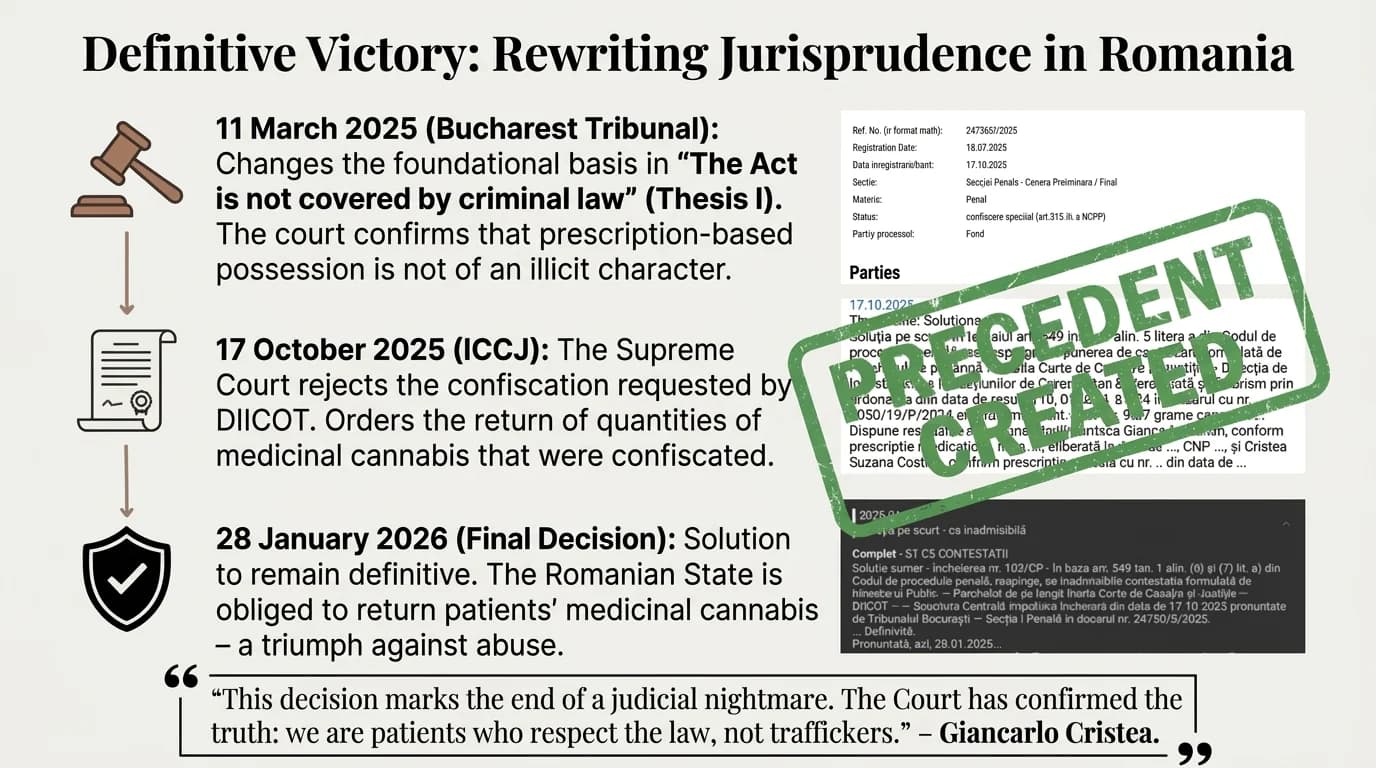
Victory I — Bucharest Tribunal, case 45878/3/2024 (March 2025)
Counsel: Raul Nicolae Bud, Gabriel Sebastian Nagy Core legal basis: GD 1915/2006, art. 49 Dismissal formula (official DIICOT quote):
"The act was not committed with the guilt required by law."
Technical classification: Criminal Code art. 16 para. (1) letter b), Thesis II — absence of guilt.
Procedural paradox: DIICOT closes the file on 20 September 2024 yet still proposes confiscation of the treatment. The complaint against that order is rejected on 7 November 2024. The medicine remains physically withheld even though the act is not an offence.
Victory II — Bucharest Tribunal, case 24750/3/2025 (autumn 2025)
Object: the special-confiscation proposal filed by DIICOT after dismissal.
Synthetic operative part:
The Tribunal rejects the special confiscation proposed by DIICOT and orders full return of the treatment (9.67g + 14.68g cannabis). Judicial costs are borne by the State.
Legal qualification adopted: the patients' conduct was "by right" (cu drept) under Criminal Code art. 16 para. (1) letter b) — a rare technical wording meaning that the action is affirmatively protected by law, not merely outside the scope of the offence.
Victory III — Bucharest Court of Appeal, case 4362/2025 (28 January 2026)
Object: DIICOT's challenge against the V2 decision.
Synthetic decision:
"The State must return the medicine — not confiscate it as drugs."
Decisive procedural ground: Criminal Procedure Code art. 549¹ para. (6) — mandatory 3-day time-limit. DIICOT filed the written grounds 49 days late. A three-judge panel unanimously confirms inadmissibility of the challenge.
Character: final and irrevocable. A national precedent.
Part XII — Glossary of legal concepts
For the non-lawyer reader. Logical rather than alphabetical order.
Dismissal (clasare) — A procedural decision by which DIICOT or the prosecutor closes the file at the investigation stage, without proceeding to a judge. It is not acquittal (which is pronounced by a judge on the merits).
Archiving (arhivare) — A ruling by which a case is concluded without continuation of the prosecution. In V2, the court archived the confiscation proposal.
Challenge (contestație) — A specific appeal route against certain prosecutorial acts. In V3, DIICOT attacked the V2 decision through a challenge rather than a classic appeal.
Inadmissibility — Rejection of a request without examination of the merits, because a procedural condition was not met (time-limit, form, standing). In V3, inadmissibility arose from exceeding the 3-day limit.
Ne bis in idem — "No one may be tried twice for the same act." A fundamental principle of European and international criminal law. Blocks DIICOT from reopening the file on the same facts after a final dismissal.
"By right" act (fapta cu drept) — Situation where an action that might appear to breach criminal law is affirmatively authorised by another legal norm (here: GD 1915/2006 art. 49 + Directive 2011/24/EU). Not merely absence of guilt, but the presence of an affirmative right.
Medical purpose — The criterion that removes a substance from the illicit-trafficking regime. A valid prescription from an EU state = evidence of medical purpose.
Special confiscation — Civil sanction applied following a criminal offence, targeting goods produced or used. Requires the existence of an offence. If the act is not an offence, special confiscation has no basis.
Mandatory time-limit (termen imperativ) — A time-limit whose breach brings irrecoverable loss of the procedural right. The opposite of indicative time-limits. Art. 549¹ para. (6) CPP contains a mandatory 3-day time-limit.
Cross-border prescription — A prescription issued in one EU state that must be recognised in the others under Directive 2011/24/EU and Regulation 2012/52.
International estoppel — The principle that a State that has taken a public position in an international forum (e.g. the UN vote on cannabis rescheduling 2020) cannot subsequently maintain the opposite domestically.
Schengen Certificate — A specific medical document attesting a patient's right to transport prescribed narcotics between Schengen states. Required for officially authorised travel.
Links — verifiable primary sources
- Romanian legislation database: lege5.ro
- EU legislation database: eur-lex.europa.eu
- CJEU case-law: curia.europa.eu
- ECtHR case-law: hudoc.echr.coe.int
- UN Office on Drugs and Crime: unodc.org
- European Medicines Agency: ema.europa.eu
- Romanian Official Gazette: monitoruloficial.ro
Update note
This glossary is a living document. It is updated alongside:
- Publication of the full reasonings of the three decisions on portal.just.ro
- New rulings in similar cases (including the 2026 proceedings against the Customs Agency for abuse of office)
- Relevant legislative changes (the Victoria Bill, revisions of Law 143/2000, amendments to GD 1915/2006)
- New CJEU or ECtHR decisions on medical cannabis
Last updated: April 2026.
The Justice vs. Abuse series continues in Part I — The Legal Story, Part II — Parliamentary Activism, Part III — The Three Victories and The Practical Guide for Travellers.
New articles, directly to your inbox
Neuro-affirming content on ADHD, autism, AuDHD and PDA
— no spam, no aggressive frequency.